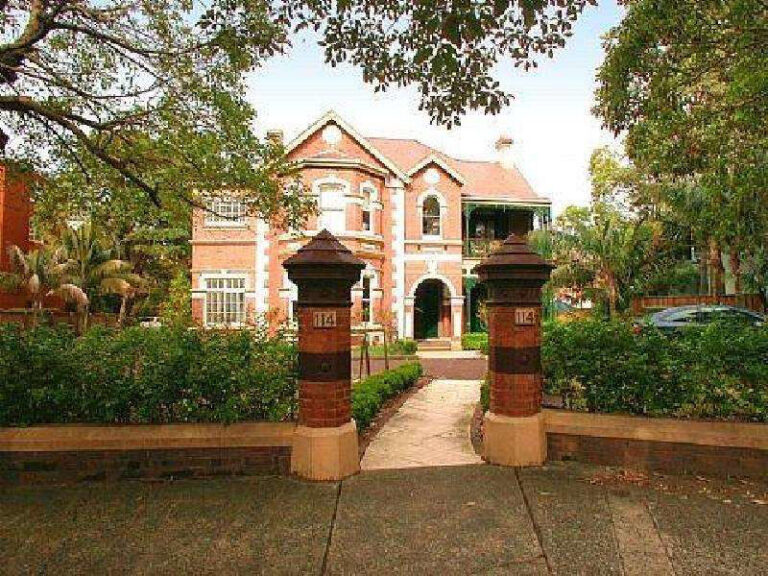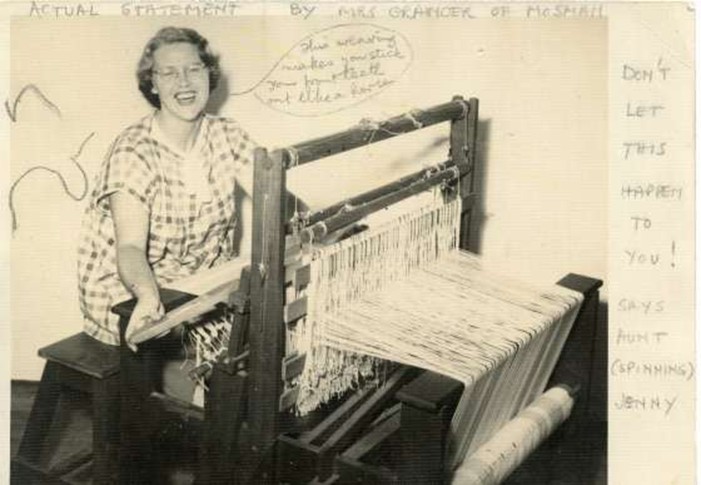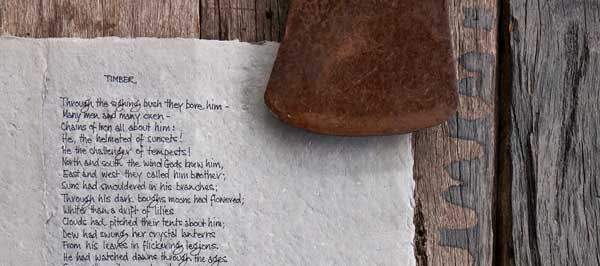
Men At Work

This exhibition grew out of a period of intense focus on the creation of In Praise of Australian Women.

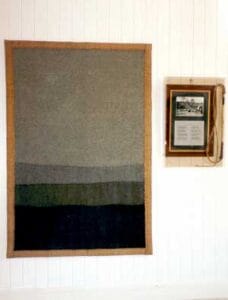
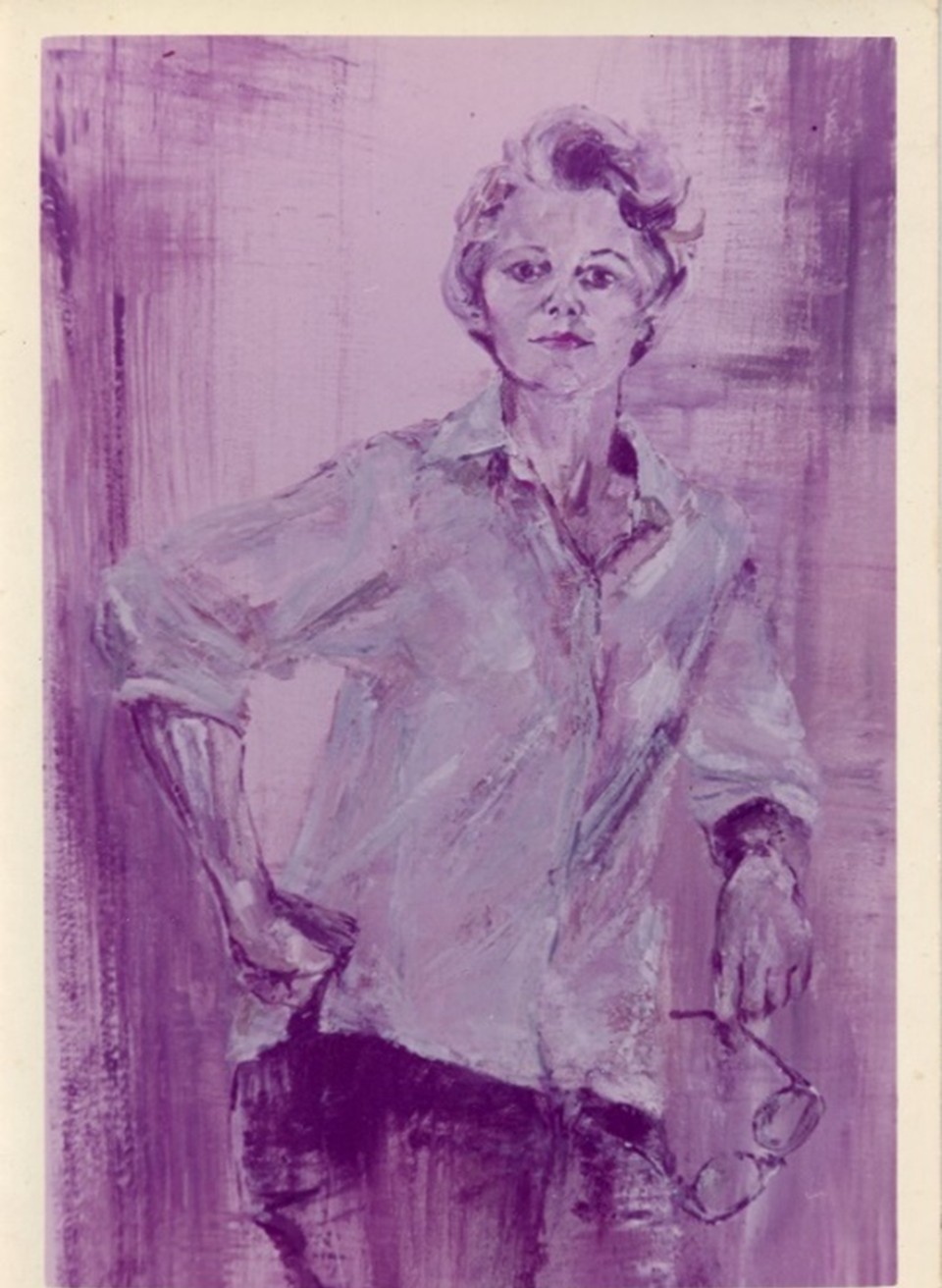
To restore equilibrium, my creative efforts were directed to the activities of Australian men – Timber-getters, Fettlers and Drovers.

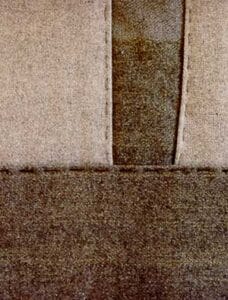
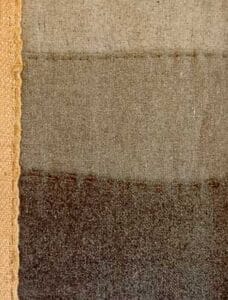
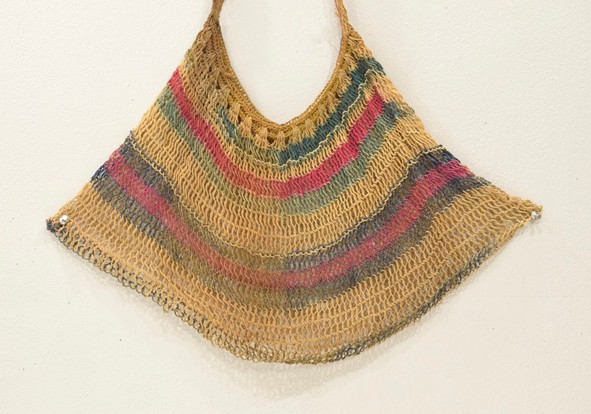
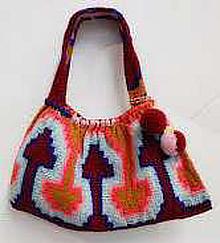
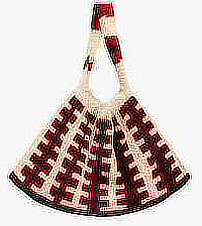
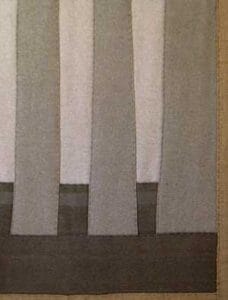
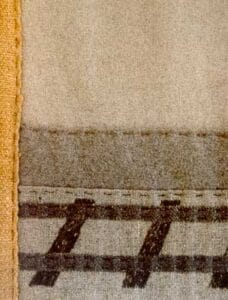
I enjoyed the freedom and challenges of a minimalist approach and used recycled, grey woollen blankets on hessian bags – in keeping with the ‘wagga’ rug tradition of Australian bush men working hard and living rough.
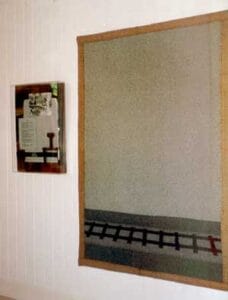
The Exhibition:
Three installations comprising ‘wagga’ rug or ‘bush’ quilt is supported by perspex boxed collection of artifacts, images and poems.

Dimensions:
Wagga – 170cm x 120cm (66” x 48”)
Boxes – 71cm x 52cm x 4cm (25” x 21” x 1.5”)

Materials:
Recycled woollen blankets hand stitched to jute bags

Size: 10 – 12 running metres

Crated weight: 100 kilograms
Comes with:

Banner (x 2) – measuring 250cm x 60cm

Education Pack for Primary & Secondary students

Laminated explanatory notes & labels

Catalogue

Condition Report Manual

Detailed hanging instructions

Media Release

Not a Still Life | Portrait of an Artist

Chapter 35: What next?

My life had shifted into a higher gear with my new partner, Giannis Arronis the handsome Sydney-based Greek oyster baron who’d come into my life by accident. I was excited at the prospect of a guided tour through his culture because at twenty-two, I was already an unabashed culture junkie.

My romantic partner switch meant I was now relieved of almost all domestic duties because we ate out six nights a week; a far cry from the years of having to make magic with mince. Sometimes we visited Greek restaurants owned by Gianni’s customers and were always warmly welcomed. I’d always start with oysters followed by a traditional Greek dish, because I was keen to try something different each time.

As well as intimate dinners, we were invited to both Greek and Australian gatherings. The standout for me was taking Gianni to his first cocktail party on the posh North Shore of Sydney, before rolling on to a Greek party in a less-posh part of the inner city.

In the time-honoured tradition of Anglo-Australian cocktail parties, we gathered at dusk to stand around, shifting our weight from one leg to the other, at the same sipping drinks and nibbling finger food whilst making light, inconsequential conversation. An hour and a half later we moved on to the Greeks. I’d already discovered that whenever Greeks gather, chairs line the perimeter of the spaces, either inside or outside, a chair for everyone.

After greetings and introductions Gianni, speaking Greek, proceeded to regale those assembled with an account of his first Australian cocktail party on the elite north side. His audience was captivated, hanging on every word as he went on and on and on, describing every small detail of the event before delivering the punch line, in English, for my benefit, “…all that and they couldn’t afford chairs!” The room then erupted with spontaneous shrieks of laughter.

A Friday or Saturday night outing I particularly enjoyed was visiting the bouzoukia—the Greek nightclub. Sometimes we were joined by Gianni’s Greek friends or mine keen to experience this fascinating facet of relocated Greek life. On our arrival, Gianni was always greeted by his musician friends with, “Gia sou Gianni!” (“Hi Gianni!”), after which the show began. As quick as a flash, without a word spoken, Gianni’s favourite tipple, a bottle of Johnny Walker Black Label whisky and cans of Coca Cola, would appear on our table with a shot of ouzo for me. After a couple of drinks, Gianni would sometimes dance the Zeibekiko, a traditional Greek dance for men. I loved to watch him dance as there were centuries of tradition in every step. Things hotted up around midnight and went on until the wee small hours so a bouzoukia session best suited serious stayers.

I revelled in Gianni’s sense of adventure. He was up for just about anything I suggested. One evening we went to the Capitol Theatre to see Jesus Christ Superstar, the super-popular musical that had taken Sydney by storm. Gianni was raised in the Greek Orthodox faith. Before he left for Australia, his mother gave him a heavy gold cross. Wanting to dress appropriately for the Super star performance, I asked him if I could wear his cross with my long-sleeved, full-length fine brown corduroy shift I’d made from left-over curtain fabric for the occasion. He agreed and off we went to the theatre. As we filed out after the show, I asked him what he thought of the performance, expecting a profound philosophical response. But I was disappointed as he simply scoffed replying, “I know the story!”

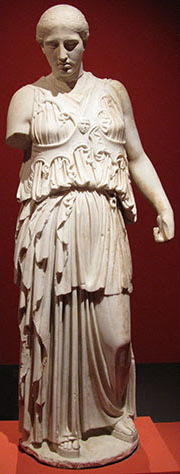
A less enjoyable experience and one I’d rather forget, took place at a party one Saturday night at Gianni’s electrician mate’s bachelor flat, above his electrical shop, in Newtown, an inner-city suburb that was home to many Greek immigrants at this time. His mate was clearly a party animal as his not very large upstairs living room was dominated by an impressive bar with columns supporting a superstructure above it. All the vertical spaces and niches were covered in red velvet, each niche with a miniature cream-coloured statue of Athena, lit from above. The overall effect was stunning.

Stylised statue of Athena—similar to the miniature reproductions decorating the bar at Gianni’s mate’s Newtown bachelor pad
Image: Wikidata.org

When we arrived, the flat was jumping with a crush of people—mostly Greeks. We stayed for a while and then took our leave descending the long flight of stairs to the side street below. As we walked to the car, from an upstairs window a bloke yelled out something in Greek. Gianni stopped dead and to my surprise in a matter of minutes, the street was filled with most of the partygoers. Lots of angry banter I couldn’t understand followed and thankfully there was no fisticuffs. The only belligerent gesture was the antagonist kicking the front tyre of Gianni’s treasured Volvo as we were about to drive off. Later he explained that the street kafuffle was in defence of my virtue.

Gianni had family in Sydney; his older brother Alexi and his wife Sophia had also immigrated from Sparta some years before. They lived in Leichhardt, a suburb adjoining Annandale and had two children. We occasionally spent time with them, particularly on Greek feast days.

My first Greek Easter with the Arronis family was a profound experience.

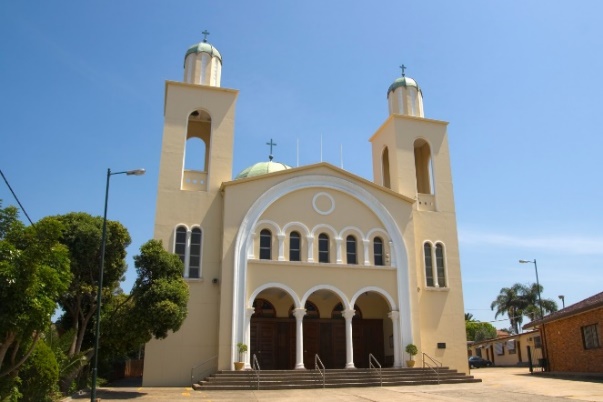
St Nicholas Greek Orthodox church Marrickville Sydney
Image: Wikimedia.org

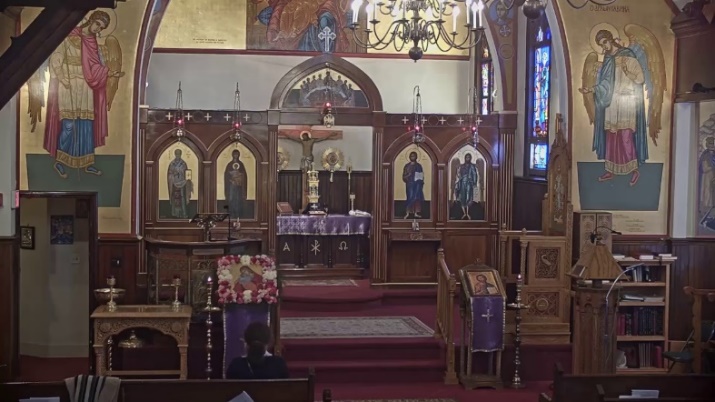
Interior of St Nicholas Church Marrickville in daylight
Image: YouTube

As arranged, we gathered at Alexi and Sophia’s house late on Easter Saturday night to attend midnight mass at St Nicholas Greek Orthodox Church in nearby Marrickville. All six of us fitted comfortably into their sedan for the run to the church. As we entered, we were each given a thin white candle with a white tulle frill before we managed to find space on a pew at the back of the church. Whilst we sat waiting for the service to begin, people continued to crowd in behind us where there was standing room only.

The service began with prayers sung by the priest who was wearing richly embellished robes and headdress. Then, just before midnight, all the lights were switched off and silence fell on the now pitch-black interior, with the only light coming from a single candle burning at the front of the church. We were enveloped by the hush of expectancy as we waited for the church bells to ring out midnight after which the priest loudly announced, “Christos anesti” (Christ is risen) before he took up the lighted candle and used it to light the candles of those worshipers nearest him, who then turned to light the candles of those seated behind. We sat in silence as the candle lighting continued until the church was filled with soft flickering candle light. It was a profoundly moving experience.

After the service, we drove back to Alexi and Sophia’s house with a lighted candle in the car with us. Before we entered the house, Alexi used the candle to make the sign of the cross on the lintel above the front door, leaving a faint grey mark. The candle was then taken inside to light the three-arm candelabra on the dining table, after which we tucked into the traditional midnight meal, prepared ahead of time by Sophia.

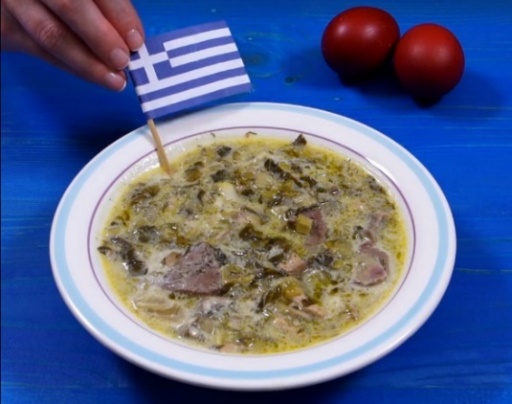
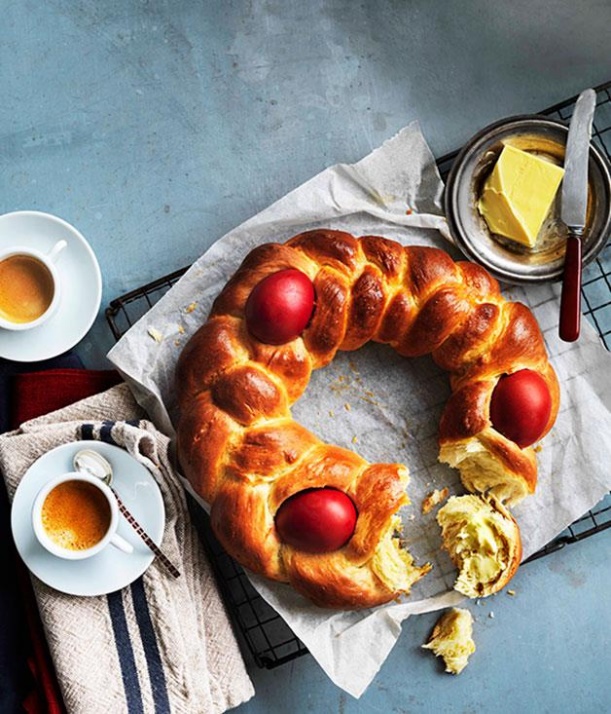
We were each served a bowl of magiritsa (Easter soup), made from the meat and offal of a lamb—the intestines, sweetbreads, lung, heart, kidney, liver and brain served in a lemon sauce and eaten with tsoureki a traditional sweet Easter bread. All this was washed down with liberal quantities of retsina wine.

Magiritsa special lamb offal soup served at Easter in observant Greek Orthodox families
Image: GreekReporter.com

I found it difficult to swallow the chunks of cooked offal, possibly because the various offal textures were unfamiliar or maybe because of the acerbic taste of the bitter herb and lemon sauce, or both. Obviously magiritsa was an acquired taste and I was very relieved to learn it was only served at Easter. Thankfully, another serving was a year away.

Tsoureki sweet Easter bread with baked with embedded eggs dyed red
Image: Gourmet Traveller

I was grateful to be included in the Arronis family’s Easter celebration because it nourished my insatiable curiosity about cultures other than my own. This and other Greek gatherings, exposed me to numerous aspects of transplanted Greek culture—the food, the language, the dances, the history and the customs with Gianni as my guide. He was happy to answer my endless string of questions, as I sought a deeper understanding of his culture and his country. Efcharistó (thank you!) Gianni!

ON REFLECTION:

Cooking: When Charlie and I split up, the daily grind of cooking an evening meal for two became a thing of the past. Our short-lived burst of dinner-party entertaining had petered out some months earlier, after which I promised myself I would steer clear of hosting dinner parties from here on in. And, I’ve held fast to my promise.

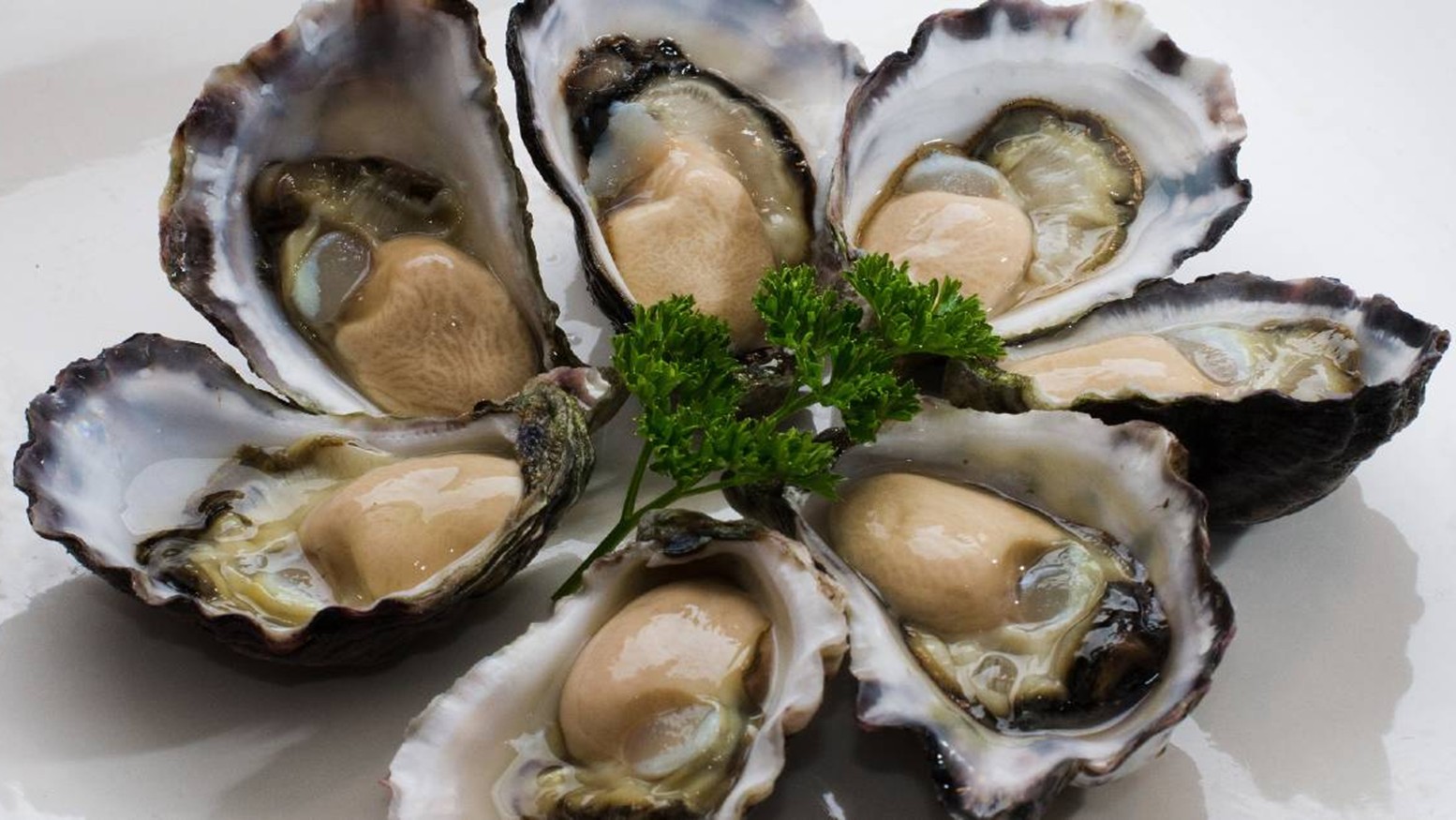
In the time of Gianni, returning hospitality developed an interesting twist, taking the form of Sunday brunch. As I’d access to an unlimited quantity of the freshest, plumpest oysters in Sydney, each guest was allocated five dozen oysters served au naturelle, mornay or Kilpatrick, washed down with lots of cheap champagne. Needless to say, my oyster-loving friends were lining up for an invitation. For me, the best part of this arrangement was that preparation was minimal and cleaning up afterwards was a breeze. Oyster shells into the bin followed by a spot of washing up and it was all over. A far cry from the all-day dinner party ordeal I’d put myself through before Gianni.

Defending a woman’s virtue: All these years on when I reflect upon having my virtue defended, I wonder if there was more to it. Was the derogatory remark flung in our direction a reflection on Gianni’s choice of an Australian girlfriend? Possibly. Or was it something else?

I knew that most single Greek men who were living in Sydney in the 1970s had limited contact with young Australian women, other than the belly dancers working at the scattering of Greek nightclubs. For Gianni to be dating a stylishly dressed Australian woman with her own house and a well-paid job, must have been a novelty for him and by extension, his family and friends.

Racism: There is no doubt that Gianni’s Greek friends were as suspicious of me as my Australian friends were of him. My circle seemed to fall into two quite distinct camps. In the first, those who’d travelled and thought Gianni was interesting because of his Greek heritage. Those in the second, considered Gianni an uneducated Greek immigrant and therefore my inferior. But nothing could‘ve been further from the truth.

FACTS:

The Zeibekiko: is traditionally a dance for men only, though more recently Greek women are also joining in. It’s sometimes known as the ‘eagle dance’ because of the free-flowing body movements and the steps of the dancer within an area of about two square metres.

https://www.youtube.com/watch?v=Na7i_Jluds4

Greek Easter: For the Greek Orthodox, Easter rituals are the most important in the church calendar and follow forty days of Lenten fasting.

The candle-smoke cross: The faint grey cross remains above the front door throughout the year and is a tangible symbol that the light of the Resurrection has blessed the home and its occupants.

Magiritsa: Greek offal soup served at Easter.

https://en.wikipedia.org/wiki/Magiritsa

Red-dyed Easter eggs: Symbolise Christ’s blood.

Retsina: Pine resin-flavoured white (or rosé) wine, made by the Greeks for at least 2000 years.

https://en.wikipedia.org/wiki/Retsina

Athena: Athena is the ancient Greek goddess associated with wisdom, warfare, and handicrafts. She was regarded as the patron and protectress of various cities across Greece, particularly the city of Athens. The Parthenon on the Acropolis of Athens is dedicated to her. In art, she’s generally depicted wearing a helmet and holding a spear, but not always.

https://en.wikipedia.org/wiki/Athena

Back to Chapter Menu

Not a Still Life | Portrait of an Artist

Chapter 34: The Oyster Baron

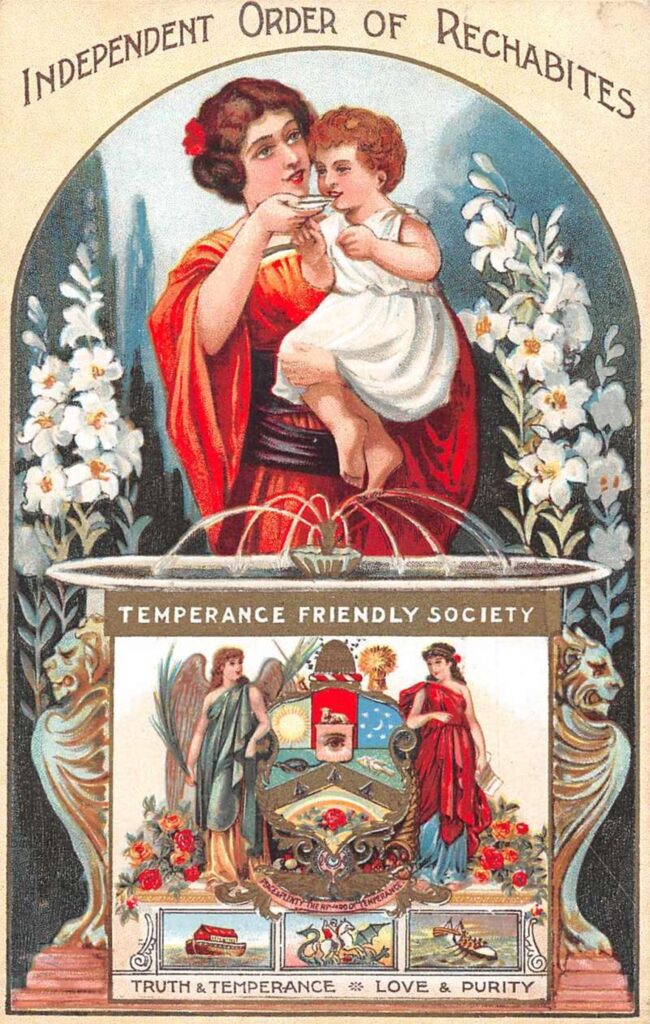
By early 1972, my partner Charlie and I, had been living together in a small terrace house in Young Street, for a little over two years. At this time, I had the opportunity to renegotiate my second mortgage with The Independent Order of Rechabites. As it stood, the bank held the first mortgage and my mother held the second. As there’d been some ructions with my mother regarding her stake in the property, I was extremely grateful to be able find another source of finance. The IOR representative, a committed ‘teetotaller’, was an associate of my boss, who owned and ran the Argent Manufacturing Company where I worked as a packaging designer. When the mortgage documents were signed and sealed, Charlie and I had a bit of a giggle because we were both regular ‘tipplers’.

Our spiffy renovations complete, I noticed my clothes were tighter. My body shape had changed, the direct result of my cooking. Our need to economise meant sourcing the cheapest cuts of meat, mostly fat-laden mince, that I presented in a myriad of creative ways. I joked that I’d write the definitive recipe book with mince as the hero ingredient. But this became less and less likely because by the end of our renovating stint, I’d not the slightest interest in mince or cooking it. I was now carrying the result of our diet so my next project was to tackle the extra kilos.

Casting around, the solution quickly presented itself, Weight Watchers. Weight Watchers was the first of numerous organisations to offer a foolproof weight-loss program to overweight Australians, in weekly meetings held across the country. I signed up in late September and every Thursday afternoon after work, I religiously toddled along to weigh in and listen to a diet-related pep talk at a church hall, not far from Young Street.

To survive the stringent Weight Watchers regime, I felt a weekly treat would help me stay on track. With the renovations complete, we now had more cash so I knew the cost of a dozen George’s River rock oysters on the shell wouldn’t break the bank.

The famous George’s River oysters
Image: farmers.org.au

I had my first ‘au naturelle’ oyster encounter whilst eating out with my food-loving father, after which I was a goner. Now, some years later, I’d no idea where to source fresh oysters in Sydney because for the duration of our relationship Charlie’s serious seafood allergy meant seafood of any kind had been off the menu. Asking around, a friend suggested the Sydney Fish Markets at Blackwattle Bay, not far from Annandale.

The following Saturday morning I took myself off to the fish market where I saw a sign reading New South Wales Oyster Distributors, and I wandered in. A drop-dead gorgeous Greek fella welcomed me and after the initial greetings, I asked the burning question: “How much do you charge for a dozen oysters?” He explained: opened oysters on the shell were so much and unopened were less. Always keen to save money and being a practical person, I asked him if he could show me how to open an oyster. My request was taken up with enthusiasm. In a thrice, the Greek wrapped his arms around me from behind and guided me through the process. After this unexpectedly cosy experience, I opted for the already opened oysters, erring on the side of common sense as a sharp oyster knife in the hands of a novice could be dangerous.

The very next Saturday I returned to the oyster shop. Once again, I made my purchase of a dozen plump fresh oysters and as I was leaving, the handsome Greek asked me where I lived. Caught off guard I didn’t want to give him my address so I thought of a number, any number, but wasn’t quick enough to change the street name as well.  And I thought no more about it.

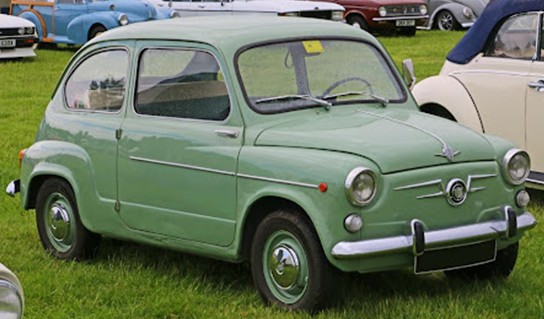
Since my mother’s fancy Karmann Ghia had been shipped back to New Guinea, I’d been driving an ageing pale green Fiat 600. I loved it. Our Italian mechanic had fiddled with the engine after which the car’s performance improved out of sight. It was nippy, powerful, cheap to run and just perfect for getting around Sydney. But it was quite conspicuous parked out in front of the Young Street terrace.

Fiat 600 two-door sedan C1965 just like mine!
Image: Simon Cars

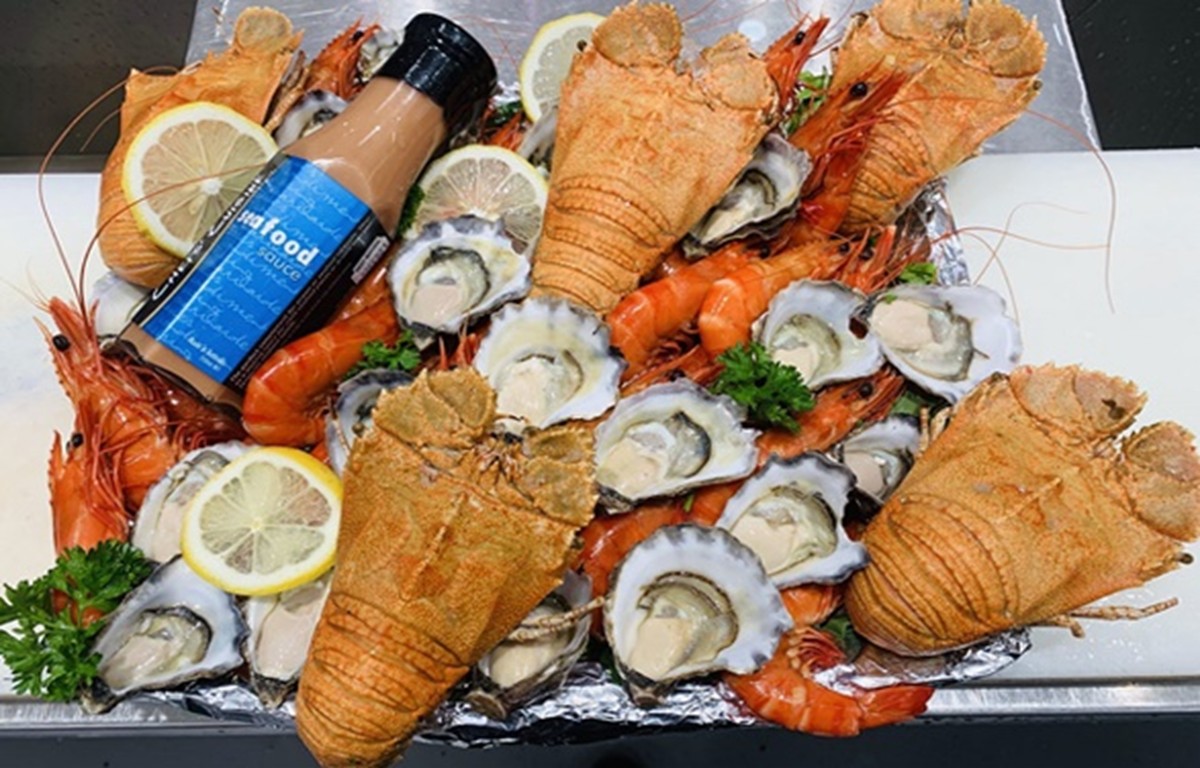
On that fateful Friday afternoon, I hadn’t been home long, when there was a knock at the door. Before me stood the handsome Greek Oyster Baron bearing gifts. A large tray with an arrangement of magnificently fresh seafood. There were Balmain bugs, king prawns and of course, a dozen oysters on the shell. I introduced him to Charlie and after graciously accepting his gift, I sent the latter-day Adonis away, not knowing what else to do.

Fresh cooked seafood tray similar to the one the oyster baron presented to me
Image: source unknown

Another week passed and come Saturday morning I once again toddled down to the fish markets to purchase my regular seafood indulgence from the Greek god. Negotiation complete he then asked me out to dinner. To my surprise, I accepted before I’d had time to realise the implications of what I’d done. How would I explain this to Charlie? As our relationship had been on hold for quite some time, I wondered if this handsome Greek would be the catalyst for us both to move on?

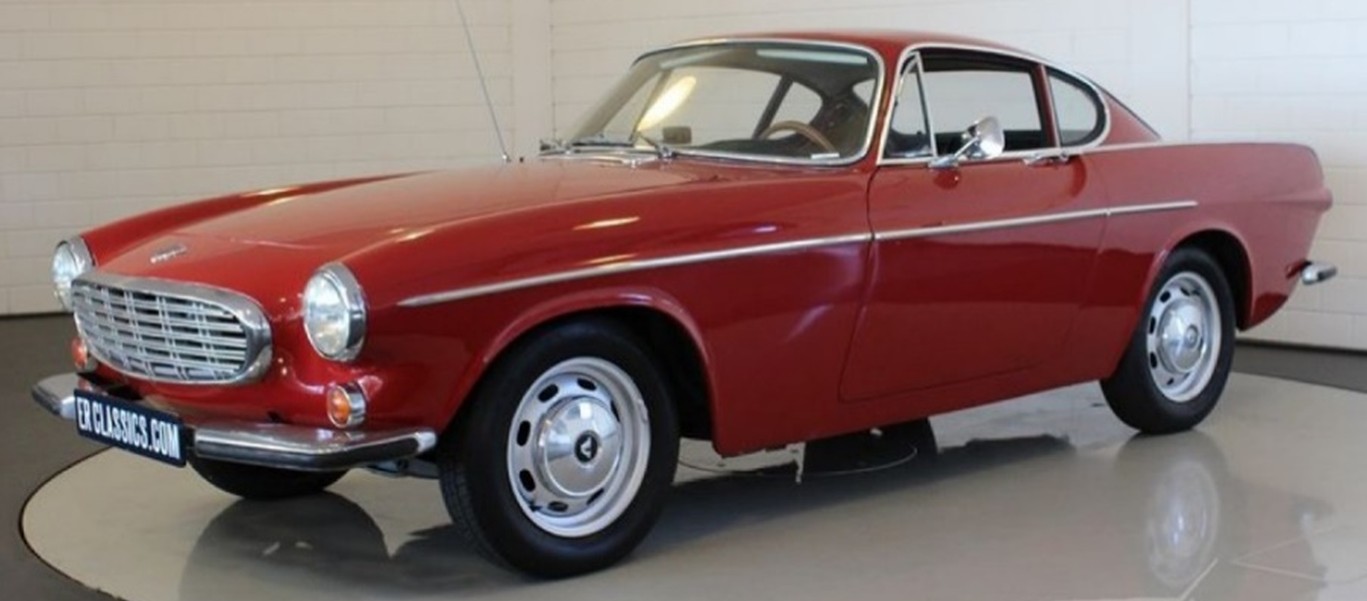
On the appointed mid-week evening, Giannis picked me up in his splendid red Volvo eighteen hundred sports coupe and we headed to Crows Nest, a North Shore suburb with a selection of swank restaurants. Over dinner he told me, amongst other things, that he carried a revolver. I was stunned, as no one in my circle of friends or acquaintances owned a revolver, let alone wore one. I did my best to conceal my shock and after I’d regained composure, I felt compelled to ask him the obvious question, “Why?” He shook his head replying, “Bloody Greeks, you can’t trust them!”

Volvo 100S coupe 1968 just like Gianni’s
Image: E&R Classics

Charlie could see the writing on the wall and moved out the following week.

And so began the most meaningful relationship of them all.


ON REFLECTION:

Mortgages: I purchased Young Street Annandale for $9000 in early 1970. My mother’s bank manager willingly provided the first mortgage of $5000 and my mother topped up with an unregistered second mortgage of $4000.  Having raised the total purchase price, I was able to use the $1000 from the compulsory savings account set up by my father, as working capital for the renovations. For the first year and a half, it was very tough financially but the experience provided a lasting cure for my spendthrift ways.

Weight Watchers: Over a six-month period, I regained my slim trim body shape whilst at the same time acquiring sensible eating habits that’ve stayed with me ever since with only the occasional wobble.

Charlie: Charlie was and is a very smart quiet fella. I was his first serious girlfriend and the first he’d lived with. At home, we fell into the customary Anglo-Australian gender roles of the early 1970s. I took the focus for our meals, housekeeping and renovation planning in addition to a full-time job. Thankfully, I was able to avoid the clothes washing task as the laundry at Young Street had become the kitchen in the room reshuffle so we used a nearby laundromat instead. Charlie helped to renovate and took the focus for paying the quarterly bills, and I took responsibility for both mortgage repayments plus the never-ending renovation costs.

Reflecting upon our relationship I realise we were a great renovating team. But once we’d discussed the technical challenges, found and implemented a suitable solution, we had little to talk about. I wasn’t particularly interested in economics and Charlie wasn’t at all interested in art. Our split when it came, was amicable with no arguments or fireworks. Afterwards, Charlie resumed his pre-Young Street lifestyle with the Birchgrove pub becoming his favourite haunt once more. We remained friends and he was very kind to me when the Greek odyssey came to a sudden end. He obviously still cared for me but, I’m getting ahead of myself.

Giannis Arronis: I was prepared to take the risk and see where this unexpected association would lead. I knew it’d give me the opportunity to explore another culture from the inside. And it did.

FACTS:

Independent Order of Rechabites (IOR), also known as the Sons and Daughters of Rechab is a fraternal organisation and friendly society founded in England in 1835 as part of the wider temperance movement encouraging total abstinence from alcoholic beverages. Always well connected in upper class society and involved in finance, it gradually morphed into a financial institution, explaining why I was able to re-finance my terrace house with them, in 1972.

In Australia, the IOR was first established in Tasmania in 1843, soon spreading to other states. IOR branches also known as ‘tents’ still exist in some Australian states though membership has fallen away over the years.

https://www.australianrechabites.org.au/

https://en.wikipedia.org/wiki/Independent_Order_of_Rechabites#

An early IOR lithograph. Images of this kind were used to promote sobriety and the importance of family values Image: Wikipedia

Back to Chapter Menu

Not a Still Life | Portrait of an Artist

Chapter 33: Dreaming of a cosy nest

In April or May of 1970 my partner Charlie and I moved into a small terrace house in Young Street Annandale, an inner-city suburb of Sydney. I’d bought the terrace with the proceeds of a compulsory savings account set up by my father to curtail my spendthrift ways. The $1,000 lump sum enabled us to move on to the next, more grown-up phase of our lives.

As our relationship was newish, it’d be interesting to see how we‘d cope with the stress, the inconvenience and super tight finances that always went hand in hand with renovating. Even though we were young, strong and optimistic, only time would tell if the relationship could withstand the physical, emotional and financial rigors we were yet to face.

Before launching into a selection of amusing renovating anecdotes, best I describe the location.

Young Street was a wide-ish street by inner city standards with concrete footpaths flanking a motley collection of brick and weatherboard dwellings, many in need of repair. Our narrow single storey brick terrace was situated about a block and a half from Parramatta Road, the busy main road connecting the cities of Sydney and Parramatta to the west.

 The terrace had a corrugated iron roof and a bull-nose front veranda with panels of decorative cast iron facing the street.

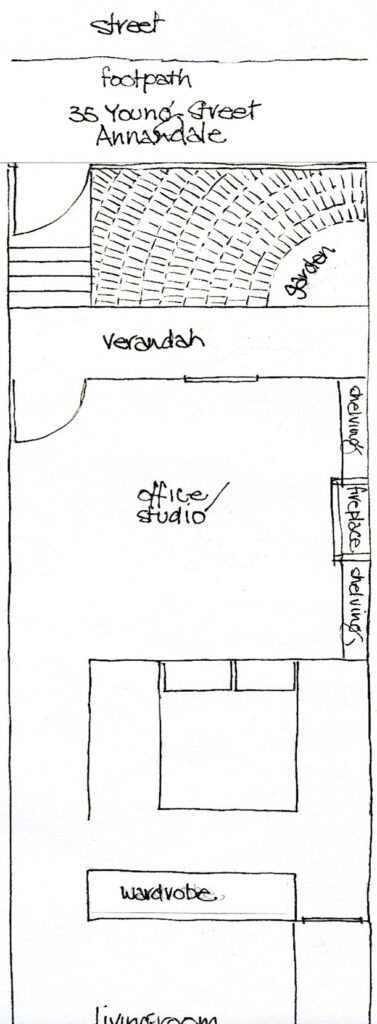
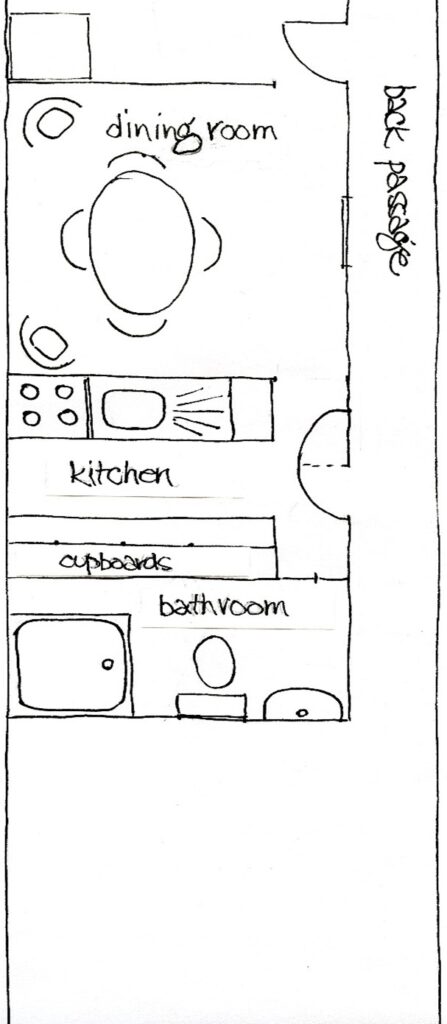
The house layout was as follows.

From the front gate, a number of brick steps up to the verandah with one more to the front door that opened into the living room, with a modest fireplace. Then a short walk along a narrow hallway with a bedroom off to the left and into the kitchen with a step up to the second bedroom.

The bathroom and laundry were accessed along an uncovered external passageway that led out to the backyard, with the outdoor loo by the back boundary and finally the back lane.

The renovators: 

Charlie: a practical fella who had electrical wiring experience. And Morley: with no renovating experience other than hanging some vinyl wallpaper in a bathroom some months earlier.

In those halcyon days of full employment, we both had full-time jobs.

Now, on to the more memorable experiences.

Experience No.1: Shortly after moving in, we realised we needed to improve the underfloor ventilation as the house was a little damp. This’d be our first major expense. We paid a fella a motza to install ventilators front and back. After the fact we realised we could’ve done it ourselves by removing a single brick and inserting a brick-sized ventilator in its place. So simple. Installing the ventilators created a serious hole in our meagre renovating budget. But the experience provided an important lesson thankfully learnt early. That is, to do the research before having a crack ourselves.

Experience No.2: One Saturday morning Charlie, in an attempt to locate the mains water inlet in the tiny front garden, accidently put a pick through the rusted galvanised water pipe. Until the water was turned off, we had the Geneva fountain in the front yard!  As Charlie had to leave for work, I was left holding the baby, so to speak. Now alone and very worried, I wondered what to do.

Before we had home-ownership responsibilities, Charlie’s favourite watering hole was the Forth and Clyde Hotel in nearby Balmain.

When I’d recovered my wits and a normal heartbeat, I decided the best place to find a plumber was at the pub. If worst came to worst, I’d jump up on the bar and ask, “Is there a plumber in the house?” And there was. He came, assessed the situation and reappeared the next day, Sunday, with what was needed to fix the problem and by late afternoon the terrace had a new copper water line from front to back. Hallelujah!

Experience No.3: The front room had a 3.2-metre-high lathe and plaster ceiling in need of repair. It was covered with a tracery of cracks and undulations, too much for a couple of novice renovators like us to handle. Charlie knew a ceiling repair fella who arrived to quote on the job early one Saturday morning, just after Charlie had left for work. Hearing a knock on the front door, I leapt out of bed, threw on my knee-length fur coat and hurried to open the door. The fella came in, assessed the ceiling and quoted after which he began pestering me to take off my coat correctly guessing I’d nothing on underneath. Written quote in hand, I managed to get him out the front door. And afterwards, extremely annoyed by his audacity, I breathed a sigh of relief. When he returned to repair the ceiling, I left Charlie to deal with him.

Experience No.4: In the room re-shuffle, the front room became the office cum sewing room, the kitchen became the living room and the laundry became the kitchen. We removed the laundry copper in the corner of the space, and planned to replace it with a four-burner gas stove. The existing brick chimney would become the stove ‘extractor’ vent, taking cooking smells up and out into the Annandale air. There was only one more brick to be removed before the stove install so late one evening I decided to remove it. When it came away, I felt an unexpected rush of cold air on my face. I was shocked because I’d assumed it was a double brick wall. But no! Wrong! It was single brick and I was through to my neighbour’s bathroom. Oh dear! Next morning, when he discovered the hole, he was understandably cross. I quickly halved the brick size before replacing it, after which harmonious neighbourly relations were restored and the new stove could be installed.

Experience No.5: We were coming to the end of the renovation with one outstanding job to complete—the front fence. Very soon after moving in, I began to chip off the render on the front of the house hoping against hope that the bricks beneath would be ‘sandstocks’—the fashionable convict-made bricks used in and around Sydney before 1840. Instead, my chipping revealed multi-coloured common bricks a sign that this row of terraces was much younger—probably built around 1890. But the damage was done. I had to continue chipping because the cost of re-rendering was way beyond our budget. As a result, I decided to use matching recycled commons for the fence. 

Driving home from work one day, I noticed a demolition site. I stopped and asked the fella if he’d clean commons for sale. I needed a thousand and the deal was quickly done. The additional cost of having the bricks delivered was out of the question, and, as Charlie wasn’t available, I got the gig using Charlie’s beat-up flatbed Fiat truck. I did two trips, five hundred bricks per trip. I loaded them, drove the truck slowly back Young Street, where I unloaded and neatly stacked each one on the footpath ready for the bricklayer. By day’s end, I was absolutely buggered. The bricklayer came the early the next day and by day’s end we had a tall front fence to match the house with embedded letterbox and Victorian cast iron front gate. What a stylish transformation.

The Young Street renovation dragged on for eighteen months and we desperately needed a break from the dust, the mess, the never-ending list of jobs and the constant drain of it all on our finances. The last major expense was installing the wall-to-wall carpet. That done, we congratulated ourselves for crossing the finishing line and went out to dinner to celebrate before moving on to other things.

ON REFLECTION
Annandale: When Charlie and I moved to Annandale in 1970, it was a working-class suburb. The surrounding houses were either rented or owned by people many of whom were factory workers. We represented the new wave of young baby-boomers who moved in to begin gentrifying this part of Sydney’s inner west.
 
Young Street: as the house was so narrow I have strong memories of feeling ‘squished in’. Life within its walls could be likened to living in a series of connected railway carriages, each carriage with a different purpose. This was an unnerving experience and one I’ve avoided repeating in the houses I’ve purchased since. 

Renovations: In retrospect, our renovations were terrible—a mish mash of colour and texture. The décor of each room differed with wallpaper hung over lining paper to help disguise the numerous lumps and bumps in the walls, the result of over 80 years of occupation. The floor treatments were equally diverse. The three rooms and the hall at the front of the house were carpeted. The dining room had a new, polished, Cyprus pine floor; the kitchen had square brown quarry tiles and the tiny bathroom had posh marble tiles. At the time, Charlie and I were very proud of our work and really enjoyed living together in the little house whilst our relationship lasted.

FACTS:
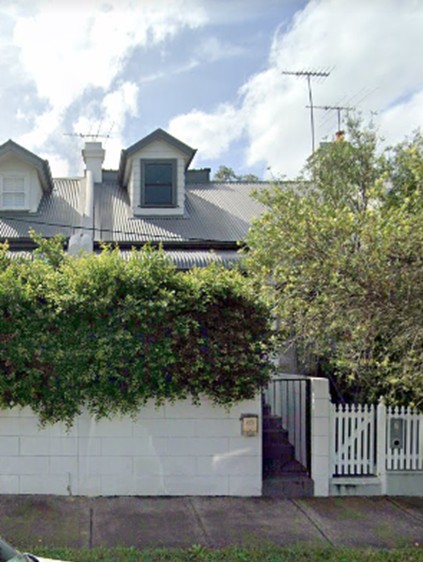
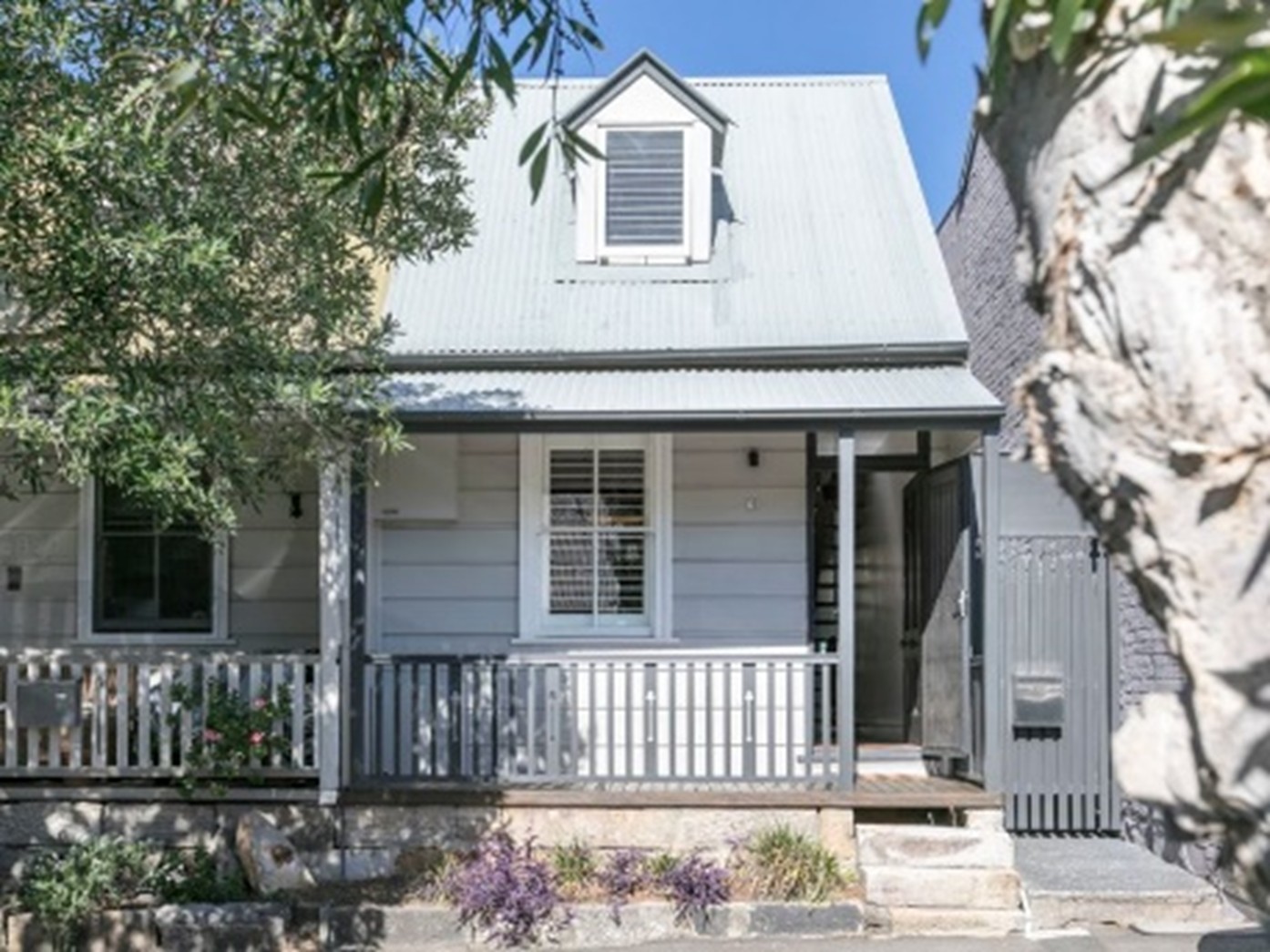
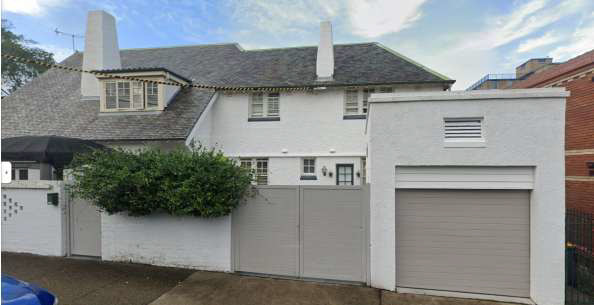
Young Street Annadale:

A recent image of my terrace house in Young Street Annandale now with a dormer window and rear addition just visible behind the hip of the roof.
Image Google Street view

Annandale: is an inner western suburb of Sydney, five kilometres from the city centre. Major George Johnston who arrived with the First Fleet in 1788, held the original 40-hectare land grant. He farmed the area and later sold it on to John Young—for whom Young Street was named. Young was a businessman, architect and mayor who began subdividing the land in earnest.

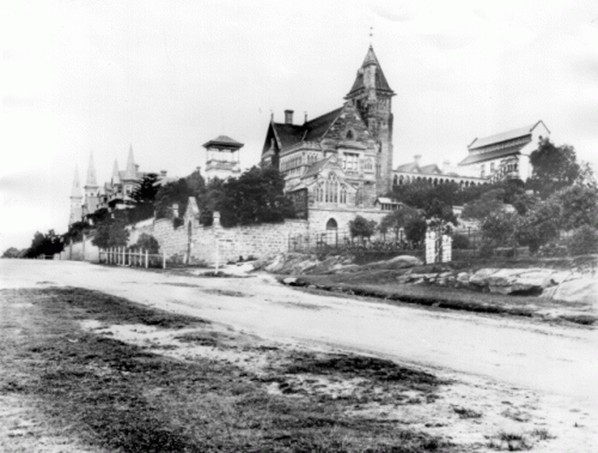
A cluster of grand ‘witch’s houses’, for which Annandale is famous, were built at the Rozelle Bay end of Johnson Street to house Sydney’s elite. Away from the Bay the houses ranged from two to three storeys down to single-storey worker’s cottages like mine. They were mostly built of brick and often rendered with stucco to look like sandstone. Most were constructed in the ‘Filigree’ style, using decorative cast iron ornaments on balconies and verandas sometimes depicting native Australian flora.

http://localnotes.net.au/?p=206

Johnson Street Annandale in the 1880s showing The Abbey in the middle ground and the ‘witches houses’ with their pointed spires further up the street
Image: Wikipedia

Back to Chapter Menu

Not a Still Life | Portrait of an Artist

Chapter 32: Happy families

I continued to share my life with Jan and Greg Sims in the small wooden house we’d recently rented in Gipps Street, Birchgrove. As we all had full-time jobs, we came and went from the house as our work hours required. Out-of-work hours we enjoyed the freedom the little dwelling gave us—a combination of cute living spaces and a back yard for creative activities. With the energy and enthusiasm of youth, we painted fabric, entertained friends and threw parties.

Gipps Street Birchgrove now fully renovated with a new roof. It sold recently for $1.75 million dollars
Image: realestate.com.au

Away from Gipps Street, my incomprehensible secretarial studies at the Metropolitan Business College had faded into the background as I was having so much more fun focusing on the fascinating art-related projects that were part of my job with the National Parks & Wildlife Service. To top up the coffers I also had a waitressing job in the evenings at one of the early family eateries at Gordon, on Sydney’s North Shore.

But our cosy domestic routine was disrupted with news of my mother’s imminent arrival in Sydney on three-months leave from her job in the New Guinea Highlands. My brother had also returned to Sydney having separated from his wife and three children in Toowoomba. As he was homeless and jobless, my mother offered him shelter from the storm at her recently-purchased two-storey terraced house in Glebe, an inner-city suburb of Sydney. I was invited to join them in a brave attempt to re-create the home we’d lost when our parents went their separate ways, and I decided to give it a go.

107 Glebe Point Road Glebe (the right-hand terrace) in 2019
Image: realestate.com.au

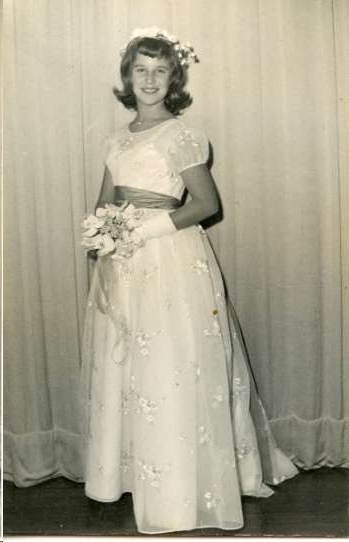
Our family effects were in storage. We’d packed up the contents of the house when we came down from New Guinea for my brother’s wedding in mid-1961. He was marrying a North Shore socialite with country connections. The wedding was to be held in the chapel at Scots College, Belview Hill, my brother’s old school.

Morley as junior bridesmaid for her brother’s wedding in Sydney in 1961
Image: Grainger family photographs

It was a grand society wedding and as a twelve-year-old I was thrilled to be included in the razzamatazz of the numerous pre-nuptial gatherings that gave both families the opportunity to check each other out. There were numerous shower tea parties too. I loved it all. And was beyond excited, to know that I was to play a bit part in this event as the junior bridesmaid.

After the wedding there was a slap-up reception for 120 family and friends at the posh Wentworth Hotel in the city. It was a magical evening for me because my father had flown in from New Zealand to be part of the celebration.

After the wedding my mother and I packed up and stored the contents of our family home because we were returning to our new life in Rabaul.

But I digress. Back to the Glebe house.

The furniture and tea chests that’d been in storage for eight years were delivered. I began the home-making process by cleaning the house, then arranging the furniture, unpacking the tea chests, washing, drying and putting away all the kitchen paraphernalia in readiness for our mother’s arrival.

My brother came and went without offering to help in any way. I resented it and said that I did. The unexpected result of speaking out was an unpleasant physical blow-up after which I got away to seek help at the Glebe Police Station just around the corner. As I tearfully related my story, the duty sergeant remained seated with his feet on the desk. When I’d finished, he smiled knowingly and told me to go home and forget about it.

As I left the police station alarm bells were ringing in my head. It was very clear that expressing my opinion around my brother could again put me in physical danger and there was nowhere to go for help. But I wouldn’t be silenced. I decided then and there to opt out of my mother’s dream of “recreating a home for herself and her adult children” and returned to live with Jan and Greg at Gipps Street where I knew I was safe.

In spite of the turmoil swirling around me, I knew I’d soon be escaping the drama to spend Christmas in Nairobi with my father and Alison. I also knew it’d be my third and last visit as a ‘dependent’ travel funding provided by the United Nations would end on completion of my secretarial studies at the MBC. But, as I’d been playing hooky for months, I knew a time-bomb was inexorably ticking. It went off with a bang when my father received my end-of-year report card from MBC. He discovered that I’d ignored his well-meaning directive to gain secretarial skills for a possible future career as an office worker.

The matter concluded swiftly and cleanly on receipt of a telegram making it clear that disobedience and deceit wouldn’t be tolerated along with instructions to immediately return my airline ticket to Qantas head office.

As I was no longer welcome in Nairobi, I’d instead spend Christmas in Australia. This sudden change of plan wasn’t such a bad thing as I’d recently made the acquaintance of one Charlie Smith, who frequented the house across the street, owned by his sister Maggie and her husband John.

As Charlie and I became better friends, I spent more and more time with his family. Their house was a solid, double-fronted Edwardian cottage awaiting renovation. Below street-level there was a huge, gloomy basement the full width of the building, which was reminiscent of a baronial dining hall with a massive fireplace at one end. Maggie was an amazing cook and John a great raconteur and wine expert. Their combined passions resulted in regular dinner parties on an impressive scale. I loved the eclectic group of people that gathered to enjoy their expansive hospitality—academics, engineers, medicos, historians, economists and artists.

In November that year, I turned twenty-one. My compulsory savings account had accrued $1,000 and I was sorely tempted to blow the lot on a calf-length grey Arctic fox fur coat. The idea wasn’t original, rather a lift from fellow-artist and work colleague Helen Ashton; artist Julian Ashton’s granddaughter, who, before departing for New York to marry an American filmmaker, had done just that. My mother managed to restrain me as she was determined to keep my feet on the ground. Instead of a fur coat, she encouraged me to consider buying a house.

At the beginning of 1970, I changed jobs. I began working with the Exhibitions Department of the Australian Museum in College Street, Sydney. My Parks and Wildlife boss recommended me for the job; an exciting three-month contract as part of the team setting up the bi-centenary exhibition, titled Cook, Banks and Australia. My skill-set was used to prepare silk-screened didactic wall panels, to help set up displays and generally make myself useful. We watched with pride as the princes, Phillip and Charles, opened the exhibition on the 1st of April, that year.

Whilst at the Museum, with my inheritance in mind, Charlie and I discussed the prospect of buying a small inner-city terrace house and trying our hand at renovating. But before we could do this, I needed to find a permanent job paying enough to cover two mortgages as well as renovation costs and living expenses. Thankfully, my luck held. In the Sydney Morning Herald’s Saturday classifieds, I discovered the Argent Manufacturing Company was looking for a packaging designer. During the interview I learned that this well-respected firm of high-quality cosmetic packaging printers was prepared to teach me all I needed to know about packaging if I accepted the job—and I did.  Now, with a generous salary assured, Charlie and I went house hunting.

We found a single-storey, four-meter wide, brick terrace in Young Street Annandale for $9,000. It was the third terrace in a line of six, and perfect for renovation. And so began our crash course in renovating. Charlie had previously worked with an electrician so in addition to a complete re-wire when the time came, we also planned to install fancy wall mounted bracket lights with the wires chased into the brick, dimmer switches and a trendy hanging corner light. We wallpapered most of the walls and laid mustard-coloured wall-to-wall carpet. Golly, we thought we were flash!

The renovation took us a little over eighteen months, after which Charlie decided to go back to university at night to complete his Commerce degree. All the while, I continued to work at Argent Manufacturing where I remained for some time after our relationship came unstuck and Charlie moved out.

But I’m getting ahead of myself because there are some amusing renovating stories to tell, before I move on to my next romantic encounter that’d be the most significant of my life though, I didn’t know it at the time.


ON REFLECTION:

Domestic violence: The indifferent response I received at the Glebe Police Station when I sought help after my brother assaulted me, taught me a very important lesson, that is to quickly remove myself from potentially dangerous situations. A lesson well learned because by doing so I’ve avoided trouble either in or out of a relationship even though I’ve occasionally found myself in some pretty wild places both here and overseas.

My father: I knew the MBC fiasco would end badly because I had arranged for my progress report to be sent directly to my father in Nairobi. As a result, it was inevitable that my truancy would come to light and it was only a question of when. But I didn’t care. To be honest, I’m surprised it took so long. Up until this point in time, I’d willingly played the role of the perfect child of a broken marriage—my futile attempt to transcend the shame I carried concerning my parents’ divorce. But, after the humiliation of my father’s “you have no talent” pronouncement, something snapped! I asked myself how could this be true after three years of full-time study at the National Art School? Had it been a complete waste of time? I didn’t think so and this was confirmed when I landed an exciting graphic design job with NPWS. Over time my rage had gradually swelled to the point where compliance morphed into defiance—the worm had turned.

Since 1969, I’ve had one brief telephone conversation with my father. He died in 1993 aged 85.

Young Street Annandale: The skills I acquired on the Young Street renovation were invaluable and later put to very good use. I’ve recently sold my fifth renovation.

Charlie: Reflecting on our two-and-a-half-year relationship, I realise we’d little in common other than renovating. After completing the renovations, we followed our trendy friends into the weekend dinner party lifestyle of the 1970s. But it wasn’t long before the novelty wore off and I was left wondering what, if anything we’d do next. Marriage and children weren’t discussed for which I’m grateful as I had no interest. I already knew there was a whole world out there to be explored. In my teens I’d often travelled overseas to visit my parents. Regular trips to visit them, one in New Guinea, the other in Kenya, had left me with an irrepressible urge to continue travelling—it was simply a question of how.

FACTS:

My brother’s wedding: As it transpired, my brother’s wedding in mid-1961 was the last time all four members of my birth family were together.

Julian Ashton: Australian artist and teacher—founder of the Julian Ashton Art School in Sydney in 1890.

https://en.wikipedia.org/wiki/Julian_Ashton

Young Street Annandale: In 1976 I sold the house for $27K. In 2016 it sold for $1.6M albeit with major additions. And in 2022 sold again, this time for 1.75M.

Back to Chapter Menu

Not a Still Life | Portrait of an Artist

Chapter 31: Reluctant upskilling

At the beginning of 1969, I returned to Sydney after spending a most interesting six weeks in Nairobi, with my father and his second wife, Alison. Upon my return, I faced the challenge of finding a place to live, because the hostel for young women at Kirribilli, was no longer an option. I’d thoroughly enjoyed the facilities there, but three years was the maximum length of stay. The time it would usually take to complete most tertiary qualifications. But the truth be told, as a headstrong twenty-year-old, I’d had more than enough of living with the regulations and curfews imposed.

My adopted Aunt Helen Klausner came to the rescue, offering me a downstairs room in her extraordinary modernist house at Hunters Hill.

Aunt Helen was an early childhood specialist. She owned and ran Fina School Requisites in Balmain, selling quality educational needs for kindergarten and lower primary school children. She visited schools all over Sydney in her pale blue VW Kombi, filled to overflowing with inspiring children’s books, art materials and imaginative wooden puzzles.

Aunt Helen’s retail manager, newly-married Jan Sims and her husband Greg, were already living at her house and when asked, they were more than happy to have another person join them to share the rent.

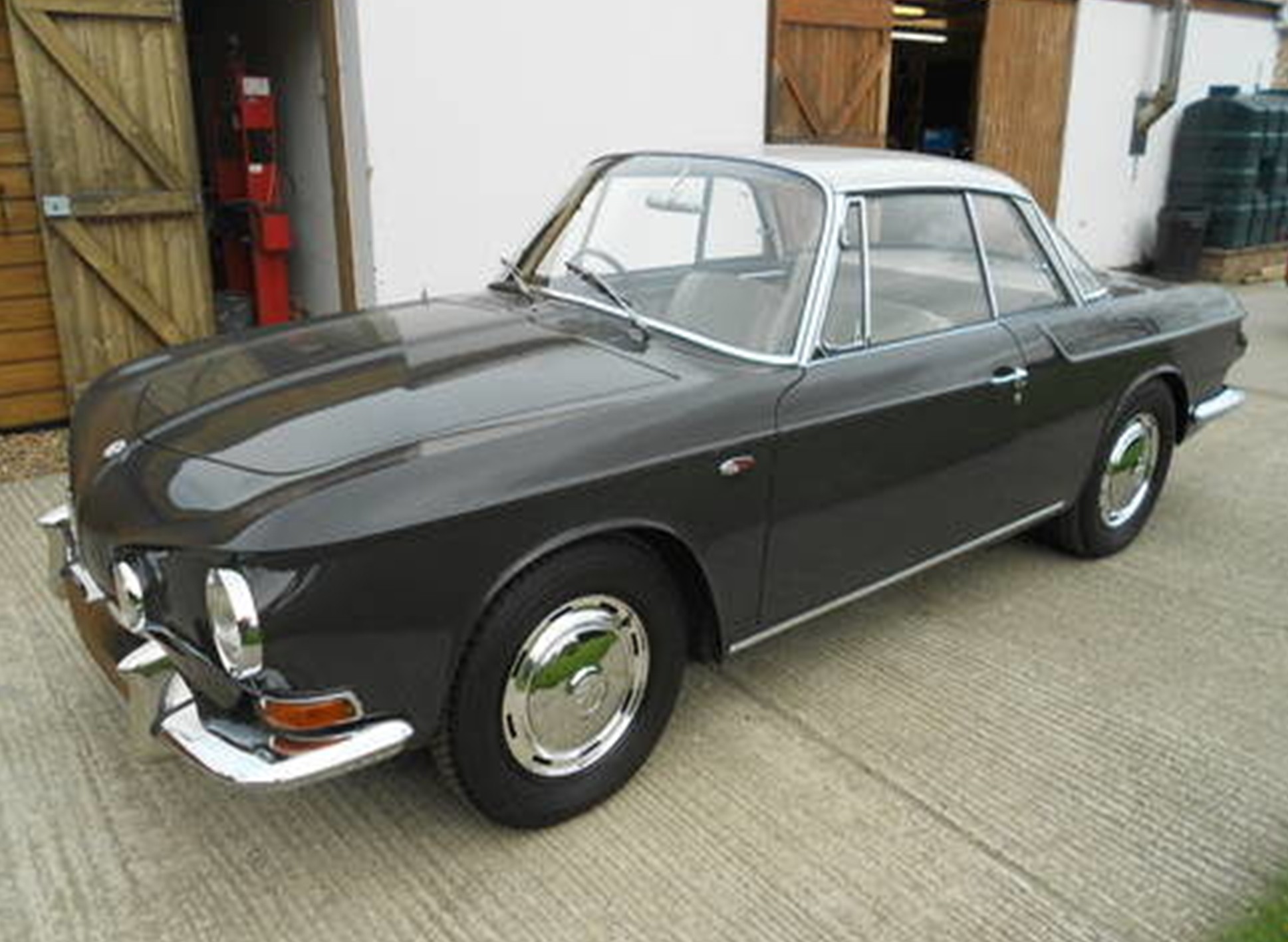
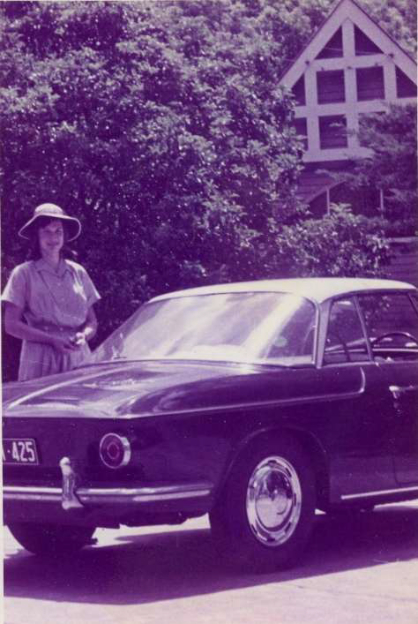
I had transport, my mother’s chocolate brown and white sports car. This was a good thing as Helen’s house was off the beaten track with public transport services erratic, particularly at weekends. 

The Karmann Ghia 1500S
Image: source unknown

Now I’d a place to live, I could begin full-time study at the Metropolitan Business College, the MBC, where I’d learn Shorthand, Typing and Bookkeeping. At the outset I was optimistic. My father had decided that secretarial training would be a more reliable meal ticket than my recently completed, three years of full-time Art School study. Once I’d recovered from the shock, I felt he’d given me the opportunity to gain an additional skill set that’ would complement my art training. But my optimism was short-lived.

The MBC building was in the city, not far from Circular Quay. As city parking was expensive, I took a bus and then a ferry to the Quay Monday through Friday to attend classes.

By way of an introduction, I’ve included a priceless quote from MBC’s 1918 promotional blurb. But, by the time I arrived some fifty years later the organisation had become a shadow of its former self.

WHAT YOU GET AT THE M.B.C.  Thorough training under the close personal supervision of the Principals. Real individual teaching and personal attention to your special requirements, only possible where an institution is adequately staffed. Classes limited; staff of 4 teachers. High-quality teaching. Only a big institution like the M.B.C. can afford to pay the salaries asked by really good teachers, and to install the complete teaching equipment demanded by modern requirements. Good positions, the natural result of good teaching under scientific, up-to-date methods. Courtesy— discipline— tone—an atmosphere of earnest, purposeful endeavour. The stimulus of success.

 Quite a rap.

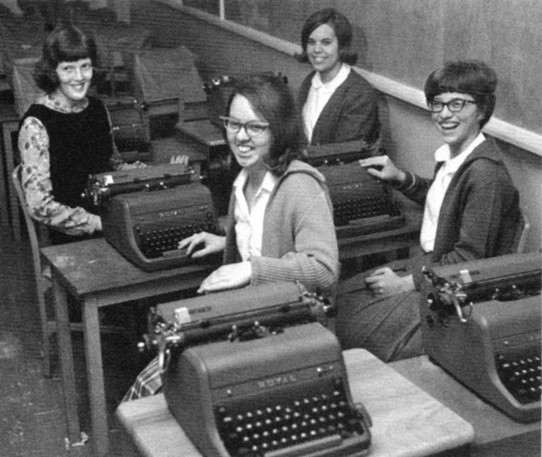
A typing room similar to MBCs in the late 1960s
Image: flickr.com

But the facilities at MBC could only be described as Dickensian. It was as though the clock stopped just after World War 2. The numerous dark, wood-panelled classrooms held a squeeze of well-worn wooden desks and chairs for Shorthand and Bookkeeping lessons. The Typing Room housed numerous antiquated typewriters set out on small desks in tight rows and smelt of old oil and metal.

Of all the new skills I was to master, Shorthand proved to be the most difficult. I found it impossible to memorise the seemingly endless pages of squiggles that represented whole words. Bookkeeping was equally difficult and typing was tricky on the heavy old typewriters from another age.             

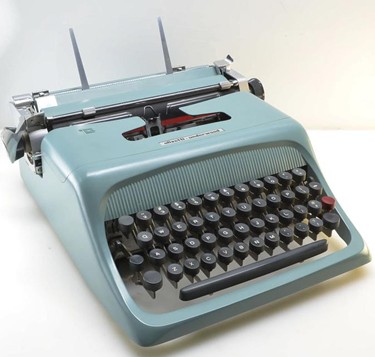
I was accustomed to my mother’s Olivetti portable typewriter, that only required a light touch instead of a heavy thump, for each letter. My fingers didn’t perform well and my typing tests were testament to my total inability to master this skill. 

Overall things weren’t looking too good at MBC and as my feelings of inadequacy grew, I was forced to ask myself the inevitable question; “How could I be so stupid?” I felt like a square peg in a round hole. I stuck it out for about four months, becoming more and more dispirited by the day. What to do? From somewhere, I heard that the newly-formed National Parks and Wildlife Service (NPWS) was looking for a part-time graphic designer. I applied for the job and got it.

An Olivetti portable typewriter like my mother’s
Image: Etsy

At the start I was able to juggle my secretarial studies with the NPWS work. But, as time went on, I found the NPWS work was much more interesting, offering a wide variety of jobs from graphics to leaflet mock-ups and visitor centre displays. As a result, I spent more and more time with the NPWS team, and less and less at MBC.

These seismic changes placed me on the horns of a dilemma. How could I tell my father I was unable to master the rudiments of a basic secretarial training and instead, found a much more exciting art-related ore exciting art-related job with a newly-formed government department? I decided not to tell him. A decision that would have lasting ramifications.

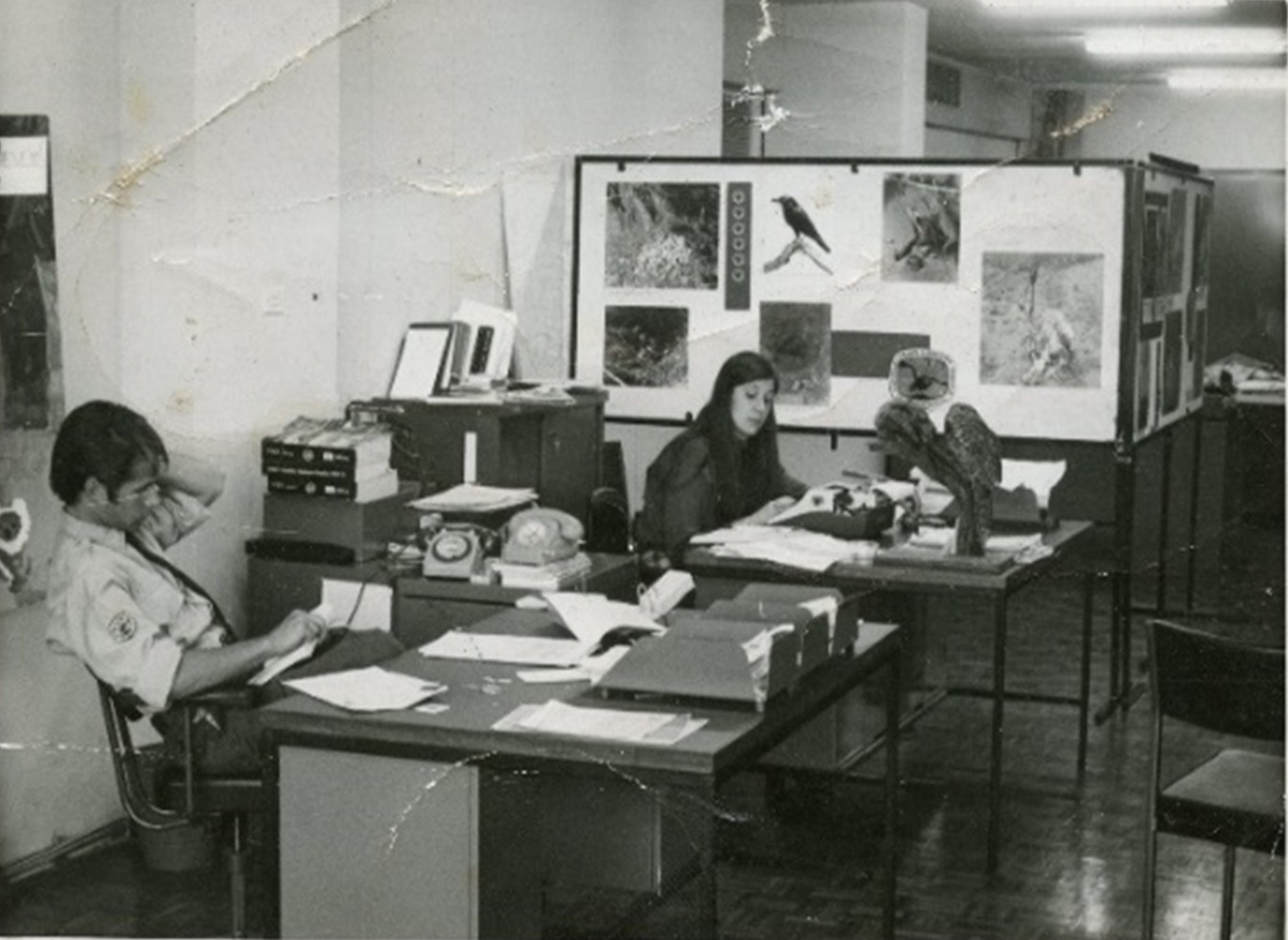
NPWS ‘creatives’ 4th Floor office. L: Roly Breckstead & R: Morley typing
Image: Grainger family photographs

Instead of using public transport, I now drove the swank Karmann Ghia from Hunters Hill to the NPWS offices in the city because the building had basement parking. The parking attendant, possibly revelling in the car’s rarity, as it was one of only four in Australia, let me to park there for very little. Things were falling into place but not in the way I’d expected, and my spirits lifted. I loved my work with NPWS and they liked the work I did.

On the home front, even though we all enjoyed living at Hunters Hill, the distances to our various workplaces were becoming bothersome. We decided an inner-city rental would be more convenient for us all. With Aunt Helen’s blessing, Jan began the search for a suitable house. Quite quickly she found a small tumbledown semi-detached weatherboard cottage in Birchgrove. It was perfect for us all.

We moved in and immediately began scrubbing and painting and decorating to make the most of the tiny spaces. Upstairs there was a dormer-windowed bedroom, downstairs a second bedroom and a living room, a kitchen, a lean-to laundry and a small bathroom and loo. All rooms were basic but functional. The backyard was particularly useful, ideal for Jan and I to produce lengths of batik fabric for an exclusive dress shop in upmarket Double Bay, happy to take as much as we could produce.

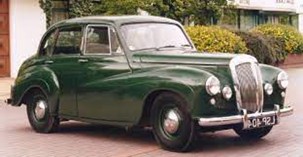
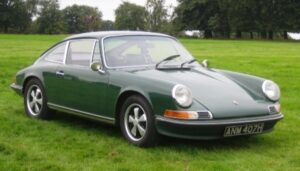
It’s worth mentioning here that in my late teens male companionship was varied and interesting. In no particular order, I dated a Daimler, a Fiat 124S, a Porsche Carrera 911, a Triumph Spitfire, an MGB, and a Fiat 500, but for one reason or another the possibility of a longer-term relationship with any one of the vehicles owners fizzled out.

Daimler

Porsche Carrera 911

MGB

Fiat

Triumph Spitfire

Fiat 500

Since leaving home at fifteen I had experienced group living in two places. Firstly, at a Queensland boarding school followed by the YWCA hostel, both all-girl institutions and more recently I’d shared digs with my adopted aunt and a newly-married couple. But I felt it was now time for me to consider a committed relationship of my own. And this would happen sooner than I could ever have imagined.

One day I noticed a nice young man coming and going from the once-grand, double-fronted Victorian brick cottage on the other side of the street. Little did I know at the time that this young man was to be my first live-in relationship. In those days, it was called ‘living in sin’ and I was up for it.


ON REFLECTION:

Metropolitan Business College: being hardly numerate I found bookkeeping a mystery. Since then, I’ve realised I learn best with an application rather than a hypothetical and it wasn’t until I had my own business and needed to track finances that I figured it out. Before long, I became sufficiently proficient to do just that, but that’s another story. 

My father: I didn’t know how to tell my father that I was no longer attending classes at MBC. I considered myself a failure and was ashamed to admit I was unable to master the secretarial skills taught there—skills other young women mastered with ease. In my father’s eyes, I had no artistic talent and now this MBC disaster. I remained mystified by my father’s pronouncement that I wasn’t talented or gifted after completing three years full-time study at the National Art School. I wondered how he knew as he’d seen none of my student artwork. Still smarting from this perceived injustice, I found it well-nigh impossible to write to him confessing that I was playing hooky from MBC and had instead stumbled into a fabulous job that paid well and utilised all aspects of my graphic design training.

Relationship modelling: My dysfunctional family life was a hotbed of hostility. As a result, my parents were unable to provide role modelling of a mutually supportive relationship for my brother and I. With no guidelines to follow, my interactions with men to this point had been confusing because I was unable to recognise genuine affection. By observing the mechanics of my house mate’s relationship, I slowly gained the confidence I needed to seriously consider the possibility of establishing a committed relationship with a man. I was now poised and ready to take the next step—Charlie.

FACTS:

The National Parks & Wildlife Service in Australia: The Service was established in 1967. It was an amalgamation of the Fauna Protection Panel and the Parks and Reserves Branch of the New South Wales Lands Department. The Lands Minister, also established a charity, the Foundation for National Parks and Wildlife, to assist the Service in raising funds for conservation. 

National Parks & Wildlife Service logo Image: Wikipedia

Foundation for National Parks and Wildlife: Whilst I was working for NPWS I was asked to produce a number of drawings of a Grass Tree in flower for the Foundation’s logo and one of my drawings was selected. I note that my original drawing has since been replaced by a koala!  

Foundation for National Parks & Wildlife
Image: Wikipedia

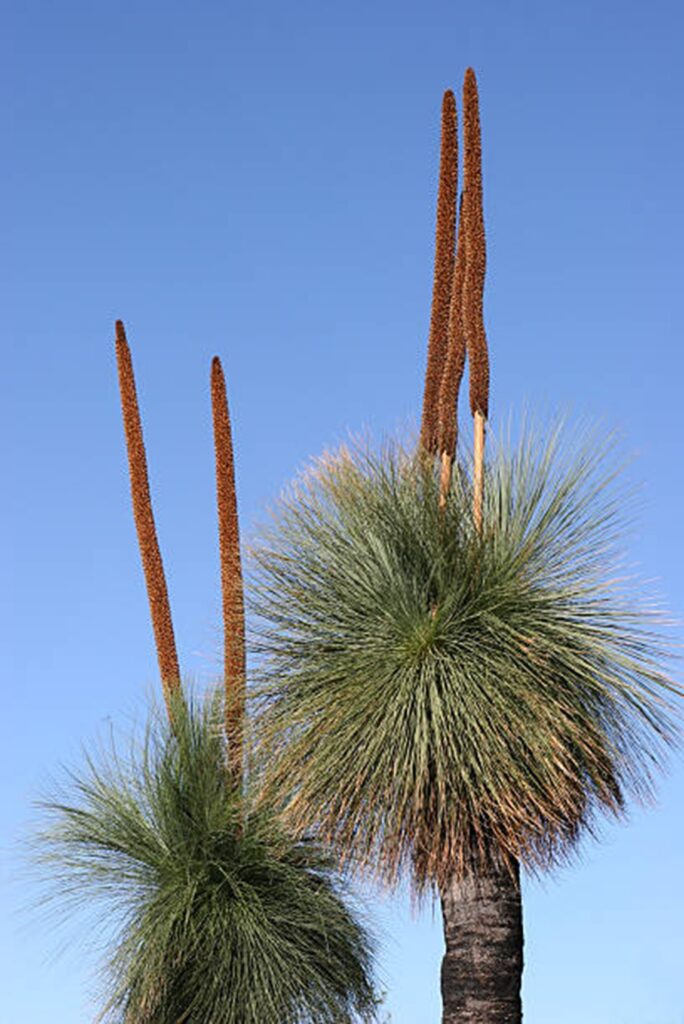
The Grass Tree: Xanthorrhoea thorntonii, is the quintessential Australian native plant. It has a distinctive black trunk below a crown of grassy leaf strands and tall thin flower spikes.

Grass tree in flower
Image: istock

Back to Chapter Menu

Not a Still Life | Portrait of an Artist

Chapter 30: Circumnavigation

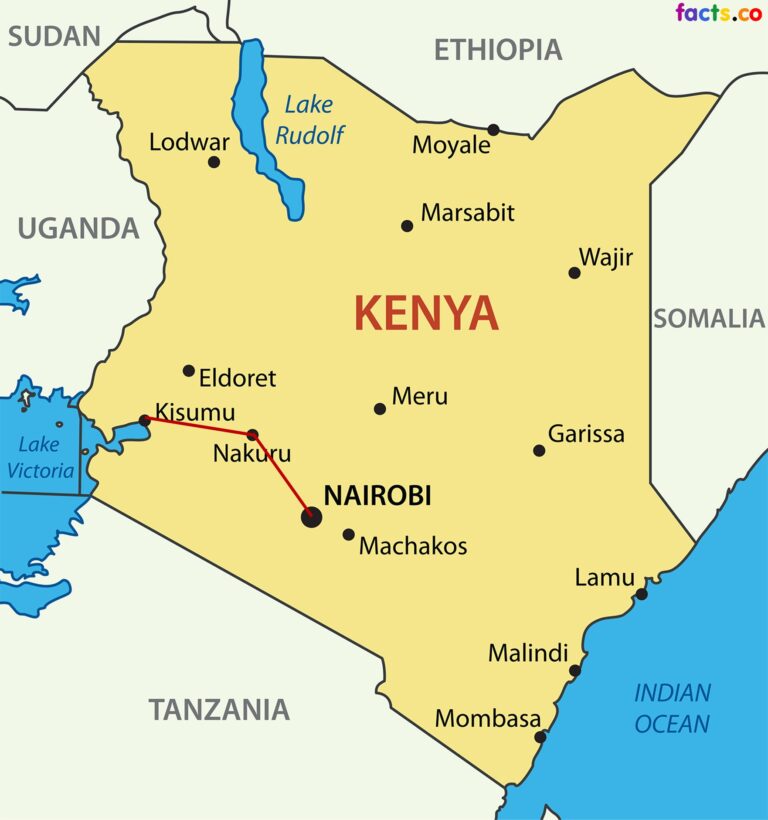
On this, my second trip to Kenya, I was excited to discover that my father and Alison, had planned another unusual family holiday—this time to Lake Victoria, a five-hour drive west of Nairobi.

Map of Kenya with red line showing the route to Lake Victoria via Lake Nakuru
Image: Dreamtime.com

We left early in the morning, taking the ‘good car’, a Toyota Crown Deluxe, my father’s pride and joy kindly provided by the United Nations for his International Labour Organisation Project. He was impatient to get away, itching to give the car a good run.

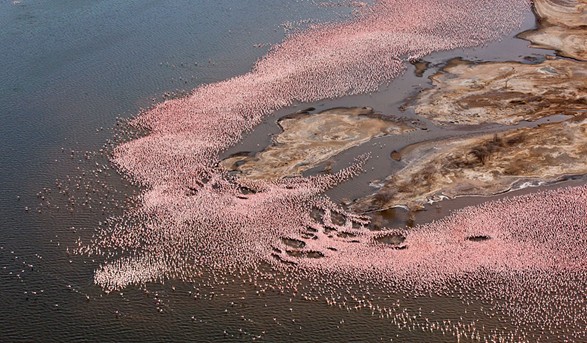
After descending into the Rift Valley, we drove west through undulating landscape for some hours. To break the journey, we took a left turn into the Nakuru Game Park, keen to see the extraordinary massing of flamingos along the shore of Lake Nakuru.

Aerial view of flamingos massing on the shore of Lake Nakuru
Image: Royal Private Safaris

Alison had prepared a picnic lunch so we parked close to the lake edge to watch flamingo antics whilst munching. The Game Park rules required humans to remain in their vehicles at all times, to avoid unexpected encounters with wildlife, any larger or more threatening than the flamingos.  As it was midday and hot, there was no sign of the ‘big ones’. We assumed the wildlife were taking a siesta under the shady trees, well away from the cacophony at the lake’s edge.

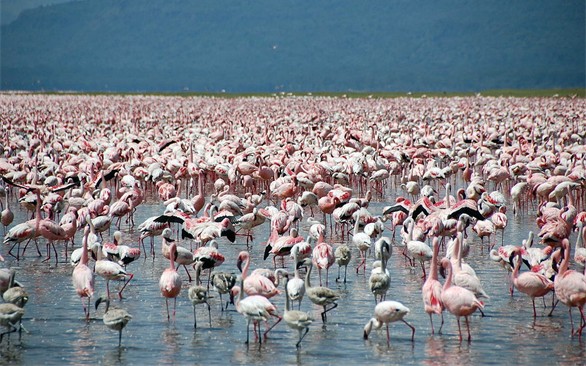
Flamingos as far as the eye can see on Lake Nakuru
Image: Wikipedia

From the car we had an uninterrupted view of the vast gatherings of gangly, red-legged birds with pink feathers and black beaks hugging the shoreline. Between squawks and honks, they gorged on the abundant algae, insects and the crustaceans along the lakes edge.

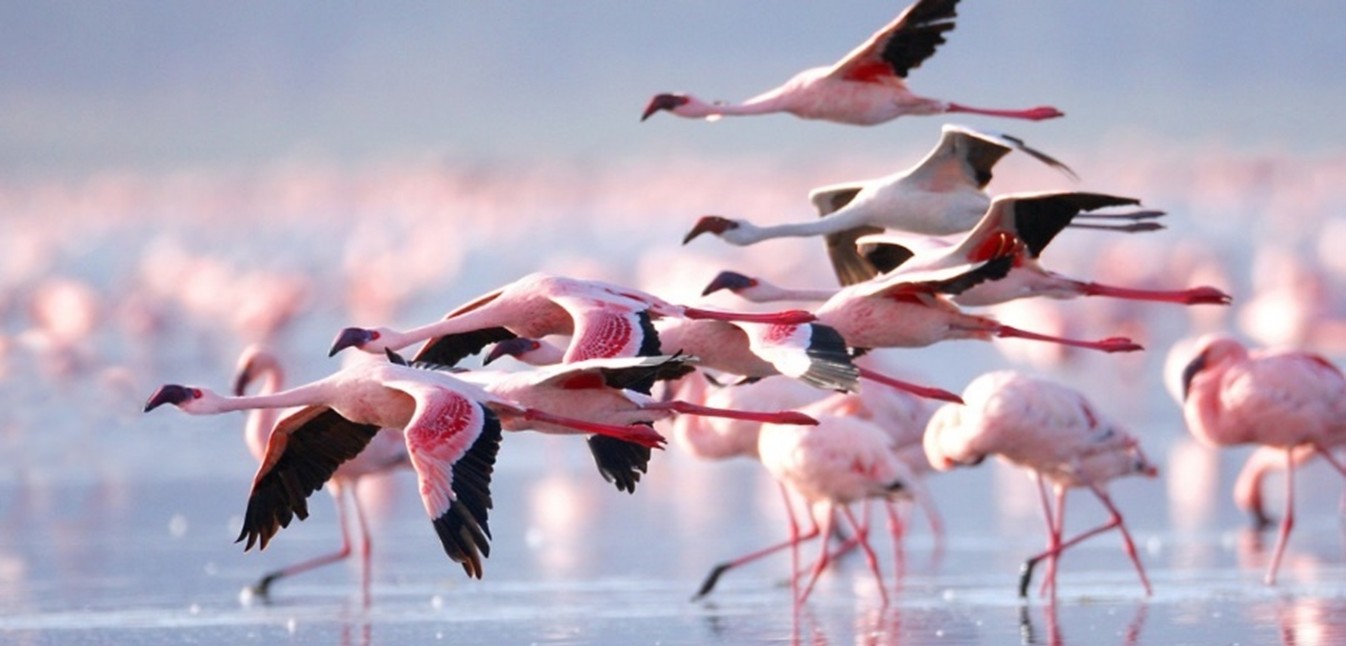
Occasionally, in response to a disturbance, a single bird would rise and hover, momentarily displaying the dramatic wing-feather colouration—a combination of pale pink orange, red and black. Then quickly select an alternate landing space, before folding its wings neatly, to disappear back into the colony once more.

Flamingos up close
Image: The Conversation

Having had our fill of lunch and flamingo capers, we continued on to Kisumu, Kenya’s largest port on Lake Victoria. There the Royal Mail Ship (RMS) Victoria was waiting to take us on a two-and-a-half-day clockwise circuit of the lake. We were to visit the ports of Musoma, Mwanza and Bukoba in Tanzania and Entebbe, Kampala and Jinja in Uganda before returning to Kisumu.

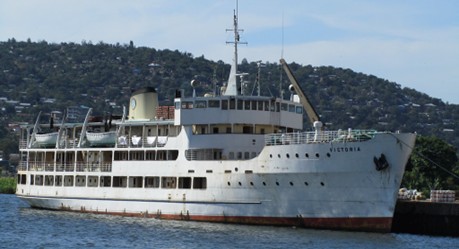
RMS Victoria berthed on Lake Victoria
Image: Wikipedia Commons

The RMS Victoria was impressive—a sparkling white ferry designed to carry both passengers and cargo. We boarded and were shown to our cabins. Shortly after departing Kisumu, high tea was served in the first-class saloon followed sometime later by dinner in the first-class dining room.                                 

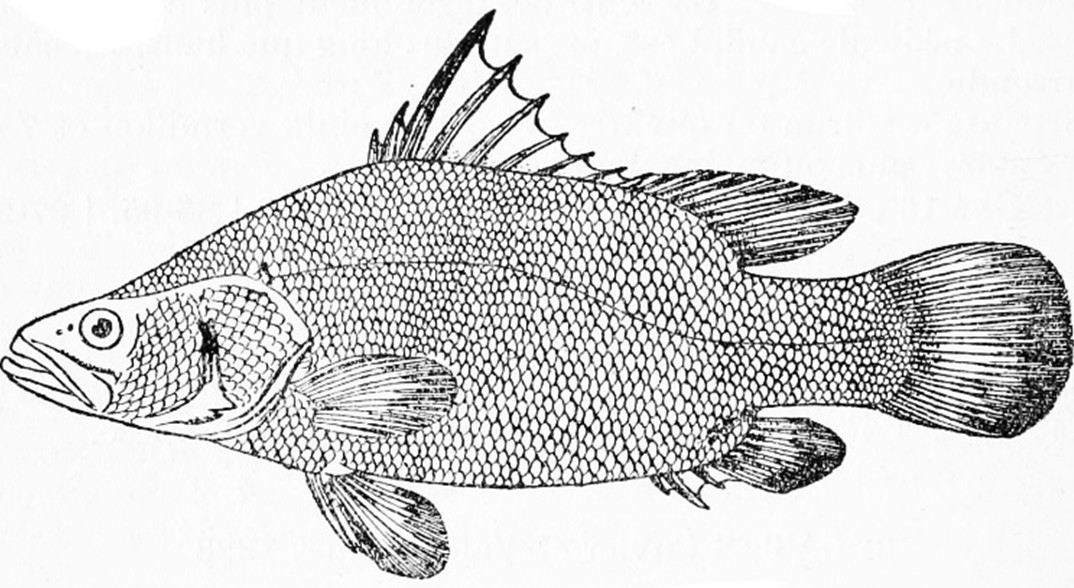
My father, an unapologetic gastronome, had been enthusing about Nile Perch on and off since we left Nairobi. He described how much he was going to enjoy eating it freshly caught from the waters of Lake Victoria. He didn’t have long to wait, as it was served at dinner. It was my first taste of Nile Perch and it was delicious. Both beautifully fresh and perfectly cooked.

Nile Perch
Image: Wikipedia.org

During the passenger briefing, we were told that we could go ashore whilst the ferry was docked in any of the ports we’d be visiting. By morning of the second day, I’d fully explored the ferry and was ready for a change of scene. In the interim, I’d befriended a group of people from India, known as Asians in Africa, also travelling first class.

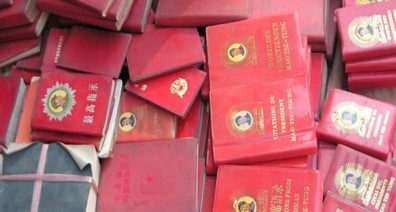
When we arrived at the Tanzanian lake port of Mwanza, my new friends invited me to go ashore with them. My father agreed. No doubt thankful that other people were offering to entertain me, giving him space for an afternoon nap. We walked down the gangplank onto the wharf, and headed towards the town centre. I was startled to see multiple copies of Mao’s Little Red Book, translated into both Swahili and English, for sale on the footpaths.

Mao's Little Red Books for sale on the streets of Mwanza Tanzania
Image: The Conversation

As we strolled slowly back to the ferry, we were confronted by a young soldier babbling loudly at me in Swahili at the same time waving his AK-47 assault rifle. I had no idea what he was saying, but my Asian friends did. They immediately responded by surrounding me protectively, at the same time increasing walking speed to get me back to the ferry as quickly as possible. To this day I’ve no idea what I did to upset the soldier, but I was grateful to have avoided an ‘incident’. Yet another serving of delectable Nile Perch at dinner helped take my mind off this unexplainable confrontation.

When we awoke next morning, we were berthed at Bukoba, with loading and unloading well underway. This time, I had no intention of going ashore to explore because I was well aware we were still in Tanzania and the prospect of repeating my experience of the previous day, had little appeal. As we pulled away from the wharf, I was relieved to see Bukoba fading into the distance and even more relieved when we were told that we’d crossed the invisible borderline into Uganda.

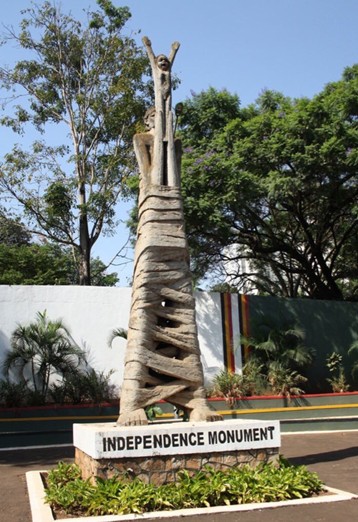
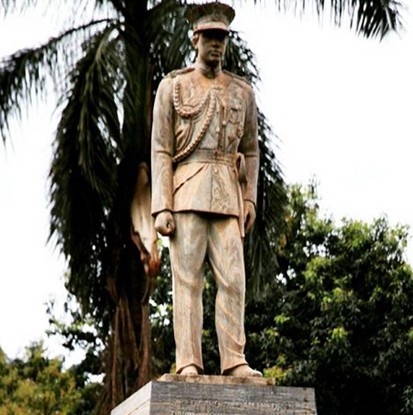
Next, we had a brief stop at Entebbe before arriving in Kampala, Uganda’s capital. Here my father and Alison persuaded me to accompany them into the city. My abiding memory of the visit was the towering Uganda Independence monument depicting a man raising a child to touch the sky and the smaller statue of Edward Mutesa the second of Buganda, the last King and first President of Uganda.

Independence monument Kampala Uganda
Image: Flickr

Statue of Edward Mutesa II of Buganda, the last King and first President of Uganda
Image: Wikimedia.org

We reboarded Victoria for the last leg of our lake adventure, and before long, arrived safely back in Kisumu.

We farewelled the crew, before climbing into the Toyota for the five-hour drive out of the Rift Valley, up onto the Nairobi plateau, and home. Enroute, we passed the time recounting the highlights of our adventure circumnavigating Lake Victoria, the water source of both the White and Blue Nile Rivers.

During my last week in Nairobi, my father raised the subject of my future. He began by asking what I planned to do when I returned to Sydney. I explained that now I had a Commercial Art Certificate from the National Art School, I was confident I’d find a job as a graphic designer in the buoyant economic climate Australia was enjoying at that time.

Without missing a beat, he swept my intentions aside, and said, “As you’re not gifted nor talented, when you return to Sydney, I suggest you go to the Metropolitan Business College to learn shorthand, typing and bookkeeping.” I was stunned beyond words. My father had taken the wind out of my sails. When I’d recovered sufficiently to think straight, I gave his proposition serious thought. As he was prepared to support me for another year I decided it’d be best to put my bruised ego aside, whilst I completed a secretarial course. And comfort myself in the knowledge that the skills I acquired would always be useful.

That settled, the next heart-to-heart was about money.

My father asked me how I was spending my allowance. I explained I was paying rent, buying clothes, shoes and matching gloves determined to maintain my Jackie Kennedy look-alike image, that of stylish simplicity. Unimpressed, he suggested setting up a compulsory savings account, instead of frittering away all of his generous monthly contribution. The savings would be released on my twenty-first birthday, some eleven months away. I reluctantly agreed, at the same time toying with the idea of finding an evening waitressing job to make up the financial shortfall, when I got back to Sydney.

I left Nairobi in late January 1969 with my pre-Christmas plans of finding an art-related job on my return to Sydney, in total disarray. 


ON REFLECTION:
My father: For my super-intelligent, electrical engineer father, both of his children were an abiding disappointment. My brother who was twelve years older than I, showed no signs of academic excellence. Because of this, I was my father’s last chance to fulfil his forever unfulfilled forever dream, to study medicine and become a doctor. Unfortunately, I lacked the scientific aptitude necessary. Besides which, my interests lay elsewhere.

For many years, I wondered how my father concluded I was, “not gifted nor talented”.

Between 1959 and 1967, I‘d seen him twice for an hour or so each time. He’d expressed no interest in my artwork or the content of my training at the National Art School, so I wondered how he could know I lacked talent. My heart ached as I considered my father’s comments in the days before I left Nairobi to return to Sydney. My confidence had been seriously undermined and my feelings were swinging wildly between acceptance and resentment. This demoralising incident and its aftermath marked the beginning of the end of our rocky relationship. But the final blow was yet to come. I’d be disinherited. But I’m getting ahead of myself.

FACTS:
Flamingos: flamingo chicks are born with grey feathers, which gradually turn pink with the ingestion of canthaxanthin, a natural dye obtained from their diet of brine shrimp and blue-green algae. Flamingo numbers explode in the rainy season, between November and May, when there’s plenty of food. But in drier months, especially during droughts, flocks move north to Lake Bogoria where flamingos are observed year-round.

RMS Victoria: was commissioned in 1961. She carried 230 passengers, 200 tons of freight and had refrigeration for perishable cargo. As she was twice as fast as her predecessor, she halved the circuit time to two and a half days, thereby enabling her to serve all Lake Victoria ports twice a week.

RMS Victoria’s vital statistics: 80m long, 12m wide, 4m draught, twin screws, diesel powered, 1500 tons empty.

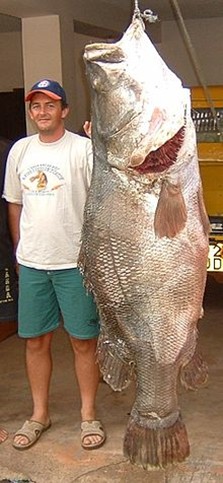
Nile Perch: is a predatory fish species introduced into Lake Victoria in the 1950s to boost the fishing industry. The fish can grow up to two meters and weigh up to 200 kg.

The introduction of Nile perch produced a welcome economic boom, but there was a down side. As a result, Cichlids, a native fish species, was taken to the brink of extinction.

A huge Nile perch and the fisherman who caught it
Image: Wikipedia

Tanzania in the 1960s: Prime Minister Julius Nyerere, who later became President of Tanzania, had a close relationship with the Peoples Republic of China, explaining why copies of Mao’s Thoughts were for sale in Mwanza.

https://en.wikipedia.org/wiki/History_of_Tanzania

Tertiary education for Australian women: In the late 1960s, few Australian women attended university. Instead, they were encouraged to train as nurses, teachers or secretaries.

Back to Chapter Menu

Not a Still Life | Portrait of an Artist

Chapter 29: Entertaining in style

As my Christmas holiday in Nairobi continued, my father and Alison announced that they would be hosting a dinner party at the house the following Saturday night. I had no idea what was involved or what part I was to play in it, if any, but it wasn’t long before I found out.

The guest list was discussed, and for my benefit, each invitee was described in detail. But a pall of disappointment descended when I realised that they were all ‘oldies’, not one of them was in my age group. I knew immediately that it’d be yet another Nairobi dinner party where, out of a sense of duty I felt obliged to feign interest in boring subjects with insincere nods and phony smiles. At each gathering, I’d noticed that the ‘over dinner’ conversations I had with my fellow invitees, became less and less coherent as more and more alcohol was consumed.

Here, dinner party planning was controlled from ‘command central’— Alison’s antique writing bureau. From the bureau came the blue hardcover ‘dinner party’ book recording the details of every previous dinner party they’d hosted together. The pages contained the names of the invitees, the menu, the wines served with each course and the date. This information was vital because, if any of the dinner party elements were spotted being repeated, it’d reflect badly on Grainger dinner party design. And loss of face was to be avoided at all costs.

My father and Alison discussed the menu at length. Once it was finalised, my father then matched his cellar wines with each course to be served: soup, entrée, main course and dessert. Forward planning gave Alison and Mareba, their domestic servant, plenty of time to shop and cook whatever could be prepared ahead of time. This was important to minimise the possibility of a culinary disaster on the night.

The Saturday morning of the dinner party dawned bright and clear. After breakfast, the house went into overdrive with the main focus being the dining room. 

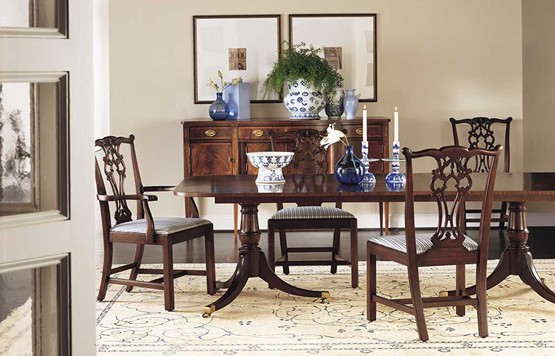
Chippendale dining suite with sideboard similar to my father’s
Image: Flickr

This was an elevated space, with a highly polished timber floor, situated between the living room and the kitchen, two steps up from each. These steps required care and concentration to negotiate, both upwards and downwards. They were particularly tricky for Mareba, too. Each day, in response to a tinkling bell, Mareba brought numerous hot dishes to the table with poise and gravitas, always dressed immaculately in a white monkey suit, topped off with a red fez with a black tassel and white sandshoes.

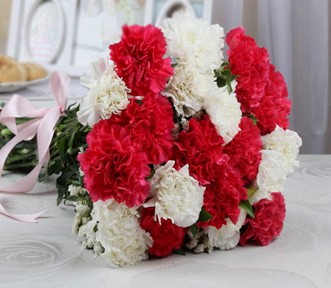
My father and Alison had a splendid Chippendale dining suite that seated eight with a matching Chippendale sideboard. On the sideboard, between a pair of three-armed silver candelabra, there was always a spherical crystal vase, holding long-stemmed red and white carnations. The carnations matched the rich red and cream colours of the patterned Persian carpet on which stood the antique table and chairs. Fresh carnations and candles materialised for the dinner party.

Red and white carnations for the sideboard
Image: Flowersacrossindia.com

The sideboard contained all the fancy trappings for this gastronomic extravaganza. The porcelain dinner set, crystal drinkware, sterling silver cutlery, cruet sets, vases for the smaller floral table arrangements and the other paraphernalia necessary to complete the table setting. Earlier in the week, Mareba had carefully polished, rinsed and dried all the silver needed for the gathering.

The final task was to set the table. But before this could happen the perfectly laundered, starched and ironed linen tablecloth was unfolded and smoothed out on top of a 2cm thick underlay of dense woollen felt—cut to the exact size of the tabletop. With my father supervising, the tablecloth was tugged gently this way and that to ensure even overhang on all sides after which the folds were ironed out of the tablecloth, the felt pad protecting the antique table surface from the heat. Now that the pristine white tablecloth was perfectly creaseless, table setting could begin.

Throughout the dinner party preparations, I felt like a spare wheel. I wasn’t asked to contribute in any way. I was simply an observer whilst a set of sequential tasks was conducted around me with the precision of a carefully choreographed dance. It was unlike anything I’d ever experienced. Before visiting my father and Alison, my ‘at home’ dinner party exposure was quite limited. My mother, a single woman living and working in the New Guinea highlands was often invited out to dinner by blokes, keen to be in the company of an attractive, intelligent, and amusing single woman in a country where they were in short supply. As a result, I had little dinner party modelling on which to draw on.

All was in readiness for the guests and we were suitably dressed up to greet them. Surprisingly, my father and Alison displayed no outward signs of the hours of hard slog they had put into preparing for the gathering. 

My father had devised a clever ploy to deliver his guests to the dining table sufficiently sober to appreciate Alison’s cooking. To do this he needed to limit their intake of alcoholic spirit, the favoured pre-dinner tipple of many Anglo expatriates, in Africa. His was a sherry offensive. With a flourish, he wheeled in a drinks trolley loaded with forty different sherries, or so he said, sourced from wineries across the world. He would then deliver a rehearsed spiel, briefly describing each fortified wine on offer sweet, medium and dry. His guests, so enthralled with his performance, would acquiesce and choose a sherry rather than their customary sundowner of brandy, whisky or gin. I was told it worked every time. And it did.

The dinner party was a great success and the food magnificent, as Alison was an exceptional cook. The wines were delicious and the company interesting, despite my earlier misgivings. Yes, the guests were middle-aged or older, but not at all boring.

Next morning when the house had returned to normal, we conducted a systematic dinner party debrief over a welcome cup of tea after which Alison added the details of this gathering to her ‘dinner party’ book.

ON REFLECTION:
The damask tablecloth: all these decades later, my memory of my father ironing the tablecloth on the table stays with me. At the time, I was conflicted. Both astounded and at the same time scathing, as I watched the care with which my father prepared the tablecloth for the dinner party. His attention to detail was breathtaking and his performance was a revelation for which I’m eternally grateful. I’ve whole-heartedly adopted his modus operandi in my own career, producing cutting edge artwork in which every aspect of the work is considered—the content, the aesthetics, the construction, and the problem-solving necessary, when breaking new ground. Like my father, I overlook nothing, and I wonder if this could be considered an example of the apple not falling far from the tree?

Sherry: in retrospect, my father’s success in controlling his guest’s intake of pre-dinner alcohol was yet another example of his need to control his environment and those in it. His, ‘my way or the highway’ credo, enabled him to justify his decisions, irrespective of dissent.  It gradually dawned on me that I was sitting on a time bomb.

Dinner parties: Since 1969 Nairobi, I’ve come to realise that throwing dinner parties was a prerequisite for middle-class, Australian couples, both before and after children. Shortly after I partnered, I bought a terrace house which we completely renovated, including a tiny dining room. I then furnished it with an oval, single pedestal, cedar dining table and six balloon-backed cedar chairs. Now, with a flash dining room, we too succumbed to societal pressure and began holding dinner parties. Like my father and Alison, activity began early on Saturday morning with fresh food shopping at the market, cleaning the house and preparing the various courses, but without the help of servants. As a result, by the time the guests arrived I was exhausted. After a couple of drinks, I found it difficult to sustain the role of a perfect hostess and serve the various courses I’d sweated blood preparing. I just wanted to go to sleep. When the relationship faltered and finally failed, I was thankful to leave the ‘dinner party’ ritual behind. After which I promised myself, I’d never cook again. I planned to express my creativity in other, more long-lasting ways.

Back to Chapter Menu

Not a Still Life | Portrait of an Artist

Chapter 28: Food glorious food

Hurrah, hurrah! At last, it was over. I was awash with feelings of relief and self-satisfaction as I’d successfully completed three years full-time study at the National Art School, considered one of the best art schools in Australia at the time.

I was super-excited to roll on to my next social commitment: a second Nairobi Christmas with my father, and his second wife, Alison. After Christmas, I’d return to Australia to concentrate on finding a job. In the meantime, I knew there were adventures of all kinds to be had on the other side of the Indian Ocean.

On my first visit, I’d sussed out the lay of the land, and was determined to make the most of what Nairobi had to offer. Of particular interest were the many skilled Asian tailors in the city who, for next to nothing, could make anything including stylish safari suits with masses of flap pockets. At the time, these outfits were the epitome of stylish casual wear, for both men and fashion-conscious women. With safari suit fantasies uppermost in my mind, before I left Sydney, I drew on my mother’s textile manufacturing contacts to source lengths of the perfect weight fabric in beige and rust for two outfits comprising a jacket and long trousers. Now, I was all set.

Like last time, the long Sydney to Nairobi journey was broken in Mauritius. This is where all Kenya-bound Qantas passengers spent an idyllic couple of days at a beachside resort, whilst awaiting the connecting BOAC flight from London. So hard to take! When I arrived at Nairobi airport, I was met by my father and Alison who I sensed, were bracing themselves for another six weeks of 24/7 with a passive-aggressive 20 year old who knew everything.

I seamlessly settled back into their household, as the weekly domestic routine hadn’t changed since my last visit. I was particularly pleased to return to the privacy of the guest bedroom, with its ensuite bathroom. As burglary was a concern, security was maintained with steel bars on all the windows. Also, both the impressive front door and the double doors to the sleeping wing, had a heavy steel bar that was swung into place at night, just before we retired. This was in marked contrast to the home security, or lack of it, I’d experienced in the New Guinea highlands, where my mother lived. There, the back door was left open at night for the cat to come and go. Here in Nairobi, the gulf between the rich and the poor, was undeniable, so, resentment of expatriates was thinly disguised.

I already knew my fun American friend, Mary Jamieson, was no longer living in Nairobi because she’d written to say her father had been transferred to Rio de Janeiro with the Library of Congress. As a result, Jamieson’s party central was gone. Sad, as Mary and her circle of friends, mostly young Peace Corps volunteers, were great company as they made the most of their opportunity to spend a couple of years living and working in East Africa. And they all had great stories to tell. Most taught English, as there was an insatiable demand to master the language of Kenya’s recently departed colonisers: the British.

Sadder still was the news that my special friend Tim Jansen, of infant baboon fame, had taken his own life. He’d been studying in Lucerne, Switzerland and was part way through a medical degree. I’d not kept in regular touch, because I wasn’t much of a letter writer. Also, shortly after I returned to Australia to complete my art studies, he’d taken up with the Australian Ambassador’s daughter and I didn’t want to get in the way. Tim’s demise created a pall of sadness that lingered for the remainder of my stay.

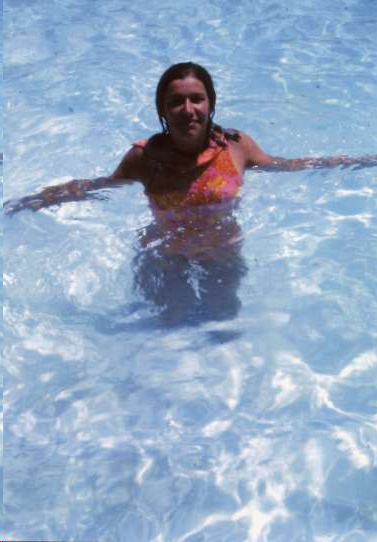
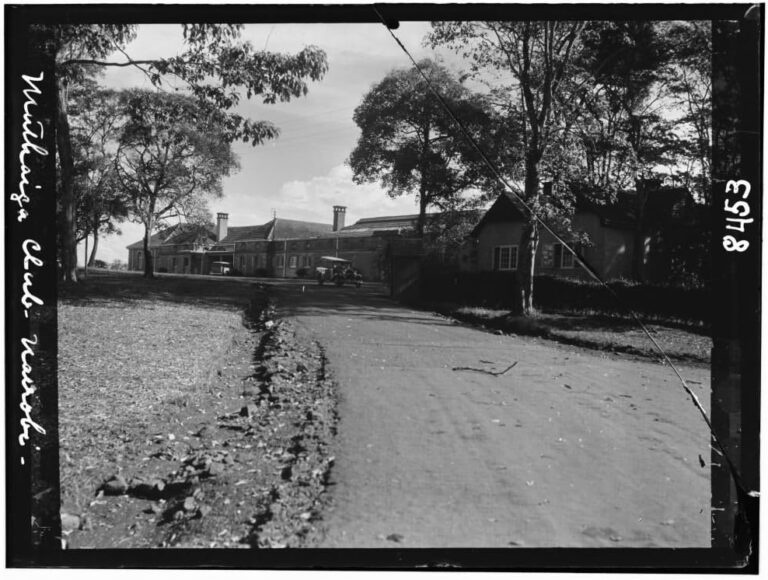
With all of my American playmates gone, I was thrown back into the company of my father and Alison though, I often managed to escape to the Muthaiga Country Club pool. The pool gave me somewhere to go and provided a modicum of relief from the underlying hostility that occasionally bubbled to the surface in interactions with my father. Disagreements that Alison managed with dexterity and grace.

Socially things began to look up. My little black cocktail dress came into its own again and it was deemed suitable to wear to a performance of ‘The Boyfriend’ at the Donovan Maule Repertory Theatre, the cultural heart of Nairobi.

We arrived in time to enjoy a delicious dinner before the show, a first for me, as none of the Sydney theatres I sometimes frequented, offered dinner before the performance. At interval, I was introduced to a recently married Sikh couple, Sheila and Rag Mahajan, who, once they were made aware of my deep appreciation of fabric and fashion, invited me to visit their house to see Sheila’s wedding saris and jewellery, followed by Punjabi lunch. I welcomed their invitation with undisguised enthusiasm.

The Mahajan’s rambling, wooden house was in a less posh neighbourhood of Nairobi, with mainly Asian residents. Once inside, Sheila’s saris didn’t disappoint in either quality or quantity. They were completely amazing. Many were traditional, with lots of gold and silver thread embellishment woven at one end and along the selvedges.

And there was more. Trunks full of psychedelic print saris, all with a matching choli top that were the acme of fashion for Asian women at the time. I gasped involuntarily as each sari length was carefully unfolded, to reveal the exquisite artistry and craftsmanship from the Indian sub-continent. It seemed that each one was more beautiful than the last. I was in heaven, surrounded by exotic textiles. 

Gold Punjabi wedding jewellery
Image: unknown

Next, Sheila showed me her exquisitely crafted gold and silver jewellery. Sets of bangles for both wrists and ankles, rings for fingers and toes, earrings, hair and forehead decoration, necklaces, chains linking nose piercing to ear and the ‘piece de resistance’, the waist chain belt, worn over the sari. My mind was blown. I’d never seen so much gold and silver in one place in my life and probably never would again. This collection of jewellery represented serious wealth.

I recovered sufficiently to think about lunch. I was surprised to notice I’d worked up an appetite, doing nothing more than unpacking and repacking trunksful of saris. Whilst waiting in the living room for lunch to be served, on the mantelpiece above the fireplace, I noticed numerous framed photographs of fierce-looking military men. The Mahajan’s were obviously a proud military family as there were photographs of the 52nd Sikh Regiment of the British Indian Army, as well as individual photographs of relatives in uniform.

52nd Sikh Regiment at Kohat North West Province 1905
Image: Wikipedia

Punjabi thali—traditionally offers the flavours of sweet, salt, bitter, sour astringent and spicy served on a shiny metal tray
Image: Flikr

I didn’t have to wait for too long before lunch was brought to the table by an elderly Asian woman. It was presented on a thali tray, that held a complete meal served in individual bowls. Each bowl containing a small serving of spicy north Indian dishes, plus rice and naan bread. And I ate alone. This was my first brush with Asian dining customs, or a thali meal, or chili.

No long after, Alison came to pick me up.  I was in a state of total overwhelm, both artistically and gastronomically, with my mouth remaining slightly numb for some hours afterwards, the result of my first encounter with chili.

Not long after my thali experience, I was given yet another unforgettable dining experience.  This time, it was a formal dinner party at my father and Alison’s house and I wondered if the Mahajan’s would be invited.

ON REFLECTION:
Tim Jansen: I wanted to know why Tim decided to take his own life. Did his early childhood experiences in a German orphanage play a part? He never spoke about it. In our conversations, he mostly focussed on his numerous, unusual post-adoption adventures.  Tim’s obvious sensitivity, as evidenced by the adoption and care of the orphaned infant baboon, possibly hinted at needs in his own life? Needs that may not have been met whilst living on his own in Switzerland. But I’d never know.

Return hospitality: the Mahajan’s weren’t invited to dinner at my father’s house whilst I was staying with him, or afterwards to my knowledge. I’d like to give him the benefit of the doubt, but in Kenya, the societal constraints of colonial social stratification lingered. Maybe their dietary differences were too difficult to deal with? Another snag was that Sikhs don’t consume intoxicants, including alcohol. Pre-dinner drinks and numerous matching wines with the meal were ‘de rigueur’ at my father’s table. Or was it that the Mahajan’s were considered ‘lesser’ socially? They were undoubtedly richer. I wonder if my father’s decision to exclude them was evidence of a lingering racial divide? I didn’t have the answers, only the questions.

Rag Mahajan: In late 1969 Rag Mahajan came to Sydney to sell rare Makonde carvings he had sourced from Tanzania. He based himself at Kings Cross. I took him to see the smash hit musical, ‘Hair’ at the Metro Theatre, just around the corner from his hotel. Afterwards he asked me to spend the night with him. What a question! I was lost for words and left immediately. His wife, Sheila, was my friend. Perhaps the nudity in the musical, and the apparent permissiveness of life in inner-city Sydney, prompted him to ask?

Exquisite examples of vintage Makonde carved figures form Tanzania
Image: bay,com.au

FACTS:
The Donovan Maule Repertory Theatre, Nairobi: was then owned and run by thespians Donavan Maule and his wife Mollie. They began performing in 1949, then built a new theatre in 1958. They produced plays and also hosted touring repertory companies performing popular plays from London’s West End, as well as short run operas and ballets. They brought British culture to this far-flung outpost, where many British expatriates craved a connection to ‘home’.

https://oldafricamagazine.com/the-donovan-maule-theatre/

Asians, people from the Indian sub-continent, in Kenya: Portuguese sailors encountered Asian merchants along the coast of East Africa in the late 15th century. The Uganda railway linking Uganda’s capital Kampala to Mombasa via Nairobi, was completed in 1901. It’d been built by 32,000 indentured Asian labourers. The railway was the conduit that opened the East African interior to Asian traders. The Mahajans were one of the many Punjabi families that remained or who chose to migrate to East Africa to take advantage of the commercial possibilities on offer.

Thali: As my interest in food from other cultures developed, I came to understand the thali meal offers six different flavours — sweet, salt, bitter, sour, astringent and spicy — a collection of taste sensations on a single plate. Small bowls contained dahl, brinjal, potato curry, raita, vegetables, papad, pickle, chutney, most laced with chilli, plus a larger bowl of saffron rice and folded chapattis. A feast.

Back to Chapter Menu

Not a Still Life | Portrait of an Artist

Chapter 27: Riding the rapids

Once again, it was time for me to return to New Guinea for a couple of weeks holiday. This was to be my last visit, or so I thought, as I was one term shy of completing my National Art School studies. I could see the end in sight and was chomping at the bit to get out into the real world to get a real job and earn real money. It wasn’t a pipe dream because this was a time of full employment and as a freshly graduated art school-trained commercial artist, I knew I’d have a choice of employment opportunities.

As always, my mother looked forward to my return to Goroka. For her, my frequent visits were a sanity-saving exercise, due to the insidious effect Highland isolation was having on her mental health even though she had plenty of male company, due to the chronic shortage of single expatriate women throughout New Guinea.

My mother’s job was very demanding. She was a fit healthy 53 year old, and an enthusiastic exponent of the Royal Canadian Air Force’s 5BX exercise regime, with its age-based, gradual progression rate. As well as her daily workout, she led a very active life, because the physical demands of her job were considerable. She was regularly climbing in and out of small aircraft to get to remote locations to teach spinning and weaving, in addition to the day-to-day management of the Wool Project’s twenty-six cells, scattered throughout the Highlands. A super-challenging remit for a one-woman-band, in a predominantly male environment, with some days more challenging than others.

To balance the intensity of her day job, my mother’s creative outlets included drawing and painting, with both oils and acrylics, sewing, and letter writing. She wrote to me regularly and also to friends. But her main focus was writing masterful letters, providing Wool Project updates and complaints in equal measure, to her boss at Trade and Industry’s Head Office in Port Moresby. I was told Head office loved receiving her letters.

Whilst living in Goroka, my mother met Jade Tripp, a well-respected portrait artist with a gift for likenesses. They clicked. They began painting together whenever they could and before long, decided to work towards holding a two-person art exhibition at the Goroka Hotel.

They painted up a storm in preparation for the show. A selection of landscapes, still life’s as well as portraits of be-feathered natives, and of each other. The exhibition centrepiece was Jade’s fabulous three-quarter portrait of my mother. I’d arrived back in Goroka just in time to help them hang the show.

Morley and a helper loading paintings for the Art show at the Goroka Hotel
Image: Grainger family photographs

Jade Tripp’s portrait of my mother, Gretchen Grainger painted in 1967
Image: Grainger family photographs

All of expatriate Goroka was invited to attend the opening. After a frantic day of hanging the artworks, in triple quick time, both artists were completely transformed. They emerged calm, coiffed and bejewelled, setting the tone for an unusually classy turnout for Goroka.

Lady Rachel Cleland, wife of the recently retired Administrator of Papua New Guinea, Sir Donald Cleland, had been invited to open the exhibition. After speeches and toasts, the paintings sold like hot cakes with red dots popping up all over the walls.

From left to right: Artist Gretchen Grainger, Lady Rachael Cleland and Artist Jade Tripp at the opening of their two-person art show held at the Goroka Hotel
Image: Grainger family photographs

This was a huge relief for both artists who had no idea how the good burgers of Goroka would respond to their artworks. The exhibition represented a huge investment of their time and talent plus the cost of framing. As it turned out, their idea had paid off on two counts. Firstly, it was a sell-out and secondly, the exhibition is recorded in the annals of memorable cultural events held in Goroka ‘in the time of the Europeans’.

A less cultural but possibly more fun event followed the art show. This was the annual ‘gumi’ race down the Asaro River early on Saturday morning.

Inner tubes from cars, trucks or large tractors were filled with air and loaded onto vehicles, including the roof of my mother’s mid-blue VW pickup truck. This truck had replaced the Karmann Ghia 1500S, which was now parked in Kirribilli, Sydney. The pickup truck was a reliable workhorse and much more suitable for the highland roads than a low-slung sports car and so much more practical for the Wool Project’s fetching and carrying.

My mother’s VW truck loaded with ‘gumis’ and racers headed for the Asaro River
Image: Grainger family photographs

Asaro River gumi race two racers aboard a tractor tyre tube
Image:backblazeb2.com

The ‘gumis’ and the racers were delivered to the starting line and later, picked up a couple of kilometres downstream. But getting to the finishing line wasn’t enough. At the end of the race, each inner tube had to be completely deflated, then fully submerged. If not, the racer was disqualified. Lastly, the soggy racers and their now floppy inner tubes, were loaded up onto the tray of the pickup truck for the drive back to town, where a slap-up celebration awaited the winner and all participants. Any excuse for a party.

Before I left Goroka, Jade Tripp made a completely unexpected but unforgettable contribution to my wardrobe. Her contribution was a knee-length, mink-dyed ‘lapin’ fur coat with dark brown leather trim at the neck, sleeves and down each side of the front closing. Jade had designed the coat and had it made by Cornelius Furs, the up-market furriers in Castlereagh Street, Sydney. But she wasn’t happy with the result. To my complete surprise, my mother offered to buy the coat for me to wear on my return to what was left of Sydney’s chilly winter. I was stoked.

Jade Tripp and Morley at Goroka airport
Image: Grainger family photographs

Morley wearing the mink dyed ‘lapin’ coat
Image: Grainger family photographs

As my time in Goroka wound down, a most surprising romantic interest developed. It took the form of a swashbuckling American helicopter pilot who specialised in high altitude external load operations. It was dangerous work, flying freight into inaccessible highland camps. He had an ‘Errol Flynn without the nasty bits’ quality about him, which I found so worldly and exciting. But my infatuation was short lived as I returned to Sydney to complete my last term at The National Art School. I was very focussed because I could see the end in sight.

But before I could launch myself into the world of paid work, I had been invited to spend the Christmas holidays with my father and his second wife who were living in Kenya. I was super-keen to visit them because I’d had such an amazing time on my first visit and I wondered what adventures they had planned this time around.


ON REFLECTION:
Recreational activities: were often quite limited for expatriates, mostly Australians, living in New Guinea. For Patrol officers, living an isolated life on outstations, reading and music were popular. Many in their early twenties, and mostly unmarried, usually had collection of books, a record player and a supply of long-playing vinyl records. Some also had imposing reel-to-reel tape recorders.

In larger centres like Goroka there were more out-of-work-time activities to choose from. Golf was a favourite. The Goroka Golf Club offered members the opportunity to combine two passions in one location: golf and alcohol consumption. Other sporty options included football and for the more adventurous, rock climbing and caving.

In smaller communities like Kundiawa, where my mother lived for a year or so before moving to Goroka, creative activities were often the brain child of an enthusiastic teacher, who’d brought some school production experience with them to their posting. Very occasionally a satirical playwright, or playwrights, would emerge. And so it was in Kundiawa. They regularly wrote hilarious topical plays and inspired community members to perform them, much to the delight of both the players and the audience, made up of all the expatriates within cooee who’d never miss a performance.

Mink-dyed ‘lapin’ coat: At the outset, I was thrilled with this coat. I couldn’t believe my good fortune, and it was the first and last fair-dinkum fur coat I’ve ever owned. I enjoyed swanning around in it impressing people, because not many of my contemporaries had a fur coat. But after a time, the novelty wore off and the coat remained hanging in the wardrobe for years.

August 1968: At the time, I knew this would be my last visit to Goroka. What I didn’t know was that I’d return once more before a break of 35 years.

Fast forward to 2007, when I returned to New Britain to spend two weeks in Vunamami village near Kokopo with my Tolai friend’s extended family. The experience was very different to the halcyon days of European control before Australia granted independence to Papua New Guinea in 1975.

FACTS:
Sir Donald Cleland: was Papua New Guinea’s Administrator from 1951 to 1957. Sir Donald and his wife chose to remain in Papua New Guinea after retiring. He was the country’s only former Administrator who did so. His wife, Lady Rachel Cleland, a trained early childhood teacher, was the driving force behind the introduction of pre-schools and pre-school education throughout Papua New Guinea.

Gumi: The word gummi n. German: rubber, gum, rubber band. The word was introduced into German New Guinea in the late 1880s. To this day, the word ‘gumi’ in Tok Pisin, describes anything made of rubber including condoms.

Back to Chapter Menu

Not a Still Life | Portrait of an Artist

Chapter 26: High altitude dancing

As the first term of my 3rd Year art studies at East Sydney Technical College drew to a close, the prospect of returning to New Guinea to visit my mother filled me with great excitement.

I put my Sydney life on hold once again, and flew out to Port Moresby, then on to Goroka, for two and a-bit weeks in “the land that time forgot”, to quote author Edgar Rice Burroughs. This quote reflected the perception many held that New Guinea was a pre-historic world; a land of fiery volcanoes, earth tremors and head hunters. The only thing missing were the dinosaurs.

But to get serious, I arrived in Goroka just in time to help put the finishing touches to my mother’s Wool Project display for the 1968 Goroka Show. We were now old hands at this ‘show’ business caper, following the Wool Project’s first and hugely successful appearance at the Mount Hagen Show in 1965. Since then, the Mount Hagen and Goroka Show committees had decided, that instead of competing for the tourist dollar, they’d take turns to host their shows year and year about. Mt Hagen taking the ‘odd’ years and Goroka the ‘evens’.

After the Wool Project had taken the Hagen Show by storm, the thrill had gone out of it for us. Now it was all a bit ‘ho, hum’, although the weavers still got a kick out of dressing up in traditional tribal costume, to demonstrate their weaving skills for all to see and for tourists to photograph. In four years, the Wool Project had become a Department of Trade and Industry success story. Handpicked groups of local tribesmen had been taught to spin and weave, and with design guidance, produced very saleable items. The income from which, in time, would be taxable.

The Wool Project was now well established at the Goroka Showground since the unusual uplift out of Kundiawa by Caribou aircraft, back in early 1967. The looms, spinning wheels and yarns were now housed in a very large circular hut made of bush materials with a thatched roof. The final touch was a recently added snazzy, hand painted ‘Wool Project’ sign hanging above the door. As a result, setting up for the thousands of people who were expected to make their way to Goroka for the ‘spectacle of a lifetime’ was a synch because we didn’t have to travel. The spinners and weavers had been busy, as evidenced by the piles of stock in the storeroom. Raw fleece and hand spun, cream wool floor rugs were in high demand, as were single bed size woollen blankets and ponchos, designed by my mother who made the most of the mill-spun woollen yarns, often mill ends, that arrived regularly from Australia, thanks to her contacts in textile manufacturing. Each item had been scoured, pressed, folded and individually packed into a clear plastic bag, with the wording ‘Hand Woven in New Guinea’, printed on both sides in big, bold, black capital letters. We were now ready for the buyer tsunami we were expecting, because the Wool Project had quickly developed a reputation for stylish, quality products. Because of this, the shows were always a sell-out, with additional orders taken, guaranteeing work for the weavers, long after the show weekend was over.

On Saturday morning, day one of the Goroka Show, the floodgates opened, and in rushed 50,000 warriors wearing full traditional dress, and two thousand tourists, including film crews and journalists, who’d arrived from all over New Guinea and beyond, on all kinds of chartered aircraft.

The Show’s official opening, provided a platform for the colonial overlords to bestow a modicum of pomp and ceremony on the formalities. This was in sharp contrast to the Highlanders watching the proceedings, who’d been practising their ritual ceremonies for thousands of years. The official opening speech was always delivered by an important European, in English, a language unintelligible to the majority of the crowd. The tribal dancers waited patiently for the formalities to conclude so they could dance for the judges.  Each group keen strut their stuff and win first prize. 

Goroka Show in the 1960s
Image: Stan Moriarty

Goroka Show in the 1960s
Image: Stan Moriarty

On Saturday night there was the much-anticipated Show Ball. The ball was an excuse for expatriates to dress up and have a ‘good time’ doing their own style of dancing with a partner, if they had one. Otherwise, it was an opportunity to drink, and drink some more, in true Territorian style. There was always live music at the Show Ball, provided by a band brought in for the evening, either from a larger centre or from Australia.

Sunday was recovery day. Most Europeans were hung over so things moved slowly. By afternoon, it was time to break camp at the show ground, with the patrol officers, known as kiaps, preparing to take their people back to their villages. For the Wool Project it was easy. At closing time, we simply locked the door of the ‘haus blanket’ and headed home exhausted, and glad it was all over.

Some days later, Jim Leahy, patriarch of the post War Leahy and Collins Highland clan, approached my mother. Jim owned and ran ‘Erindale’, a successful coffee plantation and mixed farm on the Highlands Highway not far west of Goroka. As part of his livestock mix, he had a small flock of Romney Marsh sheep that needed shearing. He asked if the Wool Project would be interested in the fleece. After inspecting the sheep, my mother agreed to take it, once the sheep had been shorn. The tricky bit would be finding a shearing machine and a shearer in this remote part of the world.

The obvious place to start making enquiries was with the Department of Agriculture Stock and Fisheries. If any department would know of a shearing machine and a shearer within cooee, they would. And they did! Someone remembered an electric shearing machine stored in a shed somewhere. And an agricultural officer, known in the lingo as a ‘didiman’ from western Queensland, put up his hand to do the shearing. We were all set.

Erindale’ farm workers and yarded sheep with full wool near Goroka
Image: Grainger family photographs

On the appointed day and time, we assembled at ‘Erindale’. Jim had the shearing machine set up in his shed and the sheep were dry and yarded under cover. I can’t recall how many head were shorn that day. But the job was made so much easier because, on the day, two ‘didiman’ shearers turned up instead of one. I was appointed roustabout. My job was to sweep the ‘board’, a slab of concrete in this shed, collect and skirt the fleece on a makeshift table, before baling each one.

Nameless Agricultural Officer shearing on ‘Erindale’
Image: Grainger family photographs

Another nameless Agricultural Officer shearing ‘Erindale’ sheep with an audience
Image: Grainger family photographs

When the shearing was done, Jim Leahy said to me, “Hey, pikinini blo Misis Blanket, I didn’t think you’d be much good [working] here today. You surprised me.” High praise indeed from the Leahy patriarch. But, my mother’s dealings with Jim weren’t over yet. Some months after shearing, Jim Leahy put a business proposition to my mother, in an attempt to lure her away from Trade and Industry, and ‘commercialise’ the Wool Project. As I recall, my mother was flattered. His enquiry was an acknowledgement of her creative thought and effort exerted to successfully introduce textile skills into the Highlands. My mother gave the proposition due consideration but decided to decline the offer, as the freedom and perks that came from working for the New Guinea Administration, far outweighed the prospect of having to start all over again.

After a couple of weeks of fun in the Highlands, I could hear Art School calling me once more. But before I returned to Australia, my mother floated an offbeat idea for my consideration. Well aware of my interest in social anthropology, she suggested I think about doing a social anthropology degree at the University of Papua New Guinea after I’d completed my art studies. I dismissed her suggestion out of hand because I’d had more than enough of study. All I wanted to do was finish my Commercial Art Certificate qualification and find a job in advertising or industry. Time would tell what the future held.


ON REFLECTION:
Jim Leahy: Patriarch Jim Leahy’s mis-assessment of my effectiveness in his shearing shed, didn’t surprise me. Clearly, he wasn’t accustomed to a self-motivated, hardworking and efficient young white woman in the shearing shed or anywhere else. I understand his time was taken up guiding the gaggle of nephews he’d encouraged to come to New Guinea in search of commercial opportunities, which could possibly explain his comment.

Social anthropology: My mother’s suggestion that I consider further study at the University of Papua New Guinea, was a perceptive one. I was first exposed to aspects of anthropology when we first arrived in New Guinea, and later, archaeology and palaeontology, whilst visiting my father in Africa. Yes, I was fascinated by all three sciences, but not sufficiently to commit to more years of study, even though the thought of returning to New Guinea permanently, had considerable appeal.

FACTS:
Edgar Rice Burroughs: was a prolific American writer. He wrote the ‘Tarzan’ books, many of which were made into movies. I remember seeing Tarzan movies at the Saturday afternoon flicks when I was kid.
https://en.wikipedia.org/wiki/Edgar_Rice_Burroughs

Goroka Show: Most tourists arrived by chartered aircraft, as the Highland roads were often impassable. Over the Show weekend, the airstrip was lined on both sides with aircraft, parked wing tip to wing tip. DC3s: Beechcrafts: all the Cessnas models: Piaggios and Twin Otters. This assortment of big and small aircraft, was indicative of New Guinea’s dependence on air transport for both passengers and freight.

Chartered DC3s parked on the Goroka strip for the 1968 Goroka Show
Image: TAA Museum

Back to Chapter Menu

Not a Still Life | Portrait of an Artist

Chapter 25: The ties that bind

It was early in 1968. I’d returned to Sydney, after spending Christmas in Kenya with my father and his second wife. Re-entry was strange in many ways and yet familiar. I was brimful of my East African experiences and eager to share them. But there was a more pressing need. The need to swiftly re-focus and prepare for my third and final year at the National Art School’s East Sydney Technical College Campus in Darlinghurst. I was nineteen and exuded confidence.

National Art School main entrance note the faint ‘technical college’ wording can just be seen above the door
Image: euroclima

For my last year of study, I chose to return to ‘Tremayne’, the YWCA hostel for young ladies at Kirribilli, because the facilities, particularly my ground floor single room suited me perfectly. Yet another advantage was that travel to East Sydney Tech was relatively straightforward. A train from Milson’s Point to the city, then a bus up Oxford Street to Taylor Square, where I got off at the Forbes Street corner, carrying all the gear needed for the day’s classes. From there, I walked down past the police station, to enter the imposing sandstone gates, of what was once the largest gaol in the colony of New South Wales. The convicts built their own gaol, using Sydney sandstone. The now repurposed buildings, pulsated with vitality and energy applied to creative pursuits, both legal and illegal.

Artists have the reputation for living life in the fast lane and my cohort was no different. They were chockful of youthful certainty and the conviction that they were in complete control of all pleasurable substances. That is, until they weren’t, by which time it was often too late. At the time, I was smoking forty tailor-made cigarettes a day. But, from somewhere deep inside the recesses of my conscious mind, came the realisation that if I had a problem with nicotine, I’d likely have one with any other substance, no matter how innocuous it may have seemed at the outset. As a result, I kept well away from everything even though there was plenty on offer to drink, to smoke and even to inject.

Students taking a break in the grounds of the East Sydney campus of the National Art School in the 1960s
Image: pinterest.com

Third year at the National Art School was the year that formative career decisions were to be carried through. Each of my classmates from Randwick Tech had already decided on his or her future artistic direction. On offer, was the diploma of Fine Art, for those wanting to become career ‘painters’ or ‘sculptors’ or ‘ceramicists’, requiring three additional years of full-time study. The alternative, was the Commercial Art certificate course, only requiring one additional year of study. This was perfect for the likes of me, unlikely to rise to the top in any of the traditional disciplines I’d been exposed to, to date, as part of my art training. In my time, textiles or multi-media studies, weren’t on offer at the National Art School. That exciting adventure would come later, when I had the chance to study in Mexico. But I’m getting ahead of myself.

It was strange being on the East Sydney Technical College campus again, this time as a student. I already knew my way around the grounds, because my mother had taught hand weaving and textile design there, for many years. Her students were destined to find work in Australia’s textile manufacturing sector, a sector that was thriving at the time. My father and I would meet my mother after class on Friday afternoons, to eat out. This was our end of the working week family tradition. The Baltican was our restaurant of choice, located within walking distance of East Sydney Tech. The Baltican served authentic central European tucker, the food my parents loved and missed since moving to Australia. Even though they were born and raised in England, each had spent chunks of time in Europe, both before and after they were married.

Early in 1968, my brother came to back to Sydney. He had left his wife and three young children in Toowoomba and was in trouble on all fronts. His trouble was physical, emotional and financial. As a returned serviceman, he was receiving psychiatric help from Caritas, a Catholic mental health facility, located directly opposite East Sydney Tech’s main entrance.

Shortly after he arrived, I received a letter from my father insisting I show compassion for my brother’s predicament, and provide familial support. I wondered how I could do this? With my weekends free, I offered to cook for him. Luckily, Oxford Street, Darlinghurst was a great place to shop for food. This was a novelty for me, something I hadn’t done for years as ‘Tremayne’ provided all my meals.

Fulfilling my commitment to cook for my brother, came with challenges. He was living in our adopted aunt’s house at Hunters Hill, a long way from both the Art School and Kirribilli. Therefore, some serious organisation was required.

So I hatched a plan. On Friday mornings, I’d leave Kirribilli for East Sydney Tech, taking with me my very large, strong New Guinea ‘bilum’ string bag. When classes finished for the day, I’d walk across Oxford Street to the butcher and green grocer to stock up on the makings for numerous delicious meals. I then took a bus, a ferry, and another bus before the long walk to my adopted aunt’s house, lugging the heavy bilum. When I got there, I’d unpack the ingredients and get down to cooking. Occasionally my brother would drop in, but most weekends I was there alone. By mid-afternoon on Sunday, the fridge was filled with fresh meals. With my job done, I’d return to Kirribilli by public transport.

I continued my self-imposed supportive routine most weekends for a number of months, rarely seeing my brother and therefore unable to provide any additional familial support. I didn’t enjoy being alone for the weekends and, I’d got to the point where I’d had enough. I made the decision to quit cooking and I can’t recall being thanked. It seems my contribution was taken for granted, possibly due to my brother’s ill-health.

Towards the end of 1968, my mother’s precious Karmann Ghia was again shipped down from New Guinea, this time for my use. The ‘Tremayne’ matron, became concerned that this rare car could be damaged, if it was parked on the street. She kindly offered me the use of ‘Tremayne’s’ one off-street parking place, on the southern side of the building. I was immensely grateful, even though the space was not ideal, as it was on a very steep slope. To get out onto the street, I had to do a reverse hill start with a cold engine. It was a terrifying start to the day.

My mother’s precious Karmann Ghia 1500S
Image: flickr

I sometimes drove to Art School, particularly if there was a ‘field trip’ planned. I would fill the car with friends and head off to wherever. I clearly remember one such outing. It was to see the recently released blockbuster movie, 2001: A Space Odyssey directed by Stanley Kubrick. After watching the movie, we were tasked to write a 500-word review. So I dashed off 500 words and submitted them, after which the teacher suggested I consider a career in copywriting. I remember laughing out loud at his suggestion as wordsmithing wasn’t my thing. I was much, much happier making things.

With the first term of my final year at National Art School done and dusted, it was holiday time. Once again, I was off to visit my mother in the New Guinea highlands. I was really looking forward to it because I hadn’t seen her since I visited in August the previous year. The reason, I’d spent the Christmas break in Kenya with my father and his second wife. I knew my mother was hanging out to hear about my time with them, and I couldn’t wait to tell her what we got up to.

ON REFLECTION:
My brother: It was plain to see that my brother was in trouble but I felt ill-equipped to help him in any meaningful way. I was a late teen with no psychological training. Feeling totally inadequate, the best I could do was listen whilst he raved on about the collective shortcomings of his wife, his in-laws and our parents.

My father’s letter: I was most surprised to receive the letter from my father instructing me to “support my brother at this difficult time”. My brother, twelve years my senior, left home when I was five. As a result, I hardly knew him. The best contribution I could dream up was to offer to cook a weeks’ worth of meals for him on a regular basis.

Copywriting: I’ve occasionally reflected upon the suggestion made by a National Art School teacher, that I should consider a career in copywriting. The 2001: A Space Odyssey written-word exercise, was the only one I recall being set during my three years at Art School. I assume the teacher was wanting to be helpful, but my ever-present insecurity, led me to wonder if his suggestion was thinly veiled judgement of my competency.

FACTS:
The Darlinghurst Gaol: was designed by convict architect Frances Greenway and operated between 1841 and 1914. It was built of sandstone using convict labour and was finally completed in 1885. A tall circular chapel stands in the middle of the site, from which six, two-storey rectangular cellblocks radiate.

Aerial view of Darlinghurst gaol with the Darlinghurst court buildings in the foreground
Image: Wikipedia

In 1922 the site was taken over by the Technical College, to house the various tertiary training schools, including the National Art School. Our second-floor classrooms were in one of the cellblocks, converted for the Commercial Art certificate course.

Bilum string bag: The bilum is a handmade string bag, made of sisal fibres and used throughout Papua and New Guinea. The bag is constructed in such a way as to stretch to accommodate large loads.

Bilum bag made of natural fibres
Image: WorldofBacara

Back to Chapter Menu

Not a Still Life | Portrait of an Artist

Chapter 24: A hot pink flush

It was late 1967, and I’d not been in Nairobi long before Alison, my father’s second wife, took me to their prestigious club for the first time. The famous Muthaiga Country Club was a late 1960s African version of Club Med, the likes of which I’d not experienced before in either New Guinea or Australia. Though, I do acknowledge, I may’ve been moving the wrong circles to experience such luxury.

Entrance to the Muthaiga Club in Nairobi Kenya
Image: Travel and Trade South Africa

The Muthaiga Country Club was for expatriates the place to be seen at. My father’s work with United Nations may have swung his membership because the Club offered the perfect milieu for him to ‘network’ within the Nairobi community and beyond. His Small Business Advisory Centre, a project initiated by the International Labour Organisation (ILO), was very new, so targeting influential people and inviting them to lunch at the Club, gave him the opportunity to talk up his project in posh surroundings. Considerable status came with membership and my father loved it. And I loved it too, because members’ families could access most of the facilities
at any time. 

Of course, as a woman, I was excluded from the men’s bar and the smoking room, areas for the male membership only. The other facilities were: tennis courts, a croquet lawn and a fancy swimming pool. For me, the latter was the most attractive drawcard of all, with its poolside bar and ‘al fresco’ buffet. No money changed hands here. Instead, a ‘chitty’ was signed for whatever was wanted. In my case, food and drinks, all beautifully presented and served. On my very first visit, I knew I’d found Shangri-La. The pool, at the Muthaiga Country Club, would be my salvation for the remainder of my stay.

As my circle of friends grew, so did the need to avail myself of the Club’s facilities, particularly the pool as it provided a means of returning hospitality for the numerous dinner and field trip invitations, I’d accepted to out of the way archaeological and wildlife sites, in both Kenya and Tanzania.

The Muthaiga Club swimming pool
Image: jennycasswell.com

Returning hospitality at the Muthaiga Club pool
Image: Grainger family photographs

Casual entertaining at the Club suited everyone, particularly my father and Alison, as the Club’s facilities removed the inconvenience of having to entertain my friends at their house. But I do remember two visitors made it through the iron curtain. One Saturday afternoon, my friend Tim Jansen arrived to the house unannounced. He’d come to introduce his infant baboon to my father and Alison. Instantly, my father became rigid with concern, worried the baboon would get loose and create havoc, damaging his antique furniture or the enormous carved Chinese living room carpet, or worse still, climb the pure silk curtains. As it turned out, his fears were unfounded as Tim had the tiny baboon under control for the duration of their visit.

A very tanned Morley with the baby baboon on my fathers carved Chinese carpet note tiny diaper with a hole cut out for the tail
Image: Grainger family photographs

At my mother’s suggestion, I arrived in Nairobi with a very basic wardrobe. The wardrobe contained a fashionable, one piece, brightly coloured halter neck swimming costume and hot pink towelling swim wrap. Also, a couple of Marimekko print cotton shifts and the obligatory little black dress to wear for cocktail parties, but not much else. The underlying and not so subtle stratagem was that, if  necessary, my father would need to add to my wardrobe at his expense.

At the start, the swimming costume got a serious work out; as did the little black dress I wore to the seemingly endless drinks parties, we were invited to attend. I managed to hold my own in my stylish homemade number worn with low-heeled black pumps.

Morley at the Muthaiga pool in her snazzy cozzie
Image: Grainger family photographs

During the day, I visited the Muthaiga Club pool as often as possible and became very tanned. So tanned in fact, that my father told me if I got any browner, I’d not be permitted to wear my ‘little black dress’ to future ‘drinkies’ gatherings. As no explanation was given, I was left guessing about my father’s motive. Maybe he was concerned his daughter would be mistaken for a mixed-race person? This assumption could damage the solid, upper middle-class image my father was keen to promote to his new circle of acquaintances.

As Christmas approached, the Grainger household moved into yuletide celebration mode, that included decorating the Christmas tree, followed by a round of festive gatherings. The culmination of which, was to be an ‘ever-so-posh’ New Year’s Eve dinner party at the Club.

My ‘little black dress’ was deemed unsuitable, so I suggested using Alison’s sewing machine and my dressmaking skills, to make a suitable evening gown for the event. My father agreed. So next morning we sourced a paper pattern for a modest, full-length, princess line dress, with short sleeves and a ‘not too low’ round neckline. Both understated and demure, I figured this modest design would be acceptable for my father and Alison and the conservative Nairobi expatriates, who’d make up our party for the planned New Year’s Eve dinner. Next, to decide on the fabric. My choice was Thai silk. Alison took me to a small Thai silk merchant’s shopfront in downtown Nairobi, next door to the main entrance of the New Stanley Hotel, Nairobi’s flashiest tourist haunt. Here, my eyes were out on stalks. I was completely captivated by the bolts of silk, stacked to the ceiling by colour, and it took me ages to make a decision. Hot pink? No. Emerald green? No. Aqua? No. Back to hot pink? After an age of vacillating, I finally decided on hot pink. We bought four yards of silk and three yards of taffeta lining.

When my father returned from the office that evening, I found it difficult to contain my excitement. I waited until the sherry was poured, before I brought my fabric purchase to the living room for the ‘reveal’. I unwrapped the yards of hot pink silk, and draped it artistically over the back of the sofa for viewing. Before I could exhale, out of nowhere came a surge of anger from my father. His reaction was apoplectic. Referring to the colour, he bellowed, “What is it about the younger generation, always having to make a spectacle of
themselves?” I was unable to reply, dumbstruck by his outburst. As the fabric couldn’t be returned, it was with a heavy heart I began making the hot pink dress.

The finished garment fitted perfectly, with a line of small covered buttons on the bodice, and a matching belt with covered buckle, that followed the princess line under the bust. Even so, as my parade had been so seriously rained upon, it was difficult for me to muster any enthusiasm for either the dress or the planned Muthaiga Club gathering with a bunch of boring ‘oldies’.

As New Year’s Eve approached, I was filled with trepidation. I didn’t want to go, but there was no way I could absent myself without raising eyebrows or ire, and I sensed the evening was going to be an ordeal. But when we arrived at the Club, matters took an interesting and totally unexpected turn. To my amazement, there were six or seven other women wearing hot pink, and not one from my generation. A vindication of sorts. But sadly, as the result of the hot pink dress drama, the relationship with my father had been irreparably damaged.

Some weeks later I returned to Australia with a heavy heart, to begin my final year of study at the National Art School. In my suitcase was the neatly folded hot pink dress. And ever after it was a reminder of my father’s unconstrained disapproval.


ON REFLECTION:
My father and the ‘little black dress’ incident: As I write, I wonder if my father’s concern about my increasingly suntanned skin could’ve been because in his circle of ‘new’ Nairobi friends my skin colour may have suggested my birth mother was ‘coloured’? As a result, this would reflect badly on his choice of first wife, in an era when fraternising with the ‘natives’ was frowned upon, particularly in countries colonised by whites, like Kenya and Papua New Guinea.

The hot pink dress: This incident was one of a number of unexpected blow-ups I witnessed in the short time I spent with my father. I found the out-of-the-blueness of his outbursts mystifying and as a result, I became very wary of what I said and did around him. Over the years since the incident, I’ve come to wonder if it was my spontaneous teenage behaviour that set him off? Possibly seen to reflect badly on his reputation? I’ll never know. Perhaps it was for the best that he left my mother and me when I was nine years old? If he’d continued to be a major influence in my life, I may’ve been more seriously affected by his mercurial behaviour.

Out of Africa—the movie: is based on the 1937 memoir of Karen Blixen in which The Muthaiga Country Club features prominently. The movie, starring Meryl Streep and Robert Redford, is the definitive portrayal of British colonial life in East Africa during and after World War 1. I saw the movie for the first time at the Elgin movie house in Scotland. Much to the surprise of the Scots seated nearby, I began to weep from the minute the movie started, as I was immediately taken back to my time in Kenya; the beautiful people, the amazing wildlife and the dramatic landscape. Fortunately, that day I was wearing a voluminous silk scarf I could use to mop up the stream of copious tears that flowed right up until the credits rolled, and the house lights came up.
https://en.wikipedia.org/wiki/Out_of_Africa

FACTS:
The Muthaiga Country Club Nairobi: opened on New Year’s Eve in 1913, and became a gathering place for the ‘well to do’ British settlers in British East Africa which became the Colony of Kenya in 1920. During colonial times author Caroline Elkins describes the Club as: ‘the Moulin Rouge of Africa’, where the elite “drank champagne and pink gin for breakfast, played cards, danced through the night, and generally woke up with someone else’s spouse in the morning.” Today, the club is frequented by the elite of Kenyan society.

Muthaiga Country Club entrance drive photograph taken in 1936
Image: Matson photo Wikipedia

Back to Chapter Menu

Not a Still Life | Portrait of an Artist

Chapter 23: Hinterland excursions

The more time I spent in Nairobi with my father and his second wife at the end of 1967, the more opportunities I had to meet people who were doing interesting things.

As my circle of friends grew, so did the invitations to be part of exploratory excursions to sites of interest, within striking distance of Nairobi. I was always keen to be part of field trips organised by the adventurous young Americans living in Kenya at that time. The young Americans fell into two camps: either students like me on holidays, or Peace Corps volunteers, who were a little older with a deeper understanding of East Africa’s history and people. Most spoke Swahili, and a number had also learned to speak Maasai or Kikuyu, the two most widely-spoken tribal languages in Kenya.

Map showing Olorgesailie
Image: Daily Mail

With boundless curiosity, coupled with the energy of youth, and unlimited access to transport with ‘white on red’ number plates, we could go anywhere, protected by diplomatic immunity. My father and Alison were only too happy for me to head off into the wide blue yonder, knowing I’d be safe with young people they considered suitable travelling companions. To be honest, I reckon they were relieved to have me out of their hair for a day, off exploring Kenya with a ‘no-frills’ modus operandi, a far cry from the level of personal comfort they preferred. It was a perfect arrangement for all concerned.

My new friend Tim Jansen, was the first cab off the rank. He invited me to join him on a day trip to Olorgesailie, a palaeolithic site, situated close to the border with Tanzania. The site was excavated by Mary and Louis Leakey in the 1940s and, as Tim was working with them over the holidays, I assume the site was discussed with exciting back stories told over morning tea. With his interest whetted; he wanted to visit the site for himself.

We headed off early with provisions and water packed for Tim’s orphaned infant baboon and ourselves. The day was clear and the landscape colours vivid, as we drove seventy odd kilometres southwest of Nairobi on single lane bitumen. The road surface eventually morphed into a rough dirt track, as we pushed further into Maasai country.

Even though Tim had told me a little about the significance of Olorgesailie, a pre-historic site where hand axes were manufactured by the thousands, I wasn’t prepared for the extraordinary step back into pre-history that I was about to take.

We arrived and parked the Kombi.

Tim took the baby baboon from his cage, and as it was a hot day, we three enjoyed a long drink of water before setting off to explore.

With the infant baboon clinging to Tim’s shirted chest, we wandered down to the raised semi-circular shaped walkway, taking us over the top of a scattering of hand axes, that spread out in clusters as far as the eye could see. I was gobsmacked. To see so many artefacts that had withstood the African climate for over half a million years, was an awesome experience. There were no words.

The raised walkway over the Olorgesailie prehistoric site littered with hand axes
Image: Prehistoric Kenya Tours

Olorgesailie prehistoric site introduction signage around 1967
Image: source unknown

Olorgesailie prehistoric site discarded hand axes made using knapping technology
Image: earthlog.org

Tim explained that between 1.2 million to 400,000 years ago Olorgesailie had a reliable source of water, a lake, that supported both hominin and animal life including extinct forms of hippo, elephant, zebra, giraffe, baboon and amphibians.

Thanks to Tim, my interest in palaeoanthropology was piqued as we wandered the site, picking our way between the dense scatterings of discarded hand axe and stone fragments. In the silence, I wondered what life would’ve been like here in the Pleistocene, 900,000 years ago when hand axe fabrication was in full swing, using the numerous varieties of naturally occurring volcanic rock in the area. This now parched landscape was once covered in grass explaining why many of the fossilised animal bones excavated were of herbivores with their teeth worn down from a lifetime of chewing.

We’d had a fascinating day and I was still in a state of overwhelm as we drove back to Nairobi, whilst the infant baboon slept. When Tim had suggested a field trip to Olorgesailie, I didn’t really know what to expect. Now I’d seen the site, I wanted to know more about the ‘knapping’ technology, used to make hand axes by the Olorgesailie people many thousands of years ago. Tim was ‘the full bottle’ on the technique, explaining that percussion was used to create sharp edged tools, used for cutting, scraping and digging. I was left with lots to think about.

Follow the blue line from Nairobi to Ngorongoro Crater Red line shows the shortcut
Image: TourRadar

A week or so later, I was invited to join Tim, Mary Jamieson and a collection of her Peace Corps friends, on yet another field trip. This time south into Tanzania visiting the spectacular Ngorongoro Crater, a seven-hour drive passing through Arusha. One of our party knew the area well and spoke Maasai fluently. He suggested a shortcut that would take hours off our travelling time. As it’d be a very long day, we loaded the Kombi with all we needed, including the infant baboon, before leaving Nairobi at dawn’s crack. We became somewhat concerned as we drove, and drove, and drove, without sighting a soul. Where were we? Were we on the right road?

We rejoiced when a human figure hove into view. It was a Maasai woman walking beside the road, carrying an assortment of black bundles. As we drew level and stopped, our dust cloud enveloped her.

Lone Maasai woman walking along a dirt road
Image: rosalux.or.tz

When the dust had settled, our Maasai speaker asked directions. An unintelligible conversation followed, after which it was decided it’d be simpler for her to come with us, to show the way. As the woman moved to climb aboard, a dense cloud of black flies arose from all she carried, to hover, and then follow her, as she stepped up into the back of the Kombi. Then, it was our turn to rise as one from sitting, in a rush to access fly-free air through the open safari roof, where we stood clutching the metal bars surrounding the opening and taking slow deep breaths.

The Maasai woman travelled with us for some kilometres directing us this way and that. Then, after giving final directions, we stopped and she alighted, leaving behind a number of her flying companions, to continue travelling with us. Thanks to her, we were now on the right track.

When we finally arrived at the crater’s edge, we celebrated with gusto before talking some time to admire the magnificent panoramic view of greenness that stretched out below us.

Looking down into Ngorongoro crater
Image: Tripadvisor

We followed the narrow track over the edge and down to explore. As we descended, there was no sign of life, either animal or human. Wanting to stretch our legs after the long, hot, dusty drive, we opted to park the Kombi and wander off through the waist-high grass, in search of game. Our foolhardy decision, didn’t seem strange at the time. I later discovered that Ngorongoro Conservation area is home to over 25,000 wild creatures. And I’m so pleased we didn’t encounter anything that was large, angry or hungry, as we wandered around. Thankfully, the return trip to Nairobi was uneventful and we arrived home with our adventurous spirit intact.

I’d thoroughly enjoyed my day out with the Americans, even though the only game we sighted was one of our number, Tim’s infant baboon, travelling in his cage at the rear of the Kombi. Our field trip to Ngorongoro crater confirmed my new friends were fearless and fun to be with. And I secretly harboured hopes that I’d be invited to join similar excursions at a later date. Time would tell.


ON REFLECTION:
Olorgesailie: Reflecting on the Olorgesailie field trip, I’m struck by the significance of visiting the site with an infant baboon. At the site, previous excavations have found fossil evidence of both the infant baboon’s ancestors and my own. Was it my imagination or was I hearing their call across a million years? I did wonder, if by choosing to be there, I was unconsciously responding to their call? I’ll never know but being taken back to the cradle of humankind affected me deeply at the time and still does to this day. 

Olorgesailie was my introduction to ‘knapping’ technology and after my visit, I thought no more about it until some years later when I worked as an archaeological illustrator for the Mexican Government. But, I’m getting ahead of myself.

Ngorongoro Crater: I consider wandering unprotected through waist-high grass in the vast Ngorongoro Crater, to be one of the foolhardiest things I’ve ever done, before or since. In hindsight, I think we were spared encounters with wildlife because we’d arrived at mid-day, the hottest part of day. Most living creatures wait out the heat, resting under a shady tree until late afternoon, when they get active. I still find myself shaking my head in disbelief when I reflect on our decision to leave the Kombi to wander the crater. Oh, the folly of youth.

Field trips: Reflecting on both the Olorgasailie and the Ngorongoro Crater field trips, I have come to realise how fortunate I was to be included. I was in the right place at the right time. When I returned to Nairobi for Christmas the following year, all the fun Americans had moved on. As a result, I’ve come to realise how many formative experiences are serendipitous in nature. To this day, I’m most grateful to those who were happy to have me tag along to visit less accessible sites of interest.

FACTS:
Diplomatic immunity: is a form of legal immunity ensuring diplomats and their family’s safe passage. Foreign nationals in the employ of their governments or, as in my father’s case the United Nations, can’t be charged or prosecuted under the host country’s laws, although they can be expelled. The concept and custom of diplomatic immunity dates back thousands of years.

Olorgasailie: The extensive site provides important evidence of hand axe culture and manufacture. It has the highest concentration of hand axes found anywhere in the world. The site was ‘discovered’ in the 1940s by paleoanthropologists Louis and Mary Leakey and further excavated in the 1960s. The work now continues under the guidance of the Smithsonian Institution based in the USA and the Kenyan Museum of Natural History with the site continuing to reveal archaeological treasures. Several butchering sites have been excavated, containing quantities of fossilised bone fragments of extinct animal species and numerous bifacial tools made from the fourteen different types of volcanic rock found in the area.
https://en.wikipedia.org/wiki/Olorgesailie
http://humanorigins.si.edu/research/olorgesailie-kenya

Hominins: a primate of a taxonomic tribe ( Hominini ), which comprises those species regarded as human, directly ancestral to humans, or very closely related to humans.
https://en.wikipedia.org/wiki/Hominini

Knapping: the technique used to produce flaked stone tools. Made by hitting a rock with a harder one, in such a way that fragments of  specific sizes and shapes are extracted from it.
https://en.wikipedia.org/wiki/Knapping

Ngorongoro Crater: Located at 1800m above sea level, the crater formed between 2.5 and 2 million years ago, when the Ngorongoro mountain erupted, with a volcanic blast so ferocious that it caved in on itself. The implosion created a caldera spanning 260 square kilometres that is 610m deep. Ngorongoro Crater is unique as the world’s largest dry crater; the only one not to have filled with water to become a lake. In 2013, the crater was voted one of the Seven Natural Wonders of Africa.
https://en.wikipedia.org/wiki/Ngorongoro_Conservation_Area

Back to Chapter Menu

Not a Still Life | Portrait of an Artist

Chapter 22: The Mary Jamieson crowd

This was my first visit to Kenya. I’d been given the opportunity to visit because my father had accepted a plum job in Nairobi with United Nations, and part of his package, was a ‘dependants’ airfare once a year to wherever he was posted. Now he and his second wife were settled, they moved in diplomatic circles. This gave me the opportunity to meet and mingle with the sons and daughters of a number of English-speaking diplomats.

The first ‘getting to know you’ gathering was held at the Australian ambassador’s residence. It was followed by invitations to the homes of a number of other diplomats; the most interesting of whom was the Jamieson family. Mr Jamieson worked for the Library of Congress, but my father suspected his job may have been a cover for intelligence gathering activity of some kind, which, in retrospect, seems likely. Their daughter Mary, was a blonde bombshell. She had many Peace Corps friends, because the Jamieson’s house served as the base for Peace Corps volunteers when visiting Nairobi for medical attention or when in need of a break. I gravitated to Mary, as the fellas in her circle were a little older and involved in fascinating projects.

John Johnston was one of them. He was based in Somalia. I met him at the Jamieson’s house whilst he was in Nairobi receiving medical treatment for bilharzia. John was a great raconteur and I loved his Texan drawl. He told me how on his arrival in Somalia, he taught English at a regional school, at the same time learning to speak Somali. He then moved to the capital, Mogadishu, where he began translating Somali poetry into English. As I was obviously fascinated by him and his stories, he went on to tell me his “how I joined the Peace Corps” story.

After completing his undergraduate degree at the University of Texas, in Austin, he was uncertain of what to do next, so he asked his family priest for guidance. The priest answered, “Son, you’ll join the Peace Corps.” And he did.

Another story he told was about the Peace Corps’ first director, Sargent Shriver’s visit to Kenya, the year before. A fellow volunteer was asked to provide lunch for Shriver and his party. Wanting to impress, he blew his entire monthly allowance on a slap-up lunch. After eating, Shriver announced, “You guys are living too well. I’ll be cutting your allowance.” When word of this devastating decision got out, John and the other volunteers were incandescent, left wondering how they’d manage on less than ‘not much’.

With my new friend Mary’s encouragement, I had an innocent dalliance with John Johnson. She suggested I consider joining him in Mogadishu. This suggestion was driven by Mary’s unrealistic belief that I could support myself painting portraits, as writer and artist Joy Adamson had done, whilst living in East Africa. Joy’s book, Born Free, brought her work with the lioness Elsa, and her exceptional portraiture to world attention. Mary’s fanciful thinking was seriously flawed, because at that point, I had no idea what kind of artist I was, but I was certain I wasn’t a portrait artist. But there was a more pressing issue. As a died-in-the-wool realist, if I was to join John in Mogadishu, I wondered what funds we’d survive on? I was already aware that the Africa-based Peace Corps volunteers had recently had a pay-cut. Did John have family money? I doubted it, and, I was certain, had I joined him in Mogadishu, my father would’ve discontinued my allowance on the grounds of irresponsible behaviour and whatever else he could think of. My actions would’ve destroyed the illusion my father was determined to advance, one of familial harmony and respectability. As a result, when John returned to Mogadishu, I farewelled him with a heavy heart. I’d miss our interesting late-night telephone conversations, but we promised each other we’d write.

Artist Joy Adamson painting somewhere in East Africa
Image: Britannica

Tim Jansen was another member of Mary circle. The adopted son of the third secretary, to the American Ambassador to Kenya, he was born in southern Germany. His father, an African-American serviceman, was stationed in the American Occupation Zone at the end of World War 2. Tim was placed in an orphanage at birth. When he was seven years old, he was adopted by a childless diplomatic couple, who took him with them to the USSR, where Tim’s schooling continued. Before long, he was speaking Russian as well as German and English. The highlight of Tim’s time in the USSR was being selected to attend a Young Pioneers summer camp, the Russian version of Scouts. For him, the experience was unforgettable.

Now fast forward to Nairobi 1967.

Tim had recently returned to Nairobi from Lucerne, Switzerland, where he was studying medicine. His now widowed father, had arranged a holiday job for him with the world-famous paleoanthropologists, Mary and Louis Leakey who were based in Nairobi. The Leakey’s fame came from their late nineteen fifties discoveries of ancient humanoids at Olduvai Gorge in northern Tanzania. Possibly, due to the Leakey’s influence, Tim had been encouraged to take on caring for a motherless infant baboon from the Nairobi Game Park Orphanage, whilst staying in Nairobi over Christmas.

The baboon went everywhere with him in a roomy cage, stowed by the rear hatch door of his father’s VW Kombi, complete with fancy safari roof and even fancier diplomatic plates.

A baby baboon similar in age to Tim’s orphan
Image: google.fr

Tim and I spent a lot of time together. We became good friends and I suspect he’d romantic intentions. But my romantic interest, though hopeless as it turned out, lay elsewhere. Nonetheless, I did accept his numerous dinner invitations. Tim and his father introduced me to globe artichokes: one single steamed artichoke served with a small side dish of melted butter. I was shown how to pull each leaf away from the central stalk starting at the bottom, then dipping the ‘meaty’ end of the leaf into melted butter before stripping the flesh from the leaf by dragging it through clenched front teeth. This process was then repeated all the way up to the ‘globe’, that was then eaten with a knife and fork. It was a meditative ritual which, whenever I’ve eaten  steamed artichokes since, reminds me of dinners with Tim and his father.

Another drawcard was Tim’s father’s comprehensive library of books, written by contemporary African writers and, joy of joys, he was willing to share them. I devoured everything he suggested, giving me a much deeper understanding of the challenges confronting the Kenyan people, after Independence. I systematically read my way through a regularly refreshed pile of fascinating books. When I’d finished reading each one, he and I’d take time to discuss the contents at length.

Reading gave me an excuse to spend time alone in my bedroom, with its metal bars on all the windows. I wasn’t accustomed to this kind of extreme security in either Australia or New Guinea. Here in Kenya, the metal bars were a leftover from the targeted violence directed at British expatriates during the Mau Mau uprising in the 1950s.

I knew Tim was planning a number of day trips to places of interest, within striking distance of Nairobi, because he had a great sense of adventure as well as access to his father’s VW Kombi. I also knew I’d be invited. I was so grateful to have the opportunity to spend time with someone my own age. And I knew intuitively, whatever Tim turned up would be fun. Bring it on.


ON REFLECTION:
After I returned to Australia, John Johnson and I continued to correspond, but after a while the flame of passion flickered and died. After the fact, I sensed my mother was less averse to the idea of me moving to Mogadishu when I explained there was an unconfirmed rumour John Johnson was President Lyndon Baynes Johnson’s nephew.

In 2020, I contacted John asking permission to name him in my writing. He agreed, and kindly offered to return my letters, stored in his ‘Old Flames’ file since the late 1960s. Re-reading them, I’m profoundly embarrassed at their general scattiness, and lack of content and depth.

The orphaned infant baboon: The daily care Tim’s baby baboon required, always took me by surprise. Often, we’d be on our way to dinner with friends, before remembering we hadn’t bathed the infant baboon. We’d return to the house, bath and diaper the tiny primate, before heading out once more. As a result, we were always late.

After the fact, I realised I’d briefly experienced parenthood, without the preparation that comes from nine-months gestation. As I reflect on my time with Tim and his infant baboon, I realise they shared the ‘orphan’ experience.

Super-tanned Morley with Tim’s diapered baby baboon on her father’s living room floor
Image: Grainger family photographs

FACTS:
John Johnson: John had a 30-year career as a folklorist and teacher at Indiana University. His Master’s degree from London University was based on his Somali research. Research for his doctorate was conducted in Mali, because in the interim, Somalia had descended into civil war. Throughout his career, he has published books and presented papers around the world.
https://folklore.indiana.edu/about/emeriti-faculty/johnson-john.html

The American Peace Corps: is an independent United States Government agency that runs a volunteer program, providing social and economic development assistance to other countries. The program was established in 1961 by President John F. Kennedy. The first director of the Peace Corps, was Kennedy’s brother-in-law, Sargent Shriver. Volunteers are American citizens, typically with a college degree who, after three months training, work overseas for two years. Volunteers work with governments, schools, non-profit
organizations, non-government organizations, and entrepreneurs in education, youth development, community health, business, information technology, agriculture, and the environment.
https://en.wikipedia.org/wiki/Peace_Corps

Bilharzia: Schistosomiasis, or snail fever, is spread by contact with fresh water contaminated with parasites released from infected freshwater snails. It’s life threatening without treatment.
https://en.wikipedia.org/wiki/Schistosomiasis

Joy Adamson: Writer and artist
https://en.wikipedia.org/wiki/Joy_Adamson

Young Pioneers: The All-Union Pioneer Organization was named after Vladimir Lenin. A Russian version of the Scouts, the name was shortened to Young Pioneers. Attendance was compulsory for both boys and girls, between the ages of 9–15, living in the USSR. Young Pioneers learned social co-operation skills in publicly funded summer camps.
https://en.wikipedia.org/wiki/Vladimir_Lenin_All-Union_Pioneer_Organization

The Leakeys: In 1959, paleoanthropologists Mary and Louis Leakey, reestablished excavation programs at Olduvai Gorge in Tanzania, that led to the discovery of Zinjanthropus boisei, the mandible of a Homo habilis, Hominid No.5 and Hominid No.7. All these finds have been dated from around 2.1 million years. The couple continued to make important discoveries until their retirement.
https://en.wikipedia.org/wiki/Mary_Leakey
https://en.wikipedia.org/wiki/Louis_Leakey

Their son, Richard Leakey, also works in palaeoanthropology and conservation. A ‘blue sky’ thinker, before his death, he commissioned Daniel Libeskind to design Ngaren: The Museum of Humankind, to be built on a cliff edge overlooking Kenya’s Rift Valley.
https://en.wikipedia.org/wiki/Richard_Leakey

Artist’s impression of Ngaren: the proposed Museum of Humankind in the Rift Valley Kenya
Image: 88designbox.com

Artist’s impression of Ngaren: close-up of the
proposed Museum of Humankind
in the Rift Valley Kenya
Image: 88designbox.com

https://www.ngaren.org/about (7min video)

Mau Mau Uprising: a violent anti-British secret society active in colonial Kenya between 1952 and 1960. Mau Mau activities hastened Kenyan Independence from Britain which was granted in 1963.
https://en.wikipedia.org/wiki/Mau_Mau_Uprising

Back to Chapter Menu

Not a Still Life | Portrait of an Artist

Chapter 21: Pirates and slaves

This was my first trip to Africa. Very soon after I arrived, I discovered that my father and his second wife Alison, had put considerable thought into planning a number of excursions to parts of Kenya they hadn’t yet explored. And, I don’t think it was coincidental, that these excursions coincided with my six-week visit at the end of 1967. I felt welcome and included.

Nairobi at the centre of this map
Image: Expert Africa 2012

Our first out of town excursion was to the Kenya’s coastal port of Mombasa, five hours by road, south-east of Nairobi.

We headed off early in the ‘good car’ — a 1966 Toyota Crown Deluxe —provided by United Nations as part of my father’s package. The car was equipped with all mod cons: leather bucket seats, electric radio aerial and electric windows. I was impressed. Even though I had an Australian driver’s licence I wasn’t invited to drive either the Toyota or Alison’s Audi whilst I was visiting. But I wasn’t at all offended. On the contrary, I was delighted to be chauffeur-driven, as it offered me the opportunity to closely scrutinise my extraordinary surroundings, as we glided by.

My father’s 1966 Toyota Crown Deluxe sedan
Image: Reddit

Hunters Lodge entrance C 1968
Image: standardmedia.co.ke

To get to Mombasa, we drove through Tsavo National Park, with wildlife wandering on both sides of the two-lane road that, for much of the way, followed the railway line. By the time we reached Hunters Lodge at Kiboko, our first stop, we’d ticked numerous boxes on our wildlife-sighting sheet. We’d seen elephant, giraffe, zebra and lesser kudu. So, it was already a good wildlife sighting day and we were only part way to our final destination.

The restaurant at Hunters Lodge was renown across East Africa for an imaginative menu. As superior catering was a pre-requisite for my father, who considered himself a gastronome, I was looking forward to something special. To my complete surprise, ‘something special’ came out of left field and wasn’t in any way related to food.

As we made our way along the covered walkway to the open-air dining area, I could hear a cacophony of bird sounds, that became louder and louder, as we approached our table. From our vantage point, the panoramic view out across the landscape, was dominated by a huge spreading Thorn tree, that was teeming with birdlife and festooned with dangling bird’s nests. It was an extraordinary sight. The tree was home to hundreds of small, bright yellow and black weaverbird pairs; their nests, in various stages of completion, firmly secured to the finer branches. I was captivated as I watched the male weaverbirds chirping noisily whilst, at the same time, weaving additional lengths of fresh green grass into their nests, taking particular care around the small circular entrance. Some females were already in residence, having deemed their partner’s woven house construction to their liking.

But I confess I have no memory of the meal as the weaverbird’s antics demanded my full attention.

African Weaver birds building their nests
Image: African Bird Club

After lunch, I reluctantly farewelled the noisy avians to resume our journey. But we had one more stop to make before Mombasa. Some miles down the road we took a left turn to go north, and before long, the settlement of Malindi came into view. Malindi was another highly regarded resort area, noted for its pristine beaches and stunning views out across the Indian Ocean.

Our destination was the famous Malindi Golf and Country Club, which was high on my father and Alison’s list of places to visit, even though neither of them played golf.

Malindi Golf and Country Club C 1960
Image: Malindigolfclub.com

Our arrival was perfectly timed to coincide with afternoon tea, much to my father’s satisfaction. We were escorted to a veranda that looked out across the ocean, and, as we waited for tea, we felt a gentle, cooling, sea breeze. The breeze was most welcome, as we were feeling the coastal heat. From our table, we could see a cerulean blue sky, with cumulus cloud formations floating above an intensely blue ocean, the blue water fading to shades of aquamarine, as it came closer to lap the sandy shore. A picture of this amazing view wouldn’t have been out of place in a glossy upmarket tourist brochure.

Malindi Beach—a beach-lover’s dream
Image: onaafrica.com

After tea we retraced our tracks, driving south to our final destination, the Mombasa Club on Mombasa Island. The Club, an imposing two or three storey colonial building with a sweeping view of the harbour, provided recreation and accommodation for their elite expatriate membership.

Always keen to explore, imagine my delight to find a fair-dinkum 16th century fort right next door to the Club! Things were looking up. The Fort Jesus build was begun by the Portuguese in 1593, to protect their profitable trade in and out of Port Mombasa. It was a huge, imposing structure with super thick defensive outer walls. At intervals along the Fort’s upper level, there were well placed openings for cannons, used to deter those approaching from any direction, with marauding in mind.

Mombasa Club on the right, Fort Jesus on the left
Image: www.delcampe.com

Fort Jesus viewed from the sea shore
Image: Tripadvisor

The only way to enter the Fort, was to walk up the sloping sally port. Once inside, the extensive internal area was scattered with a number of restored garrison buildings, as well as the remains of others, originally used for soldiers’ accommodation, ammunition and stores.

Fort Jesus sally port entrance
Image: Dreamtime.com

Fort Jesus ramparts with cannon
Image: Wikimedia

Interior of Fort Jesus with the remains of building foundations
Image: nipeplace.com.ke

I quickly made friends with the archaeologist working at the Fort. He was a nice bloke whowasn’t at all fazed by the string of questions I asked each time I visited, as I was dead keen to know about every nook and cranny. He was a mine of information. He told me that Mombasa had been founded in nine hundred AD, and became an important centre for trade in spices, gold, ivory and slaves. But it wasn’t until the arrival of the Portuguese in 1593, that the decision was taken to build a fort to protect their trade and traders.

Over our three-day stay, I visited the site as often as I could. The archaeologist, aware of my interest, took me to see additional sites where there were excavations in progress. He explained that the excavations had exposed layers of occupation down to the final layer of builders’ rubble, evidence of the fort’s genesis. He also showed me bags of catalogued ‘finds’, that had been uncovered in earlier excavations, the stratigraphic layers giving up fragments of the previous occupier’s lives. I tried to imagine what life would’ve been like for the military men living in this fortification, ready, at a moment’s notice, to fight off would-be invaders.

I was enjoying myself immensely. As it turned out, there were very few visitors to the Fort whilst I was staying next door at the Club. So, whenever I visited with more questions, I had unlimited access to the  archaeologist’s knowledge of the site.

Before we left Mombasa to return to Nairobi, I reluctantly tore myself away from the Fort, in time to do a quick spin around Mombasa’s Old Town, to see the remaining, solidly built Moorish buildings. The facades of which were magnificent, with tall studded wooden doors opening into enclosed courtyards, kept cool by thick walls, built of coral and stone. This ancient building technique helps to reduce the internal temperature of buildings in super-hot climates like Mombasa’s, centuries before air-conditioning. After our tour, we headed back up the hill to Nairobi, in plenty of time to prepare for the start of my father’s working week.

Some of Mombasa’s remaining Moorish buildings
Image: Sultan Hajiyevi.com

Spending time with my father and Alison on our first excursion, made me acutely aware that in order to make the most of my remaining weeks in Kenya, I would need to find other folk doing interesting things who were happy to have me tag along, as I’d done with the archaeologist at Fort Jesus. I’d keep my eyes peeled for the  adventurous, because I was staying in Nairobi for another month. It remained to be seen how successful I’d be.


ON REFLECTION:
Hunters Lodge: until my first weaverbird encounter, I was certain that we Homo sapiens were the first living creatures to develop weaving technology. Being from a family engaged in the alchemy of turning threads into fabric, it came as a huge surprise to find a bird species similarly engaged. It was mind-blowing for me to consider the probability that this species had been weaving fibres for eons before humans evolved to do likewise.

Fort Jesus: Fort Jesus, named ‘Fortaleza de Jesus de Mombaca’ by the Portuguese, became my refuge between meals at the Mombasa Club. I was so grateful to have somewhere to go to give my father and Alison a break from my thinly veiled, passive-aggressive teenage attitude. Since my late teens, I’ve had a continuing fascination with all things archaeological, and I’m now certain that my interest was piqued, as the result of my Fort Jesus experience, way back in 1967.
https://en.wikipedia.org/wiki/Mombasa

Comparisons: Our excursion to Mombasa Island, was for me, a hugely broadening experience. It was almost too much to take in on a single visit. As I integrated my observations, I found myself comparing the comfortable, quasi-colonial lifestyle, enjoyed by expatriates like my father and Alison, living in post-independence Kenya, to that of Papua New Guinea’s expatriates, many of whom were caught up in the uncertainty the push for independence was causing, at this time. In 1967, Independence for Papua New Guinea was some seven years away. There, some expatriates thought to stay in the hope that their
lifestyle wouldn’t be seriously affected, whereas others planned to forgo their lives of comfort and return to Australia. I imagine in pre-independence Kenya, there were expatriates confronted with the same dilemma, ‘do we stay, or do we go?’ I came to the conclusion there were similarities in both countries, with expatriates watching with trepidation, as colonialism gradually morphed into Independence before their eyes.

In Kenya independence from Britain came in 1963. For Papua New Guinea, Independence from Australia came in 1975.

Even from my egocentric teenage perspective, I could see that my father represented the new breed of post-independence workers, doing a job that wasn’t profit driven. Nonetheless, he relished the privileged lifestyle his status allowed.

FACTS:
Hunters Lodge Kiboko: The owner of the Lodge, J.A. Hunter, was variously described as a tearaway, farmer, railroad guard, big game hunter and transport agent. He was also sometimes a poacher, a game warden, a writer and a hotelkeeper. In his sunset years (in the 1950s and 1960s) he realised the wildlife that he’d so assiduously hunted now faced extinction. Instead, he began speaking out in favour of conservation. At Hunters Lodge, he created an oasis for some three hundred bird species including weaverbirds. Hunter’s one-eighty turn around, shows that it’s never too late for an attitude change.

Fort Jesus: was built between 1593 and 1596 on the orders of Prince Philip 1 of Portugal. The building covered an area of 2.5 hectares, with walls one metre thick at the base.

Map of the Mombasa Fortress in 1635. Kenya by Bocarro Antonio. Livro das Plantas de todas las fortalezas, cidades e povoacoens do Estado de India Oriental. Translation: Book of Plants of all fortresses, cities and towns in the State of Eastern India.
Image: Starforts.com

https://www.safari254.com/fort-jesus-a-piece-of-history/
https://en.wikipedia.org/wiki/Fort_Jesus

Sally port: is a secure, controlled entryway to a fortification or prison. The entrance was usually protected by a fixed wall on the outside, parallel to the door, which must be circumvented to enter. It may also include two sets of doors, that could be barred independently to further delay enemy penetration.
https://en.wikipedia.org/wiki/Sally_port

Port Mombasa: later became a key node in the complex, and far-reaching Indian Ocean trading networks, distributing ivory, millet, sesame seeds and coconuts to India and China.

Over the centuries, Mombasa’s port maintained its strategic importance, possibly explaining why it changed hands so often. It passed from Portugal to Oman, then from Oman to Zanzibar, then Zanzibar to Britain and finally, in 1963, Kenya gained Independence from Britain.
https://en.wikipedia.org/wiki/Mombasa
https://en.wikipedia.org/wiki/Kenya

Back to Chapter Menu

Not a Still Life | Portrait of an Artist

Chapter 20: Wildlife abounds

Midway through 1967, I received an unexpected invitation from my father, asking me to visit him and his second wife now living in Nairobi, for the Christmas holidays. The time frame fitted perfectly with the six-week National Art School Christmas break, and I was over-the-moon excited. As I was already a seasoned traveller, this invitation offered me yet another opportunity to broaden my horizons, this time, in Africa. 

My father and Alison had left New Zealand to take up the job of a lifetime with United Nations in Kenya. They had settled into their new life in East Africa and were now ready to receive family. By way of background: my parents separated in 1957, followed by a messy divorce. As a result, I’d not lived under my father’s roof for ten years and, as my departure date drew nearer, I experienced intensifying waves of both excitement and trepidation. After my parents divorced, my father remarried, this time to family friend Alison McRae, the daughter of well-known Sydney architect George McCrae. Thereafter, my mother who was an unforgiving woman, would, given any opportunity, voice her malevolent feelings toward Alison, criticising her looks, her figure, her taste and her lack of style. But she chose to conveniently disregard Alison’s attributes, which included her analytical intellect, as she was one of the few women to graduate in Science from Sydney University before World War 2, and her orderly, scientific mind. I’d lived with my mother’s ceaseless criticism of Alison for years, and a result my attitude towards her was somewhat jaundiced. Because of this, I did wonder how my visit would pan out—living under the same roof 24/7 over six weeks, could be a colossal test of tolerance for three people who were in effect, total strangers.

My father was an electrical engineer who’d trained at Faraday House Electrical Engineering College in London, and was now working for the United Nations (UN) International Labour Organization (ILO). For many years he had worked for W.D. Scott & Co, a firm of highly regarded Sydney-based management consultants. He’d spent some time living and working in Auckland, helping to streamline New Zealand’s plywood industry. I was told he’d been headhunted for the ILO job, and assumed that the success of the plywood project had come to the attention of the ILO recruiters.

My father’s Nairobi brief was completely different. He was to set up a small business advisory centre, offering business advice and training for Africans, struggling to compete with Asian [read people from India] traders who dominated commerce across East Africa at the time. The job came with numerous benefits, including one ‘dependants’ airfare once a year to wherever he was posted. His UN appointment was the highpoint of his long career. At last, at 59 years old, he had the professional status and the salary he craved.

At the end of 1960, my mother and I left Australia for New Guinea. Since then, I’d only seen my father twice. The first time in 1961 at my brother’s wedding to a Sydney socialite; the second in 1965, during my last week at The Glennie Memorial School in Toowoomba. He’d come to discuss my disappointing scholastic results with the headmistress after which she immediately called a full school assembly and resigned. My father cheekily took the credit for this extraordinary turn of events, even though he claimed that, during his one-hour meeting with her, he couldn’t get a word in edgeways. Naturally my mother was incensed by his audacity.

Bridesmaid Morley one of four bridesmaids for my brother’s wedding in Sydney in 1961
Image: Grainger family photographs

But I digress.

I’d had a total of four months to prepare for this grand African adventure. By departure day I had a freshly-minted passport, a vaccination booklet itemising each of the immunisations I’d received, stylish home-sewn garments including the ‘little black dress’ for cocktail parties, a hairpiece, my mother’s Kodak camera and a number of carefully wrapped Christmas gifts for my father and Alison. I was super excited, wondering what adventures awaited me on the other side of the Indian Ocean. To get there, I took a Qantas flight out of Sydney to Perth, and then across the ocean to Mauritius. Those of us travelling on to Nairobi or London knew we’d be spending a couple of days on Mauritius, whist waiting for the BOAC connecting flight from London. Fortunately, the expenses associated with this two-day layover were covered by Qantas and I must confess, I was looking forward to making the most of the amenities on offer at the posh seaside resort where we would stay, whilst waiting for the connecting flight.

Sydney to Nairobi via Mauritius
Image: Google

Sugarcane fields across Mauritius
Image: Wikipedia

My short stay on this island was an interesting experience as once again, I found myself an uninvited guest in yet another multi-racial country. Here on Mauritius, the most unexpectedly arresting visual element was the profusion of sugarcane. Every which way, there were expansive vistas of bright green. Tall, feather-tipped cane, waving gently in the breeze; the cane planted right up to the edge of the road on both sides, creating long, straight, ‘corridors’ of road, open to the sky.

We filled our days being tourists. We drove through the seemingly endless fields of sugar cane to visit sites of interest recommended by the resort staff. As we explored the island, I was fascinated by the numerous religious shrines, both Hindu and Christian, nestled into the greenery by the sides of the roads. Each one lovingly erected and decorated by the devout.

Christian shrine by the roadside— one of many on Mauritius
Image: source unknown

I must confess that we were all thoroughly enjoying the resort, with its uninterrupted views across the Indian Ocean, as we chowed down on the abundant fresh seafood the surrounding ocean provided, magnificently presented at every meal. But all too soon it was time to leave this tropical island paradise to board the aircraft for the last leg of my journey to Nairobi to holiday with my father and Alison, who no doubt, like me were harbouring niggling concerns about the success or otherwise of my visit.

They were at the Nairobi airport to meet me. We then drove to their picturesque ranch-style bungalow, set squarely at the end of an extensive paved driveway amid lawns and well-kept gardens in the quiet leafy suburb of Lavington, an enclave of the ‘well to do’.

Alison and Morley standing beside my father’s Toyota with Alison’s Audi parked alongside it in front of the garage and the servants’ quarters in the southern wing of the house. Note the Toyota’s red diplomatic license plates that provided diplomatic immunity
Image: Grainger family photographs

Their two acre ‘estancia’ was fastidiously maintained both inside and out by two Kikuyu men: Bulla the gardener and Mareba the cook and house servant, both of whom lived on the premises.

Alison had already applied her forensic mind to learning Swahili, the lingua franca of East Africa. She was determined to master the language necessary to manage the servants and ensure the household ran smoothly. For the first time in her adult life Alison, who married my father in her late 40s, wasn’t working as a scientist to support herself, or as was later the case, to support my mother and myself. A clever, active woman, she’d quickly become involved with several local charitable organisations and as my father proudly put it, she now ‘worked for charity’.

During business hours Monday to Friday my father was at the Small Business Development Centre office, so Alison was left with the task of entertaining me. She took me on whatever outings were scheduled for a given day. Once a week I accompanied her to the Nairobi General Hospital’s maternity ward, to rearrange flowers for European mothers who had recently given birth. This wasn’t madly exciting for a nineteen-year-old but I did my best not to let it show. As an aside—a week or so later I was unexpectedly admitted to the same hospital to have my wisdom teeth extracted. But, back to the story.

Late one afternoon during my first week in Kenya, Alison suggested we visit the Nairobi National Park, Kenya’s main tourist drawcard due to its proximity to the city. In less than half an hour we reached the city’s southern outskirts. Once through the entrance gates, we saw a profusion of African animals roaming free across 12,000 hectares of Thorn tree-studded grassland.

A somewhat romanticized view of animals drinking at an African waterhole in the late afternoon
Image: rightsafrica.com

The entrance to the Nairobi National Park as I remember it in the late 1960s
Image: Historypin

As a child, I’d been taken to visit Sydney’s Taronga Zoo and I recall being super distressed to see so many wild animals confined in small spaces. Here in the Nairobi National Park, the tables were turned. We humans were the ones confined to our vehicles and instructed to keep the windows and doors closed for the duration of our visit.

That afternoon, we found a space to park the car, with a ring-side view down into a sizeable waterhole, one of a number in the park. From this vantage point, we could clearly see the long lines of wildlife wandering in from all directions to drink. Our car was one of a number filled with humans, watching intently, as the animals meandered between our cars to access the waterhole. Lion, zebra, varieties of gazelle, baboon, monkey and giraffe took turns to drink, completely unperturbed by the squawking birds that swooped in and out amongst them. This was the first time I had been up-close with African wildlife, and as the temperature dropped, I was fascinated to watch the playful antics of the animals after they’d drunk their fill. I was hooked.

Visits to the National Park were the highlight of my early days in Nairobi. Whenever Alison suggested a late afternoon visit, I jumped at the chance, because as the newbie, I couldn’t get enough of wildlife-watching. Our regular visits, gave me the opportunity to identify many African animals, both large and small, making their home in this extensive area of bushland, that had been intentionally set aside for wildlife preservation and only a stone’s throw from the city.

But I knew my father and Alison had other interesting excursions planned for the remainder of my stay. Naturally I was intensely curious to know what, where and when. Thankfully I didn’t have to wait for too long to find out.


ON REFLECTION:
Visiting my father in Nairobi: My father had invited me to re-enter his life after a gap of ten years. During those years, I had seen him twice. But since enrolling at the National Art School, I’d been living independently, so I found it a tad tricky to fit back in to a tight domestic routine that was unfamiliar and offered little wriggle room. With effort, I managed to conceal my ‘know-it-all’ teenage attitude. Also, I was harbouring a sizeable load of second-hand resentment, thanks to my mother’s never-ending flow of vitriol whenever my father and Alison’s names were mentioned in conversation.

Now under their roof, I watched with fascination as Alison deftly ‘managed’ my father, particularly when she had a good idea. In a moment of conspiratorial openness, she explained her modus operandi for implementing her ideas. Firstly, she would plant the seed by briefly outlining her idea; then bide her time, waiting for my father to later claim the idea as his own. I realised this was an example of manipulation elevated to the level of ‘high art’, in marked contrast to the confrontational interactions I remember my parents having before my father left us. In these confrontations, my mother rarely got her own way and always resented it.

Having witnessed both co-existence methods, I was determined to find another way to co-exist in my own personal relationships. Instead of manipulation or confrontation, I tried consultation, and it worked perfectly. When I reflect on my subsequent relationships, I was nearly always the initiator of change, I would lead with the question, “What do you think of this idea?” As a result, most of my ideas came to fruition. I’ve now lived alone for many years, and as a result, the decision-making process is far simpler. Nonetheless, consultation
is still necessary, particularly when I’m out of my depth and need advice.

The Nairobi National Park: Following my numerous visits to the Nairobi National Park, I’ve not been able to bring myself to visit a traditional zoo in any of the many countries I’ve since lived in, or visited.

Lioness taking advantage of a car roof to provide a better view of her surroundings
Image: Flikr

After seeing a lioness lying on the roof of a vehicle with one paw dangling down over the windscreen, my perspective on wildlife management changed forever.

All these years later, I’ve come to realise what an extraordinary privilege it was for me to make multiple visits to this incredible facility, unlike the package-tour tourists who got to visit once. Living in Nairobi, we visited often, fascinated to watch the passing parade of wildlife at close quarters. Wildlife that had no fear of vehicles or people. Had it not been for my father and Alison choosing to live in Nairobi, this close-up access to the plethora of wildlife inhabiting the Park, would not have been possible.

Impressions of Africa: My first impressions of the people, the wildlife and the landscape of Africa was awe-inspiring. But it wasn’t until years later that I came to fully appreciate the gift my father and Alison has given by inviting me to visit them in Nairobi, not just once, but twice! But, I’m getting ahead of myself!

FACTS:
George McRae: (1857-1923) Alison McRae Grainger’s father, was a Scottish architect who
migrated to Australia, to become the Government Architect of New South Wales. He went on to design some of Sydney’s best-known buildings, including completion of the Sydney Town Hall, the Queen Victoria Building, and the lower entrance to Taronga Zoo.
https://en.wikipedia.org/wiki/George_McRae

Mauritius: Mauritius is an island of strategic importance. It was uninhabited until the Dutch took possession in 1594, eager to harvest the Ebony timber, and grow sugar cane. The settlement was later abandoned. The French came next, in 1715, then the British in 1810. The island became Britain’s main sugar producing colony until independence was granted in 1967.
https://en.wikipedia.org/wiki/Mauritius

Nairobi: the capital of Kenya, is situated in the south-central part of the country, at an elevation of 1,680m with a population of 10 million in 1967 that has increased to 57 million in 2024, with an annual rainfall of 926mm.

Faraday House Electrical Engineering College: referred to as a facility ‘providing engineering training for the sons of gentlemen’ operated between 1890 and 1967. The four-year course resulted in a D.F.H. (Diploma of Faraday House). My father attended this institution in the early 1930s, and the qualification stood him in good stead as he moved into management consultancy for many years before joining ILO.
https://en.wikipedia.org/wiki/Faraday_House

Swahili: Swahili is a Bantu language spoken by an estimated 150 million people in most East African countries. Swahili is officially recognised as the lingua franca of the East African community.

Nairobi National Park: Nairobi is promoted as “The World’s Only Wildlife Capital”. The National Park is located about seven kilometres south of Nairobi’s central business district. It is fenced on three sides, with the southern boundary left open to allow migrating wildlife to move between the park and the adjacent Kitengela plains. The Park’s wide-open grass plains scattered with Thorn trees, hosts a wide variety of wildlife including the endangered black rhino, lions, leopards, cheetahs, hyenas, buffaloes, giraffes and diverse birdlife with over 400 species recorded. Herbivores gather in the park during the dry season.
http://www.kws.go.ke/parks/nairobi-national-park

African Thorn trees: Vachellia tortilis, widely known as Acacia tortilis but now attributed to the genus Vachellia, grow across Africa. In extremely arid conditions it may grow as a small wiry bush but in other regions, with a higher rainfall, the tree can grow to a height of 21 metres.
https://en.wikipedia.org/wiki/Vachellia_tortilis

Picturesque Umbrella Thorn trees Vachellia tortilis shading a family of elephants
Image: Blogger.com

Close up of the thorns protecting the foliage of the Umbrella Thorn tree Vachellia tortilis
Image: iNaturalist

Back to Chapter Menu

Not a Still Life | Portrait of an Artist

Chapter 19: Pepper and the mudmen

It was the year of 1967, and I was more than half way through my 2nd year at the National Art School’s Randwick Campus in Sydney as the August holidays approached.

As always, I began to mentally prepare myself for the cultural shift that was required whenever I left Australia to return to the New Guinea Highlands. This time, I was headed for Goroka, the small settlement where my mother was currently living and working. Re-entry required adjusting to high-altitude living, a change of diet and the need to move between two languages—English and Tok Pisin.

I was really looking forward to a change of scene because studying at the National Art School was an intense experience as I concentrated on refining my art-making techniques across the subject areas on offer. With no familial support, I cracked on, rarely missing any one of the fascinating weekday classes. My down time was filled with homework, laundry, complicated dressmaking projects, in my attempt to emulate Jackie Kennedy, and socialising. 

Sgt Peppers Lonely Hearts Club Band LP record cover
Image: Steeophile.com

In May of that year, amidst the flurry of worldwide expectation, The Beatles released their Sgt Pepper’s Lonely Hearts Club Band album. With my return to Goroka imminent, I splurged and purchased the forty minutes of riveting lyrics, and cutting-edge music on an LP record. I was keen to see how the LP would be received by the expatriates living in New Guinea Highlands who, in spite of their isolation, were eager to stay in touch with what was happening in the wider world.

By the time I was due to head north, I’d played the record so many times that I knew the lyrics of each song by heart.

At last, departure day arrived. I headed out to Kingsford-Smith airport, my suitcase filled with a number of very stylish outfits I’d made since my last visit, with matching shoes and accessories for each outfit. But I wasn’t prepared to risk stowing the Sgt Pepper record in my suitcase. Instead, I carried it on board the aircraft along with my handbag and the obligatory ‘beauty case’, containing the beauty aids and make-up I’d need whilst I was away.

As always, I returned to the Goroka community exuding the confidence of an eighteen-year-old, well aware of the shortage of women and oversupply of young single men, many with a heightened sense of adventure I found most attractive.

My mother met me at the airstrip, excited to welcome me home. My visits gave her an excuse to take time off from her all-consuming job. Her job was innovative and huge—she single-handedly managed over twenty Wool Project units throughout the Highlands.

To begin with we’d spend a day or so together catching up. We’d take turns to swap snippets of Goroka gossip for snippets from Sydney. Once we’d caught up, we were ready for whatever came next: dressmaking, socialising and, this time, spinning Sgt Pepper on the record player.

In small communities like Goroka, word spreads fast. And so it was with the arrival of the Sgt Pepper LP because it wasn’t long before a couple of kiaps from Asaro, who were in town on outstation business, dropped by to suggest a Sgt Pepper party. They proposed gathering the following Saturday, at their Patrol Post, a thirty-minute drive from Goroka, and, of course, we immediately accepted their invitation.

Saturday arrived, and after we’d dressed appropriately for an outstation party, I carefully placed the Sgt Pepper LP on the back seat of my mother’s car, before driving west along the bumpy Highlands Highway to Asaro. We arrived in time to join in the mid-afternoon ‘activities’ and as you guessed, consuming alcohol. So priming the pump before the ‘Sgt Pepper’ Party proper, got started.

On outstations throughout Papua and New Guinea, the school house, if there was one, was occasionally used as the kiap’s social club, out of school hours. We arrived to find the school room had been cleared of all superfluous school-related paraphernalia and now had all the trappings of a social club. The centrepiece was the bar. The floor space, we’d later use for dancing, had been ringed with chairs. A record player, connected to two very tall speakers, was waiting, ready to play the radical songs on both sides of my Sgt Pepper record. The kiaps had invited their expat neighbours to the Sgt Pepper party, some living nearby and others like us, from further afield.

The fertile Asaro Valley remained heavily populated by many Melanesian clan groups, as it’d been for millennium long before the coming of Europeans. The men of one local clan group, the Komunive, were well known for performing a strange silent menacing dance that was acknowledged worldwide for its uniqueness. Legend has it that a group of Komunive warriors who’d survived an attack by a neighbouring tribe, fled to the Asaro River. At the river’s edge they fell into a mud puddle, emerging with their bodies coated, top to toe, in light grey mud. Their attackers, determined to finish the job, pursued them to the river’s edge where they were confronted by a cluster of ghostly figures. The attackers, convinced they were the avenging spirits of the Komunive men they’d just killed, turned tail and ran.

Asaro mudmen and mud boys today
Image: The Sun

Asaro mud boys in training for the future
Image: KKnews.cc

After their miraculous escape they realised the advantage their mud ‘costume’ gave them. They enhanced their advantage by making frightening mud masks using clay from the river then devised a grotesque, silent, free-form dance that was their imagined interpretation of the movements made by departed spirits.

Thereafter, whenever enemy tribes threatened, the Komunive men would coat themselves in grey mud, place frightening clay helmets on their heads, before taking up their weapons. At least one of their number would attach long bamboo fingernails to their fingers, and together the group would drive off their attackers with their eerie, wordless dance, accompanied by the clacking sound of bamboo fingernails.

But I digress—back to the party.

The school house cum social club was a large, rectangular building, with a smooth timber floor, woven bamboo walls and thatched roof and supported by round timber cross-beams. From the bar came a steady stream of refreshments and nibbles, so it wasn’t long before we were all sufficiently lubricated to abandon our inhibitions and take to the dance floor, to jiggle up and down to The Beatles latest songs.

As the dance floor filled to overflowing, my mother decided on a most unconventional course of action. She somehow managed to reach up and grab hold of the round timber crossbeam above her head. And what happened next was beyond breathtaking. I watched in disbelief as my mother twisted herself to hang upside down from the crossbeam, swinging backwards and forwards in time with ‘Lucy in the sky with diamonds’, with its ‘out there’ lyrics, thought to be a thinly disguised reference to LSD. I was shocked numb by my mother’s antics, but there was nowhere to hide. In public I was always anxious to make a good impression; that of a responsible teenage daughter from a broken home, but this incident wasn’t the first or the last time I’d be embarrassed by my mother’s behaviour. I’ve no idea how we got her down but the party continued into the wee small hours with Sgt Pepper on high rotation, blasting out across the Asaro Valley. It seemed the gathering couldn’t get enough of Sgt Pepper’s Lonely Hearts Club Band. I was delighted that the music was receiving the same positive response in this far-flung corner of the world, as it was globally.

As dawn broke, we bade farewell to our Asaro hosts to drive back to Goroka, noting that we weren’t the last to leave the gathering. As we were leaving, I made sure my precious Sgt Pepper record was safely stowed on the back seat of my mother’s car.

The party was over but I still had another full week of holidays in Goroka. To fill the time, I planned a number of interesting dressmaking projects using lengths of beautiful hand-woven fabric my mother had set aside for me to use.

My favourite was the skirt and poncho I made from a black and white check woollen blanket. I took the time to match the checks perfectly before lining the skirt with red cotton fabric and carefully hemstitching the poncho fringe in matching thread, to avoid fraying.

I considered myself a ball of style as I modelled the outfit; the poncho worn over a fine red wool jumper and the skirt, with flat red shoes completing the ensemble. My mother insisted on photographing the outfit on the veranda of our house, and by a stroke of luck, I still have the photograph today.

Morley on the veranda of the Goroka house, modelling an outfit she made from a black and white hand-woven check blanket. The skirt was fully lined. Note red sweater and red shoes complementing the black, grey and white squares
Image: Grainger family photographs

But I digress.

With my mega-dressmaking mission a success, I’d be going back to Australia with my suitcase full to overflowing with a number of strikingly original winter outfits that’d be most suitable for rubbing shoulders with Sydney’s stylish arts fraternity at the numerous art show openings we attended.

Before I left Goroka, my mother and I had the opportunity to discuss my future at the National Art School. I explained that towards the end of my second Year at Randwick Tech, I’d be asked to make a decision that on completion of my studies, would define my career path. There were two distinct study streams on offer. The first was the Commercial Art Certificate stream requiring one more year of full-time study, of particular interest to those itching to complete a qualification and join the workforce. The second was the Fine Arts Diploma, requiring three more years of full-time study, majoring in either Painting, Drawing, Sculpture or Ceramics. For the record, Textiles wasn’t offered as a Fine Arts major at the National Art School, or anywhere else in those days; that was years away.

For me it was a no-brainer. I wanted to complete the Commercial Art Certificate and get out into the workforce, because I knew full well, I wasn’t the fine artist the world had been waiting for.

Some days later it was time for me to return to Sydney to complete the last term of my 2nd Year art studies. I knew I wouldn’t be returning to New Guinea for Christmas that year because, for the first time, I’d been invited to visit my father and his second wife who were now living in Nairobi, Kenya.

I was really looking forward to visiting Africa for what I hoped would be a number of visits, if things worked out well.

ON REFLECTION:
New Guinea and Australia: After a couple of weeks in New Guinea, I’d begin to crave the predictability of my Sydney life.On my return, it wasn’t long before the predictability of city life began to grate. I now realise I was caught between two worlds.

Kiap parties: Outstation gatherings were a most effective way for single kiaps to return hospitality.

In retrospect, I wonder what the Asaro mudmen and their families thought of our acoustic intrusion. Their previous exposure to European music, if any, would’ve been provided by one of a number of Christian missions, with hymn singing the focus. I imagine they were completely bewildered by the discordant sounds of the Sgt Pepper song cycle, as it floated across their land for the duration of the gathering. The sounds in sharp contrast to the melodic hymns they had learned to sing in church.

Family dynamics: My mother’s unpredictable actions and reactions always worried me. My parents separated in 1958, and then divorced in 1960. In between, I did what I could to cope with the ramifications of my parents’ separation, determined to overcome the shame I felt, as the product of a failed marriage. To do this I decided to re-invent myself as the perfect daughter of divorced parents. I took the role very seriously, becoming my mother’s confidant, often unconsciously engaging in role reversal, where I became the parent and she the child. The price I paid for the years of role reversal, was a forfeited adolescence. I’ve since come to understand that adolescence is an essential developmental stage for humans; a time to explore, to push boundaries and fully interrogate life.

I’m pleased to report that I was able to revisit my adolescence when I was twenty-four years old, whilst studying in Mexico. Fortunately, Mexico was far away from the prying eyes and long memories of adopted family and friends, back in Australia. Mexico offered me the opportunity to conceal my youthful indiscretions, thereby avoiding the embarrassment of being reminded of them, long into adulthood.

Art School: By the end of second term, it became abundantly clear my creative output fell well short of the work being produced by my classmates, and, as a result, I was unlikely to find fame or fortune, as a fine artist. Being a pragmatist at heart, and in consultation with my parents, I’d chosen the Commercial Art Certificate option, the shorter of the two study streams on offer. With the decision made, I began to dream about the possible job opportunities out there in the real world, after I’d completed my course. I was filled with optimism as the late 1960s in Australia were the halcyon days of full employment and I was quite sure I’d find well-paid work as a commercial artist, somewhere in Sydney after I’d graduated.

As the result of my decision, my final year of art study would take place at the East Sydney Technical College campus of the National Art School, in Darlinghurst, where the Commercial Art Certificate stream was taught, but not until I’d returned from my first trip to Africa.

FACTS:
The languages of Papua and New Guinea: Papua New Guinea is a sovereign state in Oceania. It’s the most linguistically diverse country in the world. According to Ethnologue, the respected language catalogue, there are 839 living languages, not dialects, spoken in the country. The languages with statutory recognition are Tok Pisin, English, Hiri Motu, and Papua New Guinean Sign Language. Tok Pisin, an English-based creole, is the most widely spoken, serving as the country’s lingua franca.
https://en.wikipedia.org/wiki/Languages_of_Papua_New_Guinea

The Beatles: Sgt. Pepper’s Lonely Hearts Club Band is the eighth studio album by The Beatles, the world-famous English rock band. The album was released in the United Kingdom in May of 1967, and in Australia in July of that year. It spent 27 weeks at number one on the Record Retailer chart in the United Kingdom, and 15 weeks at number one on the Billboard Top Albums chart in the United States. It was lauded by critics for innovative song writing, production and graphic design, for bridging the cultural divide between popular music and high art, and for reflecting the interests of contemporary youth and the counterculture. Its release was a defining moment in 1960s pop culture, heralding the Summer of Love, while the album’s reception achieved full cultural legitimisation for pop music, and recognition for the medium, as a genuine art form.

https://en.wikipedia.org/wiki/Sgt._Pepper%27s_Lonely_Hearts_Club_Band

Sgt Pepper video:
https://www.google.com/search?q=youtube+sgt+pepper+documentary&oq=youtube+sgt+pepper+documentary&gs_lcrp= (25mins)

Asaro Mudmen: Wikipedia https://en.wikipedia.org/wiki/Asaro_Mudmen

Asaro Mudmen: Australian Museum re-enactment video:
https://www.google.com/search?q=asaro+mundmen+dancing+youtube&rlz=1C1GCEA_enA

Back to Chapter Menu

Not a Still Life | Portrait of an Artist

Chapter 18: Death adder quest

For me, the disadvantages of not having family living in Australia, were more than outweighed by the advantages. My parents had chosen to live and work overseas and when I visited them, I inevitably became involved in innumerable, unexpected, and enriching, cross-cultural experiences. To visit either of them meant taking a plane ride to another country every three months or so for many years. These trips were mostly to visit my mother in New Guinea, and less often, to visit my father and his second wife in Kenya.

The May holidays of 1967 loomed. As always, I was keen to escape Sydney and my predictable art student routine to head north for a few weeks of fun in the New Guinea Highlands. This time I flew to Goroka, which was now the headquarters of my mother’s Wool Project. When I visited last, I’d been part of the Wool Project uplift from Kundiawa and, three months on, the Project had settled into the new facility at the Goroka Show Grounds, on the southern side of the airstrip, not far from my mother’s house.

Goroka was and remains the administrative centre of the Eastern Highlands Province. It was a small town so it didn’t take me long to figure out the lay of the land. Luckily, I had access to a set of very fancy wheels—my mother’s precious Karmann Ghia 1500S which was available whenever I wanted to cruise around town or visit friends.

I also made new friends. Eddie Collins and his cousin Danny Leahy Junior were in business together, running the numerous Collins and Leahy enterprises that included trade stores and plantations throughout the Highlands. Team Collins and Leahy, were at the centre of things in Goroka, with their locus of operations situated in the middle of town. Their huge building was always a hive of activity with their trucks arriving from and departing to, small and large townships, scattered the length of the unsealed Highlands Highway, which, at that time, ran from Mount Hagen in the west, to the busy port town of Lae.

Collins and Leahy moved all kinds of freight including coffee, fuel, timber, sweet potato, frozen meat, tinned bully beef and rice. When I went to town, I’d sometimes visit their office, a short, three-minute drive, from my mother’s house. These men were good company; however, I had a thinly disguised, ulterior motive for visiting. I was suffering from a serious crush on Danny’s younger brother. It went no further than a crush, because we didn’t mix socially.

Throughout New Guinea, there seemed to be an invisible, though palpable, line of demarcation between the commercial traders and government employees. My mother belonged to the latter group—often disrespectfully referred to as ‘do-gooders’, because she and her fellow government co-workers were engaged in activities that weren’t primarily profit-driven. It was the likes of Eddie Collins and Danny Leahy, their male relatives and others, who, keen to make money in this unpredictable environment, carried the massive financial investment in both plant and labour, necessary to make it happen.

To keep me out of trouble for the duration of my stay, my mother had organised a clerical job for me at the District Office. I was given a stack of large census books, containing information collected by Patrol Officers working on outstations in the Eastern Highlands District. One of their jobs was to conduct a census, in each village, under their administrative jurisdiction. I recall, my job was to update the records, by carefully reading through the census sheets that listed every villager in each village, and put a line through the names of those who’d died, their death recorded at the bottom of the page. It was a mind-numbingly, boring job, but it did the trick, keeping me well away from anyone who could’ve been considered a bad influence.

Joy Higgins was another new friend. A beautiful and devout siren of indeterminate age, who worked at the Goroka Court House. She was slender and evenly tanned, spending her lunch hours bikini-clad in her back garden, topping up her tan. To avoid prying eyes, she’d lie on a towel in a coffin-shaped, screened area, supported by wooden stakes. Concealed in this way, she could side-step the oft-spoken directive for white women, not to expose too much skin. As large expanses of European skin were considered a ‘turn on’ for local men.

As well as an even sun tan, Joy’s other obsession was Fred Parker, a patrol officer based in Kundiawa, who collected both venomous and non-venomous snakes. Joy wholeheartedly assisted him to source additional snakes for his collection, even though she admitted she was terrified of them. I remember being invited to join her on a snake-collecting adventure, early one sunny Saturday morning.

Joy had organised a ride for us in a semitrailer that was going east, along the Highlands Highway. An hour or so into the trip, we caught sight of a solitary man standing by the side of the road, clutching a hessian sack. When we reached him, the driver slowed the truck to a stop. Joy then clambered out of the cabin to inspect the snakes, and pay the man what he was owed. After taking charge of the grubby hessian sack, she placed it at our feet, on the passenger side of the cabin. It was too much for me, and, as I recall, I had my knees up
under my chin until we reached the next roadside settlement. Here, we stopped and thanked the driver, before climbing down with the Joy’s precious cargo, a sackful of angry snakes. After waving the truck goodbye, we crossed the highway, to stand by the side of the road like a couple of waifs waiting to hitch a ride back to Goroka. After a short wait we flagged down an approaching truck that had room in the cabin for both of us, as well as the snakes. We arrived back in Goroka an hour or so later, safe and sound. I was so relieved to leave the hessian sack and its contents in Joy’s capable hands, and skedaddle on home.

Yet another new friend was Meg Taylor. Like me, she too was home on holidays. She was studying Law at Melbourne University. Her family was New Guinea royalty. In 1933, her father Australian kiap Jim Taylor along with brothers Dan and Mick Leahy and surveyor Ken Spinks, walked into the Wahgi Valley, the first Europeans to do so. Keen to explore further, in 1938 and 39, Taylor led the Hagen-Sepik patrol with John Black. The purpose of these ‘first contact’ patrols, was to make contact with the highland tribespeople, who until then, had lived their lives shut away from the outside world.

In 1939, whilst Taylor was once again patrolling in the Wahgi Valley, leader of the Baimarn clan at Kerowil, Maasi Pinjinga, promised Taylor his daughter, Yerima Manamp’s, hand in marriage. Ten years later, he returned to marry her. After the couple married, they spent time mining for gold at Porgora, and later settled on land west of Goroka, where they planted coffee. Jim Taylor said of his wife: “She embodies everything I love about this country [Papua New Guinea].”

Meg was the eldest of the Taylor’s three children. One weekend she invited me to visit their farm to meet her parents. It was a most interesting experience because in New Guinea in the late nineteen sixties, a white man with a native wife and mixed-race children, usually kept it very quiet. Whereas the Taylors were very open and very public, with Meg’s mother playing an important part in the management of their farm.

Their approach was the precursor of things to come. Over time, the prevailing colonial attitude of natives being considered ‘lesser than whites’ would gradually dissipate, particularly after 1975, when Papua New Guinea was granted Independence from Australia.

During my visit to the Taylor’s farm, we spoke Tok Pisin, the lingua franca of New Guinea. As we were chatting, Meg’s mother was kind enough to correct my clunky sentence construction. My feeble excuse for this shortcoming was lack of practice, as I was now spending most of my time in Australia. 

Meg Taylor as a baby with her mother Yerima Manamp and her father Jim Taylor
Image: Development Policy Centre

I’d really enjoyed my visit to the Taylor’s farm, but sadly my holiday time was running out. During my two-week stay I’d made myself useful doing a mind-numbingly, boring clerical job, at District Office, attempted to progress my crush with no success, been taken on a snake collecting adventure and had briefly rubbed shoulders with Papua New Guinea royalty.

But now it was time to collect myself, and return to Australia, for my second term of art studies at the Randwick Technical College. I was comforted in the knowledge that I’d be back again in three months for the August holidays, and yet another round of Highland high jinks.


ON REFLECTION:
Joy Higgins: All these years on, I remain mystified by Joy’s willingness to enthusiastically participate in her boyfriend’s unusually dangerous hobby. Nevertheless, I was filled with admiration for her determination to play an indispensable role in his life. She was willing to hitch her wagon to a man who was seen as different, but nonetheless admired by many, because he was ‘doing’ something with his downtime, instead of falling into the alcohol consumption trap, which was, and probably still is, the preferred recreational pastime for those living in New Guinea.

Over the years, I have occasionally reflected on Joy’s modus operandi in intimate relationships and compared it to my own. In my case, I haven’t been particularly interested in my partner’s profession or hobbies, possibly because I’ve always been fully focused on my own all-consuming art career. Joy was older, possibly explaining her enthusiastic approach to collecting snakes to make herself indispensable, or maybe she was seeking equality? Or maybe she was striving to overcome her fear? Or maybe she was modelling the perfect, supportive, uncomplaining helpmeet? Or maybe she enjoyed the excitement and adventure that came with the relationship? Or maybe it was good sex? To this day, I remain perplexed.

Meg Taylor: I’ve not seen Meg since the May holidays of 1967 as our lives and studies were concentrated in different Australian cities. Meg was studying Law in Melbourne and I was studying Art in Sydney.

FACTS:
Goroka: Goroka was and is the administrative headquarters of the Eastern Highlands Province. The town is situated on the Highlands Highway at 1,600 metres above sea level.

The town attracts tourists, both local and international, who flock to the world-famous biannual Goroka Show that began in 1957.

The province is one of the major coffee producing regions of the country.
https://en.wikipedia.org/wiki/Goroka

The Highlands Highway: The Highlands Highway, sometimes known as the Okuk Highway, is the main land highway in Papua New Guinea. It connects several major cities and is vital for the movement of people and goods between the populous Highlands region and the coast.
https://en.wikipedia.org/wiki/Highlands_Highway

Meg Taylor: Meg’s parents, Yerima Manamp and Jim Taylor, gave her an amazing cross-cultural upbringing. This rich social and linguistic experience, coupled with the intellectual prowess and legal expertise that came from her legal studies, enabled her to bring a balanced approach to policy-making, whilst she held a number of important positions on behalf of her country and its people, both at home and overseas.
https://en.wikipedia.org/wiki/Meg_Taylor

Back to Chapter Menu

Not a Still Life | Portrait of an Artist

Chapter 17: Stony broke

I reluctantly left the excitement of our unpredictable life in the New Guinea Highlands and returned to Sydney, to experience excitement of a different kind. This time, to join the first intake of Second Year Art students into the newly-completed, Randwick Technical College building, located immediately opposite the Randwick racecourse. This fancy new facility, was a far cry from the cluster of old wooden buildings, in various stages of disrepair, that comprised the National Art School’s North Sydney campus, where I’d studied for the year of 1966. 

The Randwick Technical College building completed in 1966
Image: TAFE Archives

I continued to live at ‘Tremayne’ in Kirribilli, because the facilities were exceptional value for money; a single room, and full board, for $13.50 a week. An additional advantage was that public transport from Kirribilli to the Randwick campus was reasonably straightforward. To get there, I took a train south into the city, and then a bus that took me to the door of the imposing seven-storey building. Once there, I alighted, loaded down with all the art-making gear necessary for my classes that day. This, ‘there and back again’ journey, was repeated Monday through Friday, during term time.

The young people who gathered for Second Year were an interesting mix. Like myself, they had completed First Year studies elsewhere. Each of us had both the interest, and access to the funds necessary, to continue with a formal art training. I made new friends, a number of whom, were extremely talented.

June Brownlow, the young woman who would become my ‘bestie’, had recently moved up from Victoria, where she had been studying at Royal Melbourne Institute of Technology, another highly regarded art school. She was incredibly attractive, coming from a family of equally attractive younger siblings. Their physical attributes, gave the impression that each had been stretched on the rack, as all their limbs were elongated and slender: arms, legs, torso, fingers and neck. June was ‘discovered’ by a modelling agency, and was in demand for both catwalk, and photographic work. As a result of her numerous modelling gigs, she spent less and less time with us at Randwick. I clearly remember her asking me if I would like to ‘go’ modelling with her. I was so surprised, wondering if her desire for my company, overrode her ability to realistically assess my anatomical shortcomings, the most obvious of which, were my knock-knees. Gradually she drifted away from Art School altogether, but we remained friends. From the sidelines, I witnessed her rise to modelling super-stardom. Later, she married a nice Army boy, and withdrew to the relative obscurity of the suburbs.

But I digress.

My First Year of Art School training, at North Sydney Technical College, concentrated on developing the foundation skills necessary, for a career in the arts. But in Second Year, the bar was raised, as we moved into the next phase of our art training. To further develop our powers of observation, and use them in combination with our now, well-developed, drawing skills, we were required to document what we saw, in a myriad of ways. I’ve clear memories of three, unexpectedly stretching exercises that were set that year. One each for Sculpture, Drawing and Life Drawing.

Like all the National Art School campuses, Randwick was staffed by a collection of talented instructors, many of whom were well-known and well-respected artists in their own right. I remember one instructor distinctly. His name was Laurie Wall and he was a sculptor of some note. One morning a week for a twelve-week term he guided us through the many steps necessary to make a life-size free-standing cast of a human scapula using plaster of Paris. This involved mastering the complicated process of making a negative mould.

We began by making drawings of the scapula from a human skeleton that hung in the corner of the Sculpture studio. Next a metal rod was glued into a wooden base. The rod was used to support an armature made of fine chicken wire roughly bent into the shape of a scapula and soldered into position. Damp clay was then pushed into the chicken wire and shaped to look like the real thing. I remember this process took weeks. Next came the complicated negative mould-making process that was followed by casting and finally the reveal. I was completely underwhelmed by this excruciatingly long and drawn-out exercise, akin to watching paint dry. At the time I found the process quite intimidating and didn’t imagine how this skill-set would be of any practical use in my creative future. As it turned out, for many years I was spared the need to create plaster casts. For my fellow students interested in pursuing a career producing 3-Dimensional forms, this exercise would have been extremely useful.

Yet another memorable exercise was set by our drawing teacher. We were required to draw water. To do this, we escaped the classroom, to sit quietly on a pier, overlooking Sydney Harbour, in the warm sunshine. We were instructed to watch the water as it moved; to note the shapes created by the wind, as it blew across the surface, the subtle effects of tidal currents, and the disturbances created by passing vessels. When we had the shapes firmly fixed in our mind’s eye, we recorded the shapes on paper. Back in the classroom, we were then asked to adapt our drawings to create a design, suitable for either a watercolour, or an acrylic artwork. A digital camera would’ve been a god-send for this exercise, but digital anything, was decades away.

Moving up to Second Year, brought with it a much-anticipated rite of passage. To make drawings from a naked, human body. All through First Year, we had been taking turns to model, fully-clothed. Now we were to be introduced to life drawing. As an aside, I began to notice an awkward titter when I mentioned ‘life drawing’ in non-art circles. For some, it seems that the idea of a man or a woman standing, sitting, or lying, ‘starkers’, offers the opportunity to indulge in covert sexual wonderings, or puerile, giggly attempts to disguise discomfort. But we came to see life drawing as the best way to fine-tune our drawing skills. A different model arrived each week, holding short poses at the start, that led into longer ones, over a three-hour class. Good life models are hard to find. Some ‘non-art’ folk erroneously assume that modelling for artists, is dead easy. True, taking off your kit is easy, but holding a pose for twenty minutes, without a break is difficult. We came to really appreciate the models, particularly those with less than perfect bodies, because folds of flesh, are much more satisfying to draw.

Whilst taking a break from life drawing, we’d sometimes gaze out the classroom windows to watch what was happening across the road, at the famous Royal Randwick Racecourse. From our third-floor vantage point, we had a fantastic view of the buildings and the tracks, bordered by oval swathes of lush green grass. I wasn’t from a betting family, but was curious to visit the racecourse sometime, that is, if the opportunity arose. And it did. At one point, I was very broke, hanging out for the monthly top-up, from my father.

Aerial view of Royal Randwick Race Course with the Randwick Technical College complex near the top right-hand corner of the picture
Image: Wikipedia

As I bemoaned my financial situation, a group of fellow students, who understood racing, suggested a lunch-time dash across the road, to back a winner, in an attempt to relieve my cashless predicament. What a good idea!

This was my first visit to a racecourse, and I was surprised to note that the mid-week, race meeting atmosphere, was unexpectedly laid-back. I noted groups of well-turned-out punters, as my more worldly friends guided me through to the line of bookmakers, standing ready to take my money. Ever hopeful, I tried to convince myself that a successful bet would magically multiply my last five dollars. My friends carefully explained the betting process, for ‘a win’, ’a place’, ‘an each way bet’ or ‘a trifecta’. I then selected a horse at random, possibly drawn to the jockey’s colours, and, to keep it simple, I decided to back it for ‘a win’. It was ‘all or nothing’. Sadly, it was ‘nothing’. I’d done my dough’. Overwhelmed with disappointment, we slowly straggled back to the College for the afternoon class, and afterwards, I recall having to borrow money for my bus and train fare back to Kirribilli.

Sadly, my personal life in the early part of 1967, was equally disappointing. I had a protracted break up with the angel-voiced, Paul Patent, and as a result, was nursing a seriously broken heart. My ‘Tremayne’ friends, were very supportive and caring, as I was a long way from familial support, with my mother living in New Guinea, and my father in Kenya. A number of friends were kind enough to take me home to their families for a weekend getaway in the country. Goulburn and Cowra were standout excursions, providing a welcome change of scene, as I worked my way through my emotional distress. It took months for my broken heart to heal. And, from then on in, I decided to adopt another, hopefully less painful, modus operandi. I would play the field, in the hope of finding genuine affection. Buoyed by the naivety of youth, I erroneously assumed, that I possessed sufficient judgement to ensure the next intimate relationship, would be better than the last. How wrong I was.

As my first term at Randwick drew to a close, I was once again off to New Guinea for the mid-term holidays. I was looking forward to a short break from the art school routine and the bleakness of a Sydney winter. I left Sydney, not knowing what would happen during my two-week stay in Goroka, because it was always impossible to predict.


ON REFLECTION:
Art School: My mother, who was art school trained, was delighted that I’d decided to pursue a career in the arts. Growing up, I’d shown all the signs of a creative disposition, so she chose to believe that I could follow in the footsteps of her famous artistic family. To be honest, as I’d done so badly in my final secondary school examinations, I was short of alternatives. Not being interested in much else other than stylish dressmaking, and anxious to please, I toddled off to Art School each weekday, for a nine o’clock start, and worked through to five o’clock, with breaks in between. I rarely missed a day. Driven by my family’s uncompromising work ethic that was reinforced by two years spent enduring the rigidity of a boarding school routine, I was compelled to turn up, and do what was required. In addition, I really enjoyed the subjects taught, as well as the collegiate atmosphere, created by my classmates.

The races: I am thankful I wasn’t raised in a gambling family and even more thankful that my brush with betting at Royal Randwick Racecourse was unsuccessful. Perhaps if I’d backed a winner, things may’ve been different?

The ‘failure-to-win’ experience brought with it unexpected benefits. Since I visited the racecourse that day, I’ve not placed a bet on any other fast-moving animal. However I must confess to once visiting Flemington Racecourse for the horse race that stops the Nation, theMelbourne Cup, just to say I’d been there. On that day, I placed no bets and drank no booze. Nonetheless, I had a wonderful day, enjoying the fashion and the flowers!

FACTS
Royal Randwick Racecourse:
https://en.wikipedia.org/wiki/Randwick_Racecourse

The Melbourne Cup: is the richest horse race in the world with a purse of over $8 million in 2023.
https://en.wikipedia.org/wiki/Melbourne_Cup

The National Art School: I attended:
1st Year: North Sydney Technical College campus in 1966
2nd Year: Randwick Technical College campus in 1967
3rd Year: East Sydney Technical College campus at Darlinghurst in 1968

Back to Chapter Menu

Not a Still Life | Portrait of an Artist

Chapter 16: Honouring the dead

My time in New Guinea was always action-packed, particularly over the Christmas holidays of 1966. My mother and I flew back into Kundiawa after an intense five-day foot patrol south of Karimui with Kiap Mike Baker. We were both exhausted from our extraordinary adventure and very keen to get back home.

On our return, we heard that the wake for ‘big man’ Kondom Aguando was to be held the next day at Wandi, a small hamlet half an hour by road west of Kundiawa. All the European expatriates from Kundiawa had been invited and, those that were able, planned to attend to pay their respects. Aguando had died three months earlier, in a shocking motor vehicle accident. The accident had occurred on the unsealed Highlands Highway whilst climbing the precipitous Daulo Pass, on his way home to Wandi. It had been raining heavily and his vehicle slid off the edge of the road into a deep ravine. Miraculously his driver survived.

His wake took his family months to organise and still, the shock of his death was reverberating through the Simbu District. As the day of the wake approached, community concern intensified wondering what would happen at the gathering. As a result, my mother and I had little time to de-brief, or share our Karimui patrol stories with friends. That would have to wait until after the wake.

Next morning I had no idea what to expect as we piled into various vehicles for the short drive to Wandi. When we arrived, we were greeted by an unbelievable sight. The Wandi football field was swarming with hundreds of people milling around mounds of food laid out in long rows, each mound staked and named. The mounds were made up of partly cooked pig pieces, as well as sweet potato, freshly harvested vegetables and fruit. To our surprise there was a stake with my mother’s name on it. Below the stake were two small pineapples. She was touched to be included in this serious ‘sorry business’ ritual.

Piles of cooked pig laid out at Aguando’s wake at Wandi village
Image: backblazeb2.com

After slowly walking up and down between the rows of food, I climbed the low hill that overlooked this extraordinary scene. From my vantage point, I could see Aguando’s substantial concrete grave, surrounded by a group of women, loudly bewailing their loss.

The formalities of the day were punctuated by numerous highly-regarded orators from various clan groups and the District Officer from Kundiawa, all speaking respectfully of Aguando’s contribution to the people of Simbu District and beyond. After the speeches we collected our pineapples and returned to Kundiawa with our travelling companions, all of whom had been profoundly moved by the wake experience.

The next task on the list was the preparation and planning for the Wool Project uplift. After almost two years in Kundiawa during which time the spinning and weaving enterprise had grown like Topsy, a unanimous decision was taken to move the Wool Project headquarters to Goroka, five minutes flying time from Kundiawa. As I recall, the reason given was that the Project had outgrown Kundiawa’s Category ‘B’ grass airstrip which was occasionally, due to weather, deemed unsuitable for bigger aircraft delivering larger quantities of raw fleece and yarn. Whereas Goroka was a hub airport, boasting a sealed, all-weather Category ‘A’ airstrip, making it so much easier to bring weaving materials in and then out again, to supply all twenty-six Wool Project units, scattered throughout the Highlands.

Moving day arrived. A Caribou aircraft had been chosen for the job, the only commercial Caribou in Papua and New Guinea at the time.

MAL Caribou being unloaded on the Kundiawa airstrip before being re-loaded with the Wool Project gear and
our personal effects including the Karmann Ghia parked on the left
Image: Grainger family photographs

The weavers had all the Wool Project gear plus my mother’s personal effects alongside the runway awaiting the Caribou’s arrival. After landing, it was quickly unloaded before the Wool Project gear, and our boxed household effects, were carried into the belly of the aircraft and secured.

Morley at left supervising disassembled looms being loaded into the Caribou
Image: Grainger family photographs

My mother, with hat, supervising loading the Wool Project and personal effects into the belly of the Caribou
Image: Granger family photographs

Loading the Karmann Ghia into the Caribou
Image: Grainger family photographs

Rear end of the Karmann Ghia being driven into the Caribou 
Image: Grainger family photographs

Prisoners gathered to watch the Karmann Ghia being tied down before taking off from Kundiawa for Goroka
Image: Grainger family photographs

The last item to be loaded was my mother’s precious Karmann Ghia which was carefully driven up the rear loading ramps into the body of the aircraft and securely strapped down. Then it was our turn.

We walked up the ramp, my mother carrying her surprisingly calm Siamese cat, and took our seats between the cockpit and the mountain of cargo. This event was watched by an audience of prisoners and others who’d probably never again see an uplift of this kind. Then it was up, up and away, bound for Goroka. As we took off, I turned my head to see the back door of the Caribou slowly closing. Through the gap, I was able to watch the Kundiawa township disappearing below us as we headed east. It was a weird experience and a little sad to farewell the township that had been our home for some years, knowing full well, it was unlikely I’d ever return. But there was no time for nostalgia, that would come later.

The next phase of the Wool Project had begun.

The Wool Project’s new home was at the Goroka show ground where a substantial circular building made from bush materials had been constructed in preparation for the move. Load by load, the disassembled looms, yarn, fleece and associated equipment were trucked from the airstrip to the new building and before long, the looms were re-assembled, materials stored and order established.

Next, it was time to focus on doing likewise in my mother’s newly-allocated two-bedroom house conveniently located not far from the showground.

The house, which was standard government employee accommodation, comprised an un-fenced fibro building on metal stumps, with banks of clear glass louvres above hip height.

Hardwood steps led up onto an open deck and the front door that faced the unsealed street. The house layout comprised a central living and dining space with two bedrooms off to one side, with the kitchen and bathroom off to the other. The garden was surrounded by an odd assortment of established trees and bushes, that hugged the boundary of the property, no doubt planted by the previous occupants. It wasn’t long before we had our living space ship shape, and welcoming. We were now ready to start again.

Settling into the rhythms of life in Goroka was relatively easy for us, because before moving in from Kundiawa, we had visited occasionally to see friends and for ‘shopping’ as Goroka was a larger town. Here, there was a chemist and a grocery store for tinned food, clothing and ‘freezer’, the term used for frozen meat or fish, all imported from ‘down south’. Availability was one thing but price was another as everything, other than fresh fruit and vegetables, came in to Goroka either by plane or truck. We were a captive market.

Just like Kundiawa, there was an abundant supply of fresh fruit and vegetables. In townships all across Papua and New Guinea Saturday was the biggest market day. At the Goroka market huge quantities of all kinds of freshly harvested food were brought in by the local women to sell to each other and expatriates like us. We could buy carrots, corn, pineapple, paw-paw, oranges, bananas, pumpkin, sweet potato, taro, tomatoes, cabbage, sugar cane, beans, peanuts and whatever else was in season. As a result, for all the years we lived in New Guinea, the Saturday morning shopping ritual was an unmissable event.

Sign at the entrance to the Goroka Market providing a pricing guide for both growers and buyers (C1967)
Image:ski-epic.com

Produce laid out for sale at the Saturday market in Goroka
Image:ski-epic.com

Goroka women with their bilum basket full of produce to sell at the Goroka market. See market buildings in the background
Image: ski-epic.com

As expected, it didn’t take us long to fully embrace the rhythms of life in Goroka, particularly the more diverse social life on offer thanks to a larger population of expatriates. But in late January, my action-packed Christmas holiday came to an end as it was time for me to return to Australia once more.

With a degree of reluctance, I flew out of Goroka bound for Sydney to begin my second year at the National Art School. But I knew for sure I’d be back. The unsophisticated but exciting life we were living in the Highlands of New Guinea had become part of my being.


ON REFLECTION:
Kondom Aguando’s wake: In the years since attending Aguando’s wake, I’ve occasionally reflected upon the sequence of events, that enabled me to be part of this extraordinary gathering. As a young white woman in a country where whites were often objects of curiosity, as well as resentment, to be invited to the wake, was acknowledgement of the regard in which my mother’s Wool Project was held, by Aguando’s clan, and the wider Simbu community.

Aguando supported the introduction of new ventures like the Wool Project, because he realised that the acquisition of spinning and weaving skills would offer his people another point of entry into the cash economy. He already had runs on the board. He’d been instrumental in the introduction of coffee growing in Simbu. He could see the possibilities. So on his recommendation, the people planted coffee trees. The beans were then sold and processed by the Kundiawa Coffee factory; a co-operative set up by Aguando for the benefit of the Simbu people.

Moving the Wool Project to Goroka: All these years later, I realise the move to Goroka was a cost-cutting exercise. During the first two years, The Wool Project had exceeded all growth expectations. As the result of my mother’s single-minded commitment and the Department of Trade and Industry’s unwavering support, 26 units had been established throughout the Highlands and the associated freight costs were enormous. Before the move, materials were flown into Goroka, unloaded and reloaded into a small aircraft bound for Kundiawa, where, on arrival, they were sorted and distributed. Often materials were flown back to Goroka, to then be flown out to isolated units, with no road access. So, it made complete sense to move The Wool Project into Goroka to reduce freight costs. The move certainly had advantages for me. At that time there was a glut of young, interesting, unattached men in Goroka, offering me a larger pool of male companions from which to choose; always under my mother’s watchful eye, as she was determined to safeguard my virtue. I don’t think she ever realised that I always led with my sexuality, in a futile attempt to receive love.

FACTS:
Kondom Aguando: was mourned by thousands of people both locals and expatriates. Years after the accident, the man who was driving the vehicle in which Aguando was killed, paid his family a considerable sum of money in reparations—the traditional tribal practice of seeking forgiveness.

Although Aguando had received no formal education and was illiterate, he was one of the few ‘big men’ whose influence extended far beyond his immediate locality. He is remembered by the Simbu people as the man who introduced coffee as a cash crop to the Highlands and was also active in business and local government. He is also remembered as an advocate for the Simbu people. On his watch roads, bridges, airstrips, schools and clinics were built throughout the province. Decades after his passing he is still revered as a peacemaker and a great man.

In 1982, the Simbu Provincial Building was erected in Kundiawa, and named Kondom Aguando House in his honour.
https://en.wikipedia.org/wiki/Kondom_Agaundo

Growing coffee in the New Guinea Highlands: Coffee is a seasonal cash crop that was becoming more widely grown throughout the Highlands in the late 1960s. Today coffee is the highest foreign exchange earner for Papua New Guinea, the majority of which is grown in the both the Eastern, and Western Highland provinces, as well as Simbu. The industry isn’t built on a colonial plantation-based system. Instead, production is largely by small farmers with land holdings that grow as little as 20 trees in a plot in “coffee gardens” and stand alongside subsistence crops. The crop is mostly certified as “organic coffee”.
https://en.wikipedia.org/wiki/Coffee_production_in_Papua_New_Guinea

Kundiawa: the capital of Simbu (Chimbu) District.
https://en.wikipedia.org/wiki/Kundiawa

Goroka: the capital of the Eastern Highlands District and is a larger town.
https://en.wikipedia.org/wiki/Goroka

Back to Chapter Menu

Not a Still Life | Portrait of an Artist

Chapter 15: Strolling into Papua

It was the end 1966 and the end of my first year at the National Art School in Sydney. When I arrived back in Kundiawa for the Christmas holidays I discovered a grand adventure had been planned, that would make my stay both memorable and fun. This time, the adventure was a most unusual one; to be part of a five-day government foot patrol to the Papuan border and back. I was just eighteen and up for an adventure. But before we left Kundiawa to begin the patrol, there were things to do and people to visit.

My mother was based in this small Eastern Highlands township that was home to a collection of fascinating characters doing interesting things, in spite of the isolation or, possibly, because of it. Occasionally we would receive and invitation to visit their homes after work, for a ‘sundowner’, as drinking was the preferred out-of-hours pastime throughout New Guinea.

One character in particular is a stand out from this time. Fred Parker was a Patrol Officer, known as a ‘kiap’ in Tok Pisin, living in a small donga not far from District Office, the administrative heart of Simbu province. Fred had a disconcerting hobby — collecting snakes; all kinds of snakes, both venomous and non-venomous. Batches of his venomous snakes were periodically flown to Australia to be milked by experts; the milk then used to produce antivenom. Fred encouraged the locals to collect snakes on his behalf, so there was a steady stream of snake offerings to his back door. Inside his donga the walls were lined with numerous wooden tea chests, leaving little room for furniture, so finding a place to sit to enjoy a ‘sundowner’, could be a challenge.

Fred’s party trick was to ply his guests with grog before upending a tea chest full of pythons and then standing back to watch with ill-concealed glee as his guests scattered. In the scramble that followed he noted which of his visitors were first to reach the higher places: the sink, the dining table, or for the super-athletic, the top of the refrigerator. He would then return the snakes to their tea chest whilst heart rates returned to normal and pre-dinner drinks conversation gradually resumed. I only remember one ‘sundowner’ gathering at Fred’s house. It was a frightening experience and one I wasn’t particularly keen to repeat.

As the Wool Project was my mother’s purpose for living in Kundiawa, it’s fitting to provide a little background before proceeding further with my recollections.

The idea of introducing a hand textile industry into the Highlands of New Guinea was the brainchild of Kiap Ian Burnet who came to New Guinea in 1955. Whilst posted in the Highlands, he hatched a plan to benefit the local people—he’d teach them to weave. He hoped that after learning how, they would be able to use imported Australian wool to produce saleable woven items. He succeeded in getting his pilot project off the ground in Gumine village, south of Kundiawa, which was no mean feat for a novice. After which he left the
Department of Native Affairs and moved across to the Department of Trade and Industry, determined to expand his pilot project.

To do this he needed someone with professional textile design and production skills. He approached Professor Johnston at the University of Technology in Sydney, to ask if he could recommend someone for such a venture. Professor Johnston, my mother’s former boss, immediately replied: “Yes! The best person is Gretchen Grainger who’s already in New Guinea.” Ian Burnet then asked my mother to head up the project. To do this she moved across from the Department of Education, where she’d been teaching art for some years, to the Department of Trade and Industry. With the deal sealed, the Wool Project was born.

The highland settlement of Kundiawa was selected to be the base of operations for the Wool Project as it had an established Junior Technical School with staff, students and workshops able to build weaving looms and all the other equipment needed.

Ian’s strategy for attracting support for the weaving ‘bisnis’ was a clever one. At the start the word was spread through the tight network of kiaps, who were mostly single men posted to remote highland outstations. They were being offered the opportunity to introduce this new ‘bisnis’ to their people, if they considered it a good fit. If so, the kiap would approach my mother to discuss what was involved. With the kiap on side, my mother was assured of his full support for the project. This was particularly important from the get go, when there would be inevitable teething problems whilst the recruited tribesmen were in training and the supply lines were being established.

My mother would periodically visit outstations to trouble-shoot. Also, to offer encouragement, to deliver additional training, and provide new product designs, as well as the yarns to produce them. Some outstations produced hand spun yarn and wove it into fabulous floor mats. Others wove raw fleece floor mats and ponchos, and still others wove blankets. The weavers were paid per item woven.

Now, to return to the planned adventure. Definitely my mother’s best effort yet! A five-day patrol into Papua.

Map with Karimui marked with a red dot
Image: ResearchGate

Mike Baker was the kiap at Karimui outstation, situated south of Kundiawa, some three days walk from the Papuan border. There was no road into Karimui so the only way to get the was by small aircraft. Mike had overseen the introduction of the Wool Project for his people, the Haia and Pawaia. He saw this venture as their entré into the cash economy to supplement their subsistence lifestyle.

During the Wool Project setup at Karimui, Mike and my mother had become friends. Mike’s job often took him away from the outstation to check on villages in more remote and inaccessible parts of Simbu Province. When Mike mentioned the possibility of the Grainger women joining him on patrol to the Papuan border my mother accepted in a heart-beat as she was always up for an adventure. On this patrol we’d be in the company of Mike, his cook-boi, six police bois armed with .303 rifles, fifteen patrol boxes and some thirty carriers.

On the appointed day, we flew into Karimui in a Cessna 337, loaded with Wool Project supplies of fleece and yarn for the weavers, in addition to our patrol kit of shirts, trousers and sturdy walking shoes.

Karimui outstation office with TAL AIR Cessna 337 push-pull parked by the gate
Image: Graham Syphers

Early next morning, we headed out. I was fresh from the city and accustomed to walking on paved streets with shallow inclines, but this was very different. There was no road, only a rough walking track worn smooth by bare feet with a split-timber bridge to span the occasional creek.

Rough timber bridge over a gully note women at the end of the bridge one with face covered in white clay—a sign of mourning
Image: Grainger family photographs

Mike, my mother and I lead the patrol and set a steady pace. But the worst was yet to come – the descent down the side of a 1000-foot ravine.

The descent down the side of a 1000-foot ravine. Note the children and the carriers in the background negotiating the zig-zag track with one of a number of patrol boxes suspended on a pole and carried by two men
Image: Grainger family photographs

My mother and I crossing the bush bridge Note the audience on the far bank
Image: Grainger family photographs

We made it to the bottom without mishap and thankfully, the men who guided me over the rickety pole bridge across the river, kindly offered to haul me up the other side of this very steep ravine. I was somewhat embarrassed to need help in light of the pervasive colonial attitude of ‘white man’s superiority’ that was alive and well at the time. But, as a woman, I was probably off the hook! Thankfully, on this patrol there was only one major ravine to negotiate.

On the flat, we ambled along. The patrol had been alerted to my mother’s recently developed passion, for bush orchids. So, whenever an orchid was spotted high up in a tree, it was the signal for the patrol to stop, whilst one of the party, with verbal encouragement aplenty from the rest of us, clambered up to dislodge it and add it to the growing collection. After which, the patrol continued.

We spent each night in the various ‘house kiaps’ dotted along the way. These buildings were for the exclusive use of the kiap when on patrol. They were built by the villagers in the traditional style, using bush materials and raised off the ground on stilts, with log steps and an arched roof.

Mike’s patrols were very well organised. The cook-boi would go on ahead to prepare hot water for a bucket shower, and cook a delicious meal, both most welcome at the end of a long day’s walk. What luxury in the vastness of the bush surrounding us.

L to R: My mother and I holding ‘resort’ poses on the veranda of the ‘hous kiap’ note the staircase made of stumps
Image: Grainger family photographs

For the first couple of days of the patrol, I remember being very stiff, but was reluctant to admit it, as I wanted to avoid being considered a ‘softie’ from the city.

On day three, we reached our destination, a small village very close to the border with Papua. My mother and I were the first white women to visit this village and the reception we received from the villagers is one I’ll never forget. When we got to the centre of the village I was told to stand very still whilst a cluster of old women whooped and hollered as they took turns to feel my leg muscles through my jeans. I stood rooted to the spot for what seemed an age, until each woman had carefully squeezed each of my legs from ankle to crotch in what proved to be an extremely unnerving experience. Afterwards, a number of jokey explanations were proffered. For example, that I was being sized up for eating and / or assessed for my gardening ability in this hilly terrain. Neither explanation appealed to me in the slightest.

I don’t remember much of the return trip. In truth, I was hanging out for it to be over as I was tired and dirty and craving creature comforts so I was delighted when Karimui outstation hove into view.

Morley hamming it up for the camera whilst crossing the raging river at the bottom of the ravine for the second time on the return trip. Note the police boi keeping his balance with the others looking on with concern—wanting to avert disaster
Image: Grainger family photographs

On our return, it was unusually chilly and for some reason I hadn’t brought a sweater with me. Mike, our ever-considerate host, offered me his cream hand-knitted Aran sweater, which was a farewell gift from his mother when he left his home in Ireland to explore the wilds of New Guinea.

When I was clean and warmly dressed, Mike and I headed out to the primitive grass volleyball court behind the house to have a game of ‘singles’.

Mike Baker and Morley playing volley ball on the Karimui court
Image: Grainger family photographs

Attempting an impossible return, I tripped and fell face down onto a slimy log lying alongside the court, smearing rotten bark down the front of Mike’s precious sweater. What to do? The logical thing. I offered to wash it as I was concerned the ground-in mucky stuff would permanently stain the sweater. After a careful washing, to my great relief, all the marks came away.

Thankfully, it was a perfect drying day. With no way to remove the excess water, rather than using the washing line, I made the fateful decision, to lay the sweater out flat to dry, on the lush green grass in the back yard. The reason? I was concerned that if the water-logged sweater, was suspended from the washing line, it would stretch out of shape.

Unbeknownst to me, that day was lawn mowing day at Karimui, where the grass grew super-fast because it rained heavily and often. A fancy ride-on mower, with extra-wide cutting path, was the station’s pride and joy, and the mower-boi was always keen to fire it up. But on this day his enthusiasm was misplaced, when he came to mow the back yard. Instead of going around the sweater, he mowed right over the top of it — as if it was invisible.

When I saw the lawn scattered with clumps of crimped lengths of cream wool, I couldn’t believe my eyes. A split second later, I let out a long, loud, involuntary scream of anguish that could be heard all over the station. Once I’d recovered from the shock, self-condemnation began. After a time, this emotion gave way to incredulity. How could this happen? It took a while and a couple of stiff whiskeys to settle me down after which we began to plan sourcing a replacement sweater from Ireland. This would be a challenge from the remote New Guinea Highlands, but not impossible.

The next day, the Cessna 337 returned to Karimui to take us back to Kundiawa. As we took off, I was so relieved to see the scene of the sweater-mangling catastrophe disappear behind us. Ever after, the sweater incident was hardly mentioned, but the five-day patrol out of Karimui was, and still is. In the retelling, it’s described as ‘a gentle stroll into Papua’. Of course, this is a massive understatement.


ON REFLECTION:
On patrol: I look back on our patrol experience and realise how fortunate we were to be included in this adventure. It gave us the opportunity to see parts of New Guinea most expatriates would never see. Though, at the time, I simply took it in my stride.

Social anthropology: My interest in social anthropology was first kindled whilst we lived amongst the Tolai people, in Rabaul. I learned some words in Kuanua, the Tolai language, words I remember to this day. Our opportunity to visit a very remote village at the southern boundary of the Simbu province, was made possible by Mike Baker. The experience provided a natural extension of my interest in the New Guinea people and their way of life.

My mother noted my interest, and when I’d completed my art studies, she suggested I consider enrolling in a social anthropology degree at the University of Papua New Guinea. But after three years full-time study at the National Art School, I desperately wanted to get a job and earn my own money, using the commercial art skills I’d acquired.

Patrol high jinks: Cooling off after a hot day’s walking.

Mike Baker and Morley cooling off in a freshwater river
Image: Grainger family photographs

Mike Baker hatching a plan as Morley floats by
Image: Grainger family photographs

Mike Baker puts his plan into action and douses my mother with a bucket of river water
Image: Grainger family photographs

Mike Baker looking smug afterwards
Image: Grainger family photographs

FACTS:
A Patrol Officer’s life: highly regarded former kiap Jim Sinclair wrote of his kiaping experiences as follows:

“The years so spent are in many ways the finest and most rewarding of the patrol officer’s life, filled with the satisfaction of country covered, new people seen and new mountains climbed.”

This is true for each of the three kiaps mentioned in this story: Ian Burnet, Fred Parker and Mike Baker. Their extraordinary experiences during various postings throughout the New Guinea, formed the foundation of their future careers.

Patrol Officer Ian Burnet: Ian was the son of nineteen sixty Nobel Prize winner, Sir Frank Macfarlane Burnet, the eminent Australian virologist. In 1955, Ian began his time in Papua New Guinea as a Cadet Patrol officer at Lorengau, then Manus Island and later postings in the Highlands to Gumine, Bomai and Lufa. Ian was instrumental in gaining funding from the World Bank and the United Nations Development Project for constructing the Highlands Highway.

He was a Tok Pisin interpreter for the first Papua New Guinea House of Assembly, Vice-President of the Public Service Association and represented permanent officers during actuarial negotiations in the early 1970s. He was a member of the Papua New Guinea Tariff Board and Passenger Motor Vehicle Board before leaving Papua New Guinea in 1974.

Patrol Officer Fred Parker: This man’s passion was wildlife. He spent time collecting reptiles whilst he was living in the Highlands and has a number of species named for him. The Blind Snake Gerrhopilus fredparkeri, the Karimui Basin Whitelip python Bothrochilus fredparkeri also known as Leiopython fredparkeri and the Snake-necked turtle Chelodina parkeri.

Blind snake Gerrhopilus fredparkeri
Image: Ecology Asia

Karimu Basin Whitelip Python Bothrochilis fredparkeri or Leiopython fredparkeri
Image:Leiopython.de

Snake-necked turtle Chelodina parkeri
Image: Gettyimage

Patrol Officer Mike Baker: Mike left Simbu Province in 1968 to work with Conzinc Riotinto Australia (CRA) on Bougainville. His job was a difficult one as it involved negotiating with the Darenai people, whose land was being destroyed by CRA’s Panguna copper mine. Whilst jogging early one morning, he was shot six times, after which he was medevacked to Australia. He was lucky to survive. When he recovered, I understand he continued to work for CRA until his retirement. He didn’t return to Papua New Guinea.

Patrol Officers: More than 2000 Australians served as patrol officers and district officers in the former Territory of Papua and New Guinea between 1949 and 1974. They were commonly known as ‘kiaps’, a Tok Pisin version of the German word for captain. Young men aged between 18 and 24 with “initiative, imagination and courage” were encouraged to apply to become cadet patrol officers in Papua and New Guinea. Successful applicants attended the Australian School of Pacific Administration before being dispatched to Papua or New Guinea for field experience under the supervision of a veteran kiap. After a 21-month term, a cadet became a patrol officer. They were required to maintain law and order as commissioned offers in the Field Division of the Royal Papua and New Guinea Constabulary and to serve as magistrates of local courts. They introduced and maintained postal services, radio communication, roads and airstrips. They regularly patrolled villages and maintained contact with village leaders. Their role was to bring the benefits of “modern civilisation” and a form of governance to all villages in their jurisdiction. They were also required to write detailed reports about their patrols, providing observations of village life, health needs, languages spoken, land disputes, initiation ceremonies, food production, building and cooking methods. These reports have been archived, and provide a wealth of information for those researching Papua New Guinea’s post WW2 colonial history.
https://www.pngaa.net/Library/CareerChallenge.htm
https://www.naa.gov.au/help-your-research/fact-sheets/papua-new-guinea-patrol-reports

Back to Chapter Menu

Not a Still Life | Portrait of an Artist

Chapter 14: Unrequited love

It was August 1966, and the prospect of taking a break from Art School study to return to the New Guinea highlands always filled me with great excitement and expectancy. This time, Kundiawa was my destination. The Kundiawa community comprised our hosts, the Simbu people, and a diverse collection of expatriates, mostly Europeans, often misfits, who had found a niche in this country that was often referred to as ‘the last frontier’. It was an unpredictable place where incidents, both amusing and not so, often came out of left field.

A few days into my holiday family friend, Richard Carlson, arrived back in Kundiawa with a freshly-minted New Zealand commercial pilot’s licence, the result of an expensive twelve months of intensive study. He returned to New Guinea for two reasons: firstly, to get a job flying small aircraft that were and continue to be the life-blood of the Highlands, and secondly, to propose marriage to his former girlfriend.

By way of background—before leaving Kundiawa for New Zealand, Richard was in a relationship with the talented Wendy Gall. Wendy was one of two young English women who had been offered the opportunity to travel overland from the United Kingdom to the New Guinea highlands with Dick Kelaart, the licensee of the Kundiawa Hotel. Dick had purchased a brand-new Land Rover in London, and planned to get it home the long way.

In return for their amazing travel adventure, the women agreed to work at Dick’s hotel, affectionately known as the Kundiawa Hilton, for two years with accommodation provided in addition to wages. Wendy, a ‘cordon bleu’ cook, managed the kitchen and Annabelle Donald worked front of house and the bar. Dick had struck gold. The women were a magnet for the mostly male drinkers who flocked to the hotel, craving the company of the good-looking, twenty-something, English-speaking women, as European women were in short supply throughout New Guinea.

Richard was one of the lucky ones. Young and virile with dreams of becoming a Qantas pilot, he was an attractive prospect. Wendy, who had her choice of suitors, chose him.

To make money, Richard worked long days on the road, buying coffee for the Kundiawa Coffee Society. He was saving like crazy, to pay the hefty course fees necessary to obtain a commercial pilot’s licence. When he’d saved enough cash, he planned to head off to New Zealand, where he knew could obtain the cheapest accredited qualification. Richard was an expansive young man who, emboldened with the rashness of youth, on more than one occasion voiced his belief that when he got to New Zealand, he’d be knocked down in the rush of beautiful young women keen to cohabit. He fancied they’d be willing to provide everything he needed: regular sex and a quiet, supportive domestic environment necessary to balance his intense focus on aviation study.

Richard packed his dreams and his possessions, farewelled Wendy, and headed east, to embark on his next big adventure. But as is often the case, his fantasy-fuelled plans came to naught. Once he’d settled in, and the anticipated flood of eager, attractive young women didn’t materialise, he invited Wendy to join him. With Dick Kelaart’s blessing, she left the Kundiawa Hilton, and headed for New Zealand. Why the arrangement was unsuccessful is not known but, after three months, Wendy returned to Kundiawa, and her job at the hotel. Naturally, the publican was thrilled. And everyone else too, as we all loved her and the fabulous, gastronomic delights she managed to conjure, often from limited ingredients.

Time passed. Some ten months later, Richard returned to Kundiawa, having obtained his commercial pilot’s licence. He brought with him an engagement ring for Wendy. As it was difficult to find a private space to propose marriage in Kundiawa, my mother offered our first floor flat, for their evening rendezvous. My mother and I then adjourned to the Hilton, where we anxiously awaited the outcome of the proposal. In the interim, unbeknownst to Richard, Wendy had taken up with another young man, and as a result, she wasn’t at all interested in rekindling her relationship with him. So, when Richard presented his proposal along with the ring, Wendy took it, and then, on the spur of the moment, tossed it out through the open glass doors, over the balcony and into the darkness. As a result, there could be no doubt in Richard’s mind, that Wendy’s answer was a definite, “No”.

Notwithstanding, Richard quickly assembled a group of locals, gave them torches and instructions to carefully search the area below the balcony. The search was unsuccessful. Searching resumed at first light, but once again, turned up nothing. Rejected, Richard left town broken-hearted and with his pride in tatters, and, to my knowledge, the ring was never found.

But, even before the Richard and Wendy drama, I was having boy/girl challenges of a different kind.

As a result of the gender imbalance throughout Papua and New Guinea, and even more so in the Highlands, as a young single woman, I assumed any number of young men would be interested in spending time with me. But no-one stepped forward. Why not? I was smart, attractive and very stylishly dressed. So, what was wrong with me?

Some years later, I discovered why. My mother had put the fear of God into all the young men living in and around Kundiawa, by threatening to cut off an important part of their anatomy, if they dared lay a finger on me! Irrespective, one brave fellow stepped forward. He was a recently graduated agricultural officer, keen to help the highland farmers by introducing some of the techniques he had gained at Agricultural College, in Australia.

One afternoon, he invited me to drive out to visit a group of Simbu farmers, living on a ridge, outside the Kundiawa township. I don’t know how well his advice was received, but I do know that the Simbus had been successfully growing crops in this very high rainfall, mountainous terrain for hundreds, and maybe thousands of years. To this day, I wonder how he hoped to improve their cropping methods. Possibly with the introduction of fertilizer? At this time, these people were subsistence farmers, with limited purchasing power, making fertiliser a distant dream. Sadly, the friendship petered out and, knowing what I know now, it’s highly likely that my mother chased him off.

The next exciting event was the arrival of the Canadian Rena Ware salesman. He was offering the Canadian-made, ground-breaking, waterless, stainless-steel saucepan sets to a captive market. He knew he was about to make a killing because the Europeans that were living in the New Guinea Highlands at that time had very little to spend their money on.

The enterprising Mr Rena Ware, began his sales trip in Mount Hagen, and then followed the Highlands Highway down through to Lae. He visited every single isolated community he could access on his way to the coast, enticing many cashed up expatriates to purchase his superior saucepans.

Like the others, my mother was enthralled by his spiel and splashed out. She was thrilled with her purchase. The shiny, eighteen-piece Rena Ware set, replaced the random collection of battered old saucepans in our kitchen, with one exception—the newly-purchased, revolutionary, non-stick, Teflon coated, frying pan.

A Rena Ware saucepan set similar to the one I inherited from my mother
Image: PickClick

My mother had recently purchased the frying pan in Sydney and brought back to Kundiawa in her suitcase. Along with the Rena Ware, it had pride of place in our kitchen. But before long, and to my mother’s utter amazement, the internal surface of the frying pan, had been transformed from dull black to shiny silver, and now matched the Rena Ware saucepans! How? Our diligent house boi had taken it upon himself to remove the black, non-stick coating. He scrubbed, and scrubbed, and scrubbed, believing he was removing cooked on food. This was completely understandable because our house boi didn’t cook for us. He’d never before seen anything with a Teflon coating. At the time, my mother was gutted, but her displeasure didn’t last long. She simply took it in her stride, because incidents of this kind, were part and parcel of living in New Guinea.

On a more sombre note, just before I left to return to Sydney, the Kundiawa community received some very bad news. Simbu Province was devastated to hear that Narku ‘big man’ Kondom Aguando, had been killed in a vehicle accident on the unsealed Highlands Highway. He was being driven up the notoriously dangerous Daulo Pass, situated between Goroka and Kundiawa, on his way home to his family at Wandi. It was pouring with rain and the vehicle slid off the road and into a deep ravine.

The Kundiawa community was deeply affected by Kondom’s death, as was all of Simbu Province, because his positive influence extended far beyond his immediate locality. For some days we noticed a degree of tension in the township. Some were concerned that his death may result in social unrest. Fortunately, nothing untoward transpired to disturb the peace and tranquillity of life in Simbu province at that time.

Aerial view of the Highlands Highway, now called the Okuk Highway, the engineering marvel that winds its way up from the coast to Highlands of New Guinea Dowlo Paas is in the bottom left hand corner
Image: Stegman Cinematography

For me, all too soon another memorable holiday in the wilds of the New Guinea Highlands came to an end. Once again, I was sad to be leaving the separate reality of Kundiawa, but Art School was calling, and as always, I answered the call.

ON REFLECTION:
Richard Carlson: Richard was deeply affected by the unexpected rejection of his marriage proposal, and its repercussions. We remained friends for years afterwards, and spent time together in Sydney, and later in Mexico when he was flying into Mexico City for Qantas. I watched from the side lines as he played the field and after some years, he married.

Wendy Gall: In return for a life-changing overland trip from London to Kundiawa, Wendy fulfilled her two-year commitment to publican Dick Kelaart, after which she flew back to London to marry a banker, some years her senior. For three years, during the 1980s, their elegant terraced house at Victoria Park, became my London base of operations, whilst I was living in the north of Scotland at the Findhorn Foundation.

During Wendy’s long widowhood, she served her community as chairperson of the successful ‘Save Barts Hospital’ campaign begun in 1993 for which she was awarded an OBE.

Rena Ware saucepans: I was very surprised when my mother offered me her precious Rena Ware saucepan set to add to my non-existent hope chest. At the time, I considered the gift a bit of a joke. However, I feel she was ever hopeful I’d find a good bloke and settle down.

Over the years I received a number of marriage proposals and, to this day, I wonder if it was me or the saucepans that piqued their interest? Who knows?

Some fifty-plus years on, I continue to use the saucepans daily, and they are fabulous still.

Australia and New Guinea: As I travelled between Australia and New Guinea, I didn’t realise that I was caught between two worlds. When we first moved to New Guinea, we lived in the small expatriate community of Rabaul, located on the eastern tip of New Britain, surrounded by the Tolai people. I was fascinated by the Tolais, their culture and their languages. These resilient people had successfully withstood various waves of colonisers. In chronological order, the Germans before World War one; the Australians after World War one, the Japanese in World War two; and, lastly, at the end of the War, Australia took over once again. For thirty more years Australia governed Papua New Guinea, granting the people Independence in 1975.
https://en.wikipedia.org/wiki/Tolai_people
https://en.wikipedia.org/wiki/History_of_Papua_New_Guinea

In 1960s Rabaul, we only mixed with other Europeans. Very occasionally, I had the opportunity to connect with the locals, and when I did so, I loved it. These interactions marked the beginnings of my life as a culture ‘junkie’—a state of being that prevails to this
day.

FACTS:
Rena Ware saucepans: In 1941, Rena Ware began production in Canada. The saucepan range has been redesigned a number of times since my mother’s purchase, in the mid-1960s.
https://www.renaware.com/cookware

Daulo Pass: is situated half way between Goroka and Kundiawa at 2478 metres above sea level and marks the highest point on the Highlands Highway.

Kondom Aguando: Aguando contested the Highlands seat in the 1961 elections, and was elected to the Legislative Council, where he demanded more development of the Highlands.

Kondom Aguando important Simbu leader in the early 1960s
Image: pngattitude.com

A documentary, Kondom Agaundo, M.L.C., was made in 1962. In the first elections with universal suffrage in 1964 he contested the Simbu seat, but finished third, losing to Waiye Siune. He continued as a member of the Eastern Highlands District Advisory Council, and became chairman of the Kundiawa Coffee Society, the largest co-operative society in Papua New Guinea at that time.

Aguando is known to have had at least fourteen wives and was buried at his village at Wandi, five kilometres north-west of Kundiawa.

The Simbu Province headquarters building, as well as the high school near his grave are named in his honour.
https://en.wikipedia.org/wiki/Kondom_Agaundo
https://www.thenational.com.pg/celebrating-life-pioneer-leader/
https://adb.anu.edu.au/biography/agaundo-kondom-9316

The Highlands Highway: now known as the Okuk Highway, is the lifeblood of the New Guinea Highlands. It’s 700 kilometres long, and runs from Lae in the Huon Gulf, to Mount Hagen and, after our time, was extended to provide access to the Porgora gold mine.

The Okuk Highway formerly known as the Highlands Highway running from Lae to Mount Hagen and beyond
Image: Business Advantage PNG

Back to Chapter Menu

Not a Still Life | Portrait of an Artist

Chapter 13: Snakes alive!

I hadn’t returned to the New Guinea Highlands since the August school holidays of 1965.

It was now May of 1966, and this time, I was on my way to Kundiawa in Simbu Province, located between Mount Hagen and Goroka. 

Kundiawa circled in red
Image: Missionaries of the Sacred Heart

In the intervening eight months there had been a number of major changes in my life. I’d obtained a Queensland drivers licence, completed Year 12 study at the Glennie Memorial School and left Toowoomba without a backward glance to focus on my immediate future in Sydney. My intention was to study art at the National Art School. I imagined my life in Sin City would be jam-packed with a myriad of exciting experiences in addition to an art training. This confluence of activities seemed a perfect fit for a self-confident young woman like me who was determined to give life a really good shake.

I was fortunate to secure a place at the National Art School and began my art training in early 1966.

At the outset, I thoroughly enjoyed the freedom and buzz of city life which was in marked contrast to the restrictions of the boarding school experience I had recently left behind. By the end of first term, I was yearning to reconnect with the wild grandeur of the New Guinea highlands and to once again breathe Kundiawa’s clean, crisp mountain air that was in marked contrast to Sydney’s air quality.

To set the scene: Kundiawa was then a small Eastern Highlands settlement, with a police station, a hospital, a post office, a bank, a fresh food market, a hotel, several trade stores and a small airstrip, one of a number in the mountainous Eastern Highlands.

Settlement of Kundiawa from the air circa 1965 note buildings scattered on both sides of the central airstrip
Image: guwentravel.com

The town’s European residents fell into two quite distinct camps—those who worked for the Administration, that is Government, and those engaged in private enterprise.

My mother had been employed by the Administration for almost five years, before moving to Kundiawa. Her new job was huge. She’d signed on to set up and manage The Wool Project. A Department of Trade and Industry initiative, to introduce spinning and weaving to the Highland people. As always, accommodation was part of the package. She was allocated a modern, airy, two-bedroom flat above Buka Stores, the most popular trade store in town. The building was situated alongside the airstrip. The flat’s living room had the most splendid views, out through a wall of glass with double glass doors, that opened out onto a narrow balcony. Irrespective of the time of day, the view across the airstrip to the rugged mountain ranges beyond, was breathtakingly beautiful. In quieter moments, I loved to revisit the view.

My mother had arrived in Kundiawa with all our possessions including her precious car, a Karmann Ghia 1500S. Unfortunately, secure undercover parking wasn’t provided as part of the rental deal so she’d no choice but to park to one side of the Buka Stores main entrance.

My mother’s Karmann Ghia 1500S Type 34
Image: Flickr

One morning, not long after moving in, she discovered a deep scratch in the duco, running the full length of the car, on the driver’s side. She was horrified and instantly became incandescent with rage. Who would dare vandalise her precious car? With steam coming out of her ears, she immediately drove to the police station. After a time, she calmed down sufficiently to explain her predicament, and ask for advice.

Charlie the security snake—Amethystine Rainforest python
Image: Wet Tropics Management Authority

The police officer on the desk was at a loss to know what to do. But, another officer, wanting to be helpful, had a bright idea. He owned a large python, named Charlie and he kindly offered Charlie for security duty. As many of the locals were afraid of snakes, his suggestion was to place Charlie on the back shelf of the car, as a deterrent. My mother, who was at her wits end, agreed to this mad-cap proposal. So, Charlie was gently placed on the back shelf, after which my mother drove back to the flat, where she parked beside the Buka Stores entrance, as usual, hoping that Charlie would do the trick. Time would tell.

Once the shoppers caught sight of Charlie through the car’s rear window, they were mesmerised. As both side windows were wound up, leaving only a small gap for air, they soon realised there was no danger, and as a result, more and more people crowded in close around the boot of the car to see him. After a time, the noonday heat became too much for Charlie, so he slowly slithered down across the back seat, and through the narrow gap between the front seats, in search of a cooler spot.

Sometime later, my mother, keen to check the effectiveness of the recently installed ‘reptile security service’, came down to find a large crowd clustered in close around her car, hoping to catch a glimpse of Charlie. But it became clear that he was making matters worse rather than better, so after dispersing the crowd, my mother decided to return Charlie to the police station. But, where did he go? He’d found a cooler spot, under the dashboard on the driver’s side, even though it was a bit of a squash for a fattish snake. And, it wasn’t until my mother sat herself in the driver’s seat, that she noticed a thick loop of Charlie, dangling down above the pedals. Terrified, she reversed out, and drove back to the police station very slowly, all the while fearful that the rough ride, caused by the uneven road surface, may disturb Charlie, prompting him to rearrange himself. If he did this, he could drop down onto her legs, thereby making it impossible to continue driving.

Fortunately, the police station was only three minutes away. But extracting Charlie proved very difficult. He was extremely reluctant to leave his cool possie under the dashboard. His owner tried to sooth him, saying, “Now Charlie, it’s time for you to come out.” and, “There, there Charlie. Take it easy fella.” But no amount of coaxing helped, so drastic action was needed. Finally, he was dragged out backwards, causing his scales to ruffle, and as a result, he became very, very cross. My mother was so relieved to be rid of Charlie and I’m reliably informed that this was the first and last time he was offered for security detail.

True, I was on holidays but my mother wasn’t. The Wool Project headquarters and workshop were situated on the other side of the airstrip and it was a given that I would make myself useful whilst I was visiting. Having been raised around weavers and weaving, I knew the ropes. Each weekday morning I drove the low-slung Karmann Ghia across the top of the grass airstrip and down the road leading to The Wool Project building. The building, known as the hous blanket, had been hastily erected on the grounds of the Simbu Junior Technical College in preparation for my mother’s arrival. It was a large airy building made of bush materials with a concrete floor that had been built by the staff and students of the College. Kundiawa had been chosen as the Wool Project’s base of operations because the success of this new enterprise was contingent on the support that the College staff and students would provide. In addition to building the haus blanket, they would use my father’s drawings to construct the weaving looms and other equipment the Wool Project needed.

I soon discovered that the weavers were both Endugla and Kamaneku tribesmen who’d been hand-picked for this bold project. By the time I arrived, this new group of recruits were already fully trained production weavers, so for a change my role was social rather than practical. As I spoke the lingua franca, Tok Pisin, I had fun getting to know them better because I knew full well it was possible to weave and chat at the same time.

Some evenings, my mother and I’d skip cooking, and walk down to the only hotel in town, the Kundiawa Hilton, to have dinner with the licensee, Dick Kelaart. Dick was a Dutchman, who’d made his way to the New Guinea highlands from Indonesia. To our delight, he brought with him his vast knowledge of Indonesian food. He was a serious ‘foodie’ and, as a result, the tucker at the Hilton, was always unusual, and delicious. But menu planning was often affected by the erratic delivery of provisions, that were trucked up the Highlands Highway, from the port of Lae. Heavy rain on the highway, occasionally caused major landslips, that could delay deliveries for days. Thankfully, the township had an abundant supply of fresh fruit and vegetables, grown by the local women, and sold at the Kundiawa market.

One evening we arrived at the Hilton to find Dick in a flap because his English cook had suddenly taken off to New Zealand, pursuing a love interest. Out of the blue he asked me if I’d take over running the kitchen. As an over-confident seventeen-year-old in search of challenging experiences, I accepted his request in a heartbeat; all the while knowing that I’d be guided by both Dick and his super-well trained kitchen staff.

Because we ate at the hotel often, I knew that both the lunch and dinner menu comprised three courses: choice of soup; choice of up to three main courses; and choice of dessert plus coffee. The kitchen had a large oil-fired Aga stove and an equally large propane gas one. The combined heat output of both stoves made the kitchen space very warm. Because of this, it was sometimes difficult to keep the serving staff looking crisp and cool as they moved between the hot kitchen and the cooler dining room.

Whilst working at the Kundiawa Hilton, an important phase of my limited musical education began. Stacked beside the record player in the dining room was an eclectic collection of LP records. In the pile, I found two records by an American group, The Byrds, titled Mr Tamborine Man and Turn! Turn! Turn! For about a fortnight I listened to both LPs on high rotation as we prepped for lunch and dinner seven days a week. Thankfully whilst I was holding the fort, Dick managed to find a permanent replacement cook and my job was done.

In summary, the August holidays of 1966 dished up the unexpected. Exposure to snakes, hotel catering and imported contemporary music were broadening experiences for me. But all too soon it was time to return to Sydney to continue my art studies. I farewelled my mother and my new friends knowing full well that I’d be back again in three months for the August holidays.


ON REFLECTION:
The Glennie Memorial School, Toowoomba: My time at boarding school was an unpleasant experience in a cold and loveless environment. As a direct result of those two unhappy years, I vowed I’d never ever return to Toowoomba. In 1983, I did return for a year and again in 1987, and I’ve lived here ever since. This city suits me, because as I’ve gotten older, my needs have changed. Here, I’m safe in my bed at night; a major consideration for a single woman. In addition, this community supports me in a myriad of practical ways. This support, has enabled me to continue making cutting-edge artwork for all the years I’ve lived here.

Art studies: My mother, variously known as Ethel Vera Wyon and Gretchen Grainger, belongs to a dynasty of British artists and engravers. After completing her secondary education in England, she went on to art school, where she acquired skills she put to good use ever after, in both her private and professional life. As I grew up, it was obvious that I too, had creative leanings. Fortunately, my mother nurtured my creativity, in the hope that I’d follow in her famous family’s footsteps, by pursuing a career in the arts. But my father had other ideas. He secretly harboured dreams of a successful career in medicine for me. In my teens, I came to know that a medical career was his unfulfilled aspiration, instead of the career path he was encouraged to follow, that of electrical engineering. Luckily, my underwhelming academic performance, made medical studies a bridge too far.

My mother’s Type 34 Karmann Ghia 1500S: In hindsight my mother’s relationship with her Karmann Ghia was most interesting. When my parents’ marriage broke up, my father took the ‘good car’, a 1950s black Mercedes Benz. Ever after my mother was determined to have a Mercedes Benz of her own, and later she did. In between she had an odd collection of second-hand vehicles and then, roll of drums, the brand new Karmann Ghia which was purchased from the Volkswagen showroom in either Lae or Port Moresby. It was the only one in Papua or New Guinea and my mother revelled in the exclusivity!

To explain, one of the perks for expatriates living in Papua New Guinea at that time, was the duty-free purchase of brand-new motor vehicles. The only proviso was that the vehicle remained in Papua New Guinea for two years before export. Many expats took advantage of this perk, my mother included. The Karmann Ghia was brought down to Australia twice before it was finally returned to Port Moresby to be traded in on a grey Mercedes Benz 230 Compact. After two years the Benz was also shipped to Australia, where it was used to take us all over the country. Then, some weeks before we left Australia for Mexico, it was sold. Mexico? Well, that’s another story.

Responsibility: I took on management of the Kundiawa Hotel kitchen without a second thought, believing in my ability to figure out what had to be done and to do it. In my family, I’d always been encouraged to ‘have a go’.

Popular 1960s music—The Byrds: Even though we found ourselves living in a small settlement in the remote New Guinea Highlands, we weren’t beyond the influence of cutting-edge music-makers from other parts of the world.

FACTS:
Kundiawa: the capital of Simbu Province. Sitting at 1500 metres above sea level, it is surrounded by still higher mountain ranges. The area has an annual rainfall of 2265cm with a daily temperature range of 14°C to 26°C. The province enjoys a perfect temperate climate—warm during the day and coolish at night.
https://en.wikipedia.org/wiki/Kundiawa

The Simbu people: had first contact with Europeans in April 1933, when the Taylor-Leahy patrol walked into their valley.

Jim Taylor
https://adb.anu.edu.au/biography/taylor-james-lindsay-15678

Mick Leahy
https://adb.anu.edu.au/biography/leahy-michael-james-mick-7134

Karmann Ghia 1500S Review:
https://www.australiaforeveryone.com.au/files/motoring-karmann-ghia.html

Back to Chapter Menu

Not a Still Life | Portrait of an Artist

Chapter 12: The art school adventure begins

In mid-January 1966 my mother, who’d come to Sydney to settle me into Art School, returned to New Guinea and took her fancy Karmann Ghia 1500S with her. From then on, I was without wheels in the big smoke.

I had already been accepted to study at the National Art School’s North Sydney Campus. The campus was easily accessible by public transport from my digs at ‘Tremayne’, the YWCA Hostel in Kirribilli. The hostel wasn’t far from Milson’s Point station with electric trains going north to the Art School, or south to the city over the Harbour Bridge.

At ‘Tremayne’ I shared a first-floor room with another young woman but before long, the build-up of art-related clobber that was stored under my bed became unmanageable, making it difficult for both of us. My storage dilemma was noted and before long I was offered a single room on the ground floor that’d once been the sickbay. I was overjoyed as the room was close to all I needed. Including: the common room that was perfect for setting up my sewing machine; the TV room; the dining room; the basement laundry; and the wall-mounted pay phone for making outgoing calls, that was located in the hall just outside my door. All this, plus tucker for $13.50 per week. Perfect.

Money-wise I was unbelievably well off. I’d cash to burn because my mother’s considerable monthly maintenance payment that was enough to support both of us in reasonable comfort, was passed over to me, hollos bolus. The reason? My father had got wind of my mother’s well-paid job establishing a textile industry in the highlands of New Guinea. The news didn’t please him but, this unexpected turn of events certainly pleased me.
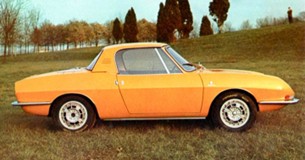
I was excited at the prospect of art school. By way of background, the National Art School’s North Sydney campus was one of a number of state-run facilities, used for training first year art students. It was housed in a cluster of rundown fibro and weatherboard buildings, with little aesthetic appeal, squished onto a very small block of land. We were expected to attend Monday to Friday nine to five, and we did so willingly, because the classes were so interesting.

The study year comprised three terms. In each term we had two different subjects per day, one in the morning and one in the afternoon. Subjects included lettering, design, outdoor sketching, drapery drawing, antique model drawing from plaster casts, perspective drawing, watercolour painting, sculpture and quick sketching, for which we each took turns to model. In nineteen sixty-six, the cost of attending one of the best art schools in the country, was twelve dollars per term, payable to the Department of Technical and Further Education.

Each weekday morning I walked up to Milson’s Point station. I had my Masonite drawing board with large sheets of white cartridge paper attached, tucked awkwardly under my arm. Over my shoulder I carried a bag containing everything I needed for the classes including pencils, paints and brushes. From Milson’s Point I took the train one stop north. Then a bus, followed by a short walk to the Art School complex.

We were a diverse group of students. Those who’d completed the New South Wales School Leaving Certificate were either 17 or 18 years old, whilst others who’d passed the Intermediate Certificate were only 15 or 16. As part of my application I’d presented an unimpressive Queensland Senior that is, Year 12 Certificate. Thankfully it was disregarded because entry to the National Art School was contingent upon the quality of the artworks, we each submitted for consideration. 

A drawing class at the Julian Ashton Art School circa 1930 with students using ‘donkeys’ and easels as we did 35 years later at the National Art School
Image: Julian Ashton Art School Sydney

I quickly made friends within the student body. A number of my fellow students were self-funding their studies by taking factory work, or whatever other work they could find, during the Art School holidays. I clearly remember one story; a young woman who took a job in a pickle factory. Afterwards she said she would never eat bought pickles again, because, whatever fell on the floor was scraped up and put back into the pot. Her disturbing story has put me off buying commercially-made pickles ever after.

As my studies progressed, my design teacher, invited me to her home for Saturday lunch. Trained in Switzerland, she brought with her an innovative approach to teaching design that we all loved. Naturally, her home was beautifully decorated with exquisite handwoven cushions and furnishings, Persian carpets and hand embroidered table linen. I understand it was unusual for a student to receive an invitation to visit the home of a National Art School teacher and, to this day, I wonder why I’d been invited. Her son, about my age, was also at lunch. Perhaps there was a bit of matchmaking in the air? Or maybe she felt sorry for me, all alone in the big city? I guess I’ll never know.

For a while my weekends were taken up sewing custom-made scrim curtains. Before returning to New Guinea, my mother had given me a second-hand Brother sewing machine. This was a heavy ‘clunker’ I was able to put to profitable use.

For example, some ex-New Guinea friends had relocated to Sydney. They’d purchased a block of land on which they’d built a Pettit+Sevitt project home. The home featured many full-length windows that required many sets of full-length curtains. I was happy to help, as I love sewing and the extra money was handy too.

Mid-1960’s flat-roofed Pettit+Sevitt project home
Image: canberrahouse.co.au

I used the ‘clunker’ to make my own clothes as well. I did my best to emulate Jackie Kennedy, the fashion icon of the era. For me, Jackie was the embodiment of sophisticated simplicity. To mimic her style, I chose to use Vogue designer patterns, following each step of the detailed pattern instructions ‘to-the-letter’. The unexpected spin-off from my single-minded approach, was that I learnt lots of unusual garment construction tricks that I’ve drawn on ever since.

French designer Pierre Cardin’s Vogue pattern I made up in cream wool—it was tricky to make, in a totally impractical colour but remained one of my favourite winter outfits
Image: Vogue Patterns Paris

Occasionally I used some of my generous allowance to invest in stylish ‘off-the-peg’ garments. The right accessories to complement these garments and all the other outfits in my wardrobe, were vital. Shoes with a matching handbag and gloves, were purchased from the up-market David Jones department store in the city.

One weekend towards the end of my first term at Art School, my classmate, Jenny Spence died. She suffered from asthma. This was my first ‘up close and personal’ experience of death and it threw me for a loop. Jenny had just begun dating Kirk Hansom, my boyfriend Paul Patent’s best friend. We were devastated by the suddenness of her death as she was loved by us all. With a heavy heart, I bought a suitably sombre maroon outfit for the funeral to be informed a day later that it was to be a ‘family only’ funeral. Sadly Kirk, Paul and I were unable to farewell our kind, gentle and talented friend. As a result of Jenny’s death, a pall of sadness hung over us all for the remainder of our first term at Art School.

The pall of sadness was momentarily lifted for me when I received an unexpected job offer. A fellow student had noted my interest, nay, my obsession with fashion, borne out by the quirky outfits I wore to Art School each day. From our lunchtime chats she was well aware of both my sewing skills and my strong background in textiles. It seems she had made mention of me to her mother who was deeply involved in the Sydney fashion scene. I was invited to meet her mother. We discussed what she had in mind and the upshot was a job offer. I was flattered to be asked and quite surprised to discover that the skills I already possessed had value in the real world. But I’d set my heart on a formal art training, so after giving some considerable thought to the possibility of a career change, I politely declined her offer.

I was very relieved when Art School exams were done as I was still in shock from Jenny’s sudden departure and itching to get away from it all. As a distraction, I focused on making a number of unusual outfits to take with me to New Guinea for the May holidays. This time I was headed to the small highland’s township of Kundiawa in Simbu District, where my mother was overseeing the establishment of The Wool Project. As always, I was looking forward to pitching in. Easy for me because I’d been around spinning wheels and looms since before I was born. As The Wool Project was growing like Topsy, I knew an extra pair of experienced hands would be most welcome. At its zenith, my mother was managing 26 ‘units’ throughout the Highlands. After the fact it’s comforting to know that the spinning and weaving skills acquired by the people as a result of their textile training, were in use long after my mother left the country in 1973.

But I’m getting ahead of myself…


ON REFLECTION:
The National Art School: In my first year at Art School, my drawing, painting and sculpting skills were enhanced and refined. These foundation skills provided the bedrock of my subsequent career in the arts. They’re the skills I would later combine with textiles and material culture, to create a series of thematic touring exhibitions to tell our stories—stories of both hardship and success.

Grief: The sudden death of my friend Jenny Spence was a massive, mind-numbing shock. I was bereft and found it difficult to cope with the vacuum Jenny’s death created in my life.

I’d only once before experienced a similar all-consuming shock. When my father left my mother and I, I was nine. I’d witnessed him beat my mother black and blue before he departed. Since I’ve come to understand that many children are conflicted when family life is disrupted; in my case not by death but by withdrawal. I also know that many abandoned children feel responsible for family breakups, but not me. I was relieved my father was gone as I didn’t want to witness a repeat performance of his superior strength and anger directed
at my mother or at me. Even though I’d a strong connection with my father, I realised I couldn’t trust him.

Today my mother could take out a Domestic Violence Order against my father. But this was not the case in Sydney in the late 1950s. Then it was a time of deep dark family secrets held close. In my family, the image my parents were keen to project to the world was one of educated upper-middle-class respectability and domestic harmony. But the reality was very different.

FACTS:
Scrim: a reasonably priced lightweight translucent woven textile made from cotton, hemp or flax. Often used to make curtains for the trendy modernist-inspired houses, that were the rage in late 1960s Sydney.

Pettit+Sevitt builders: Brian Pettit and Ron Sevitt were the rising stars of contemporary house design in 1960s Sydney. They were the builders of choice for many adventurous first home buyers who purchased blocks of land in the Northern suburbs, where new land releases proliferated.

Pettit+Sevitt began by commissioning the talents of Michael Dysart and Ken Woolley—the latter the nineteen sixty-seven winner of the Australian Institute of Architects design award. Later on, innovative house designs were provided by the heavy-hitters of Australian architecture, including Harry Seidler, Russell Jack, Robin Boyd and Neil Clerehan.

Pettit+Sevitt built 3,500 houses for Australians between 1960 and the early 1970s.

Pettit+Sevitt history: https://www.pettitandsevitt.com.au/
http://www.canberrahouse.com.au/houses/pettit-sevitt.html

A typical Pettit+Sevitt project home floor plan from the mid-1960s—note master bedroom ensuite, laundry, kitchen and family bathroom block—keeping the plumbing and drainage in one area kept the cost down
Image: Pettit and Sevitt Courtyard plan Flickr

Back to Chapter Menu

Not a Still Life | Portrait of an Artist

Chapter 11: The big smoke

In late November 1965, my mother came to Toowoomba in Queensland to pick me up from the Glennie Memorial School where I had just completed my Year 12 studies. I was filled with joy at the prospect of being free of the rigid boarding school regime that I’d begrudgingly endured for two long years. Just before I left school, I went for my driving test. As I’d been driving since I was twelve, I assumed it was a foregone conclusion I’d pass the test with flying colours. Ahead of time I’d had a couple of lessons to refine my driving technique and as anticipated, I succeeded first go. I was super-proud to be the holder of a freshly issued Queensland Drivers Licence. At last, I was legal! I was just seventeen.

My mother drove into the school’s front drive in a very swank chocolate brown and white Volkswagen Karmann Ghia 1500S, that she’d brought down with her from New Guinea. The car was unkindly referred to by some as a poor man’s Porsche and I understand it was one of only four in the country. And my mother relished the exclusivity!

Morley in Glennie summer uniform, standing beside her mother’s Karmann Ghia 1500S with PNG registration plates in the front drive of the Glennie Memorial School in late November 1965. Note the Glennie chapel in the background
Image: Grainger family photographs

Lennon’s Hotel Toowoomba built in 1957. It is six-storeys high and the tallest building in the city in 1965 designed by Architect Dr Karl Langer
Image: National Library of Australia

After numerous tearless farewells, we drove down town to Lennon’s Hotel, which was the place to stay in Toowoomba at that time. Lennon’s was renowned for an adventurous menu including Bombe Alaska—an exquisite desert of vanilla ice-cream encased in sponge cake, covered with baked meringue and served flambé. The perfect treat to celebrate my escape from boarding school!

Next day we headed south to Sydney to stay with a close family friend, Helen Klausner. Helen lived in a two-storey house, designed by modernist immigrant architect Harry Seidler at Hunters Hill—well, actually it was Gladesville the adjoining suburb, but Hunters Hill was considered a much better address!

I loved visiting Helen. She had style in spades, possessing both generous loving nature and a beautiful figure. Helen’s wardrobe was always overflowing with unconventional designer clothes and to my delight, she was happy to share them with me.

Helen was also a fantastic cook. In most Australian households at that time the patriarchal expectation was that dinner would be on the table no later than six o’clock each evening. This was an expectation that Helen chose to ignore. At Helen’s house, dinner was served when the dinner was ready and not before. She was never apologetic. It could be seven, or eight or even nine o’clock before the food came to the table and it was always worth waiting for.

Not far from Helen’s house there was a small shopping centre with a hairdressing salon. For special occasions the hairdresser would put my long, straight brown hair up into a French roll, a very popular 1960s hairstyle. With a French roll, Helen’s borrowed clothes and matching high-heeled sling-back shoes, I felt I held my own in the Sydney fashion stakes.

We spent Christmas catching up with friends. However, the dreamy summer holiday spent celebrating my escape from boarding school was short lived, as there was the pressing need for me to produce a folio of artwork to submit for consideration to the selection committee of the National Art School. I’m almost certain that my acceptance was the result of my mother’s influence and not necessarily the contents of my folio. Many of the Art School staff were her colleagues as she taught hand weaving and textile design at the University of Technology, in the years before we moved north to the wilds of New Guinea.

With my mother’s return to New Guinea imminent, the next challenge we faced was to find a suitable place for me to live in Sydney, ideally within striking distance of the National Art School. A friend suggested ‘Tremayne’ in Carabella Street, Kirribilli. It was a respectable YWCA hostel providing accommodation for out-of-town girls, some studying and some working, located just up the road from Kirribilli House, the Prime Minister’s official Sydney residence. As New Guinea was my home, I fitted the ‘Tremayne’ selection criteria and was offered a room, and then another, where I remained for all three years of my art school training.

Over the Christmas break I began finding new friends.

I met the members of a three-piece folk band calling themselves ‘The Ornithologists’; Brian Cooper, Greg Kingsley, and Paul Patent…all three with more than a passing interest in birds! Brian played guitar and banjo, Greg played guitar and Paul sang like an angel.

Paul Patent’s band ‘The Ornithologists’, performing. L to R: Greg Kingsley, Brian Cooper and Paul
Image: Unknown

They performed ‘covers’ of popular folksingers, including Bob Dylan, Peter, Paul and Mary, The Byrds and The Seekers and often had weekend gigs around Sydney—their only opportunity to perform, as they all had full-time jobs.

Paul was a year older than me and worked with the Bank of New South Wales. Neither of us had our own transport, though occasionally Paul was able to borrow his family’s Daimler. He would drive from Hunters Hill, where he lived with his recently widowed mother, to visit me at ‘Tremayne’, a twenty-minute run. Paul’s mother was a kind and inclusive woman who taught me how to iron a man’s shirt, as well as introducing me to rabbit stew. This was a new and surprisingly delicious culinary experience for me, because in my family we didn’t eat rabbit.

‘The Ornithologists’ were also deeply engrossed in the Sydney music scene, often travelling some distance to hear other groups play. They were overjoyed when they heard that the Modern Jazz Quartet (MJQ) would give one only performance at Sydney University on their way to Japan. Naturally, we all went along, well aware that the MJQ’s music was known and loved worldwide. The MJQ concert was a formative experience for me as it was the first time I’d heard African-American jazz musicians play on stage.

MJQ record cover
Image: Modern Jazz Quartet

Another close family friend was Kitty Gaul, who worked in ‘public relations’ and, as a result knew ‘everybody who was anybody’ in Sydney and beyond. Her social circle included artists, musicians, journalists, public intellectuals and writers, including Charmian Clift and her husband George Johnson. The couple had lived with their three children, on Hydra Island, in Greece, for some years. The family had recently returned to Australia and were finding it difficult to fit back in.

Kitty decided to throw a New Years’ Eve party at her Mosman flat and Charmian was invited. I too was invited and with permission, brought ‘The Ornithologists’ along with me for an evening of fun. I clearly remember a tipsy Charmian cornering us to lament, how difficult it was to converse with her teenage daughter, because she was in perpetual motion, ‘go-go’ dancing, morning, noon and night. ‘Go-go’ dancing was the exciting dance craze sweeping Sydney at the time. Charmain told us that she often pleaded with her saying, “Please keep still. I’ve forgotten what you look like!” We thought her comments were both amusing and sad.

Yet another pre-Art School experience was a brush with the Mosman Branch of the Young Liberals. My new friend Maryanne Walters was a card-carrying member. She encouraged me to join and, in what seemed like seconds, I found myself with the job of Minutes Secretary of the Branch. This was my first and last tango with either committee structures or conservative politics. To this day, I’ve not mastered the skill of taking minutes of meetings. My problem is that I become so engrossed in the ‘to-ing’ and ‘fro-ing’ of the discussion, I find it impossible to keep track of the main points.

But I digress.

I was delighted to be back in Sydney as it was my home town before we headed north to live in New Guinea. I’d been away for five years. But in the couple of months I’d been back I’d already found an interesting cross-section of new friends, a boyfriend, had a place at the National Art School and reasonably priced accommodation. How much better could it be?

I was poised ready to begin my first year at the North Sydney campus of The National Art School. Fortunately, the campus was within striking distance of ‘Tremayne’.

As the result of my extraordinarily positive art experience at boarding school, I was very excited at the prospect of learning more about art, both theoretical and practical, under the tutorship of a number of highly respected practicing artists. The future looked rosy.


ON REFLECTION:
A Queensland driver’s licence: Acquiring my driver’s licence was an important rite of passage. After successfully completing the compulsory driving test, I was thrilled at last to be ‘legal’. I loved driving. Driving without a licence in New Guinea was never a problem but driving without a licence in the city was asking for trouble.

‘Tremayne’ the YWCA hostel at Kirribilli in Sydney: Living at ‘Tremayne’, gave me the opportunity to meet many interesting young women my own age who mostly came from different parts of rural and regional New South Wales. As our friendships developed, we were able to support each other as we ventured out into the world beyond ‘Tremayne’s’ protective walls. As young attractive women, we were sometimes confronted with situations that tested us physically, morally and philosophically. It was very comforting to know that when needed, we had a shoulder to cry on. Ironing a man’s shirt: I was touched when my boyfriend Paul’s mother offered to teach me how to iron a man’s shirt. Obviously, shirt ironing was a skill she felt I needed. I didn’t have the heart to tell her I’d been ironing my father’s shirts since I was eight years old. However, her method was a little different, so it wasn’t a wasted exercise.

Paul Patent: As I recall, my relationship with Paul lasted for about eighteen months and during that time we shared my virginity. It was a disappointing experience under less-than-ideal conditions, after which I played it safe, as I was in no hurry to repeat the experience.

L to R: Greg Kingsley, Morley, Paul Patent and Kirk Hansom, standing by the front verandah of Paul’s home at Hunter’s Hill
Image: Unknown

Charmian Clift: Meeting acclaimed author and journalist Charmian Clift at Kitty Gaul’s party was an unexpected surprise because I’d grown up hearing lots of stories about her life before she and her husband George Johnson left Australia for London in 1951. Some years later they moved to Greece, making a home on Hydra Island and, in nineteen fifty-seven, my mother visited them there. She was on her way back from the United States of America, after spending six months studying at the Rhode Island School of Design. She was entranced by the Johnson’s idyllic Greek lifestyle and after divorcing my father, thought seriously about moving us to Greece. However, my father threw a spanner in the works, refusing to allow me to leave Australia so my opportunity to attend the International School in Athens and learn to speak Greek, instead morphed into learning to speak Tok Pisin, the lingua franca of New Guinea. Seems my father wasn’t worried about our move to New Guinea. Perhaps because it was closer? It’s strange how things work out.

But I digress.

Even as a typically egocentric seventeen-year-old, it was clear to me that Charmian Clift was deeply unhappy as we made small talk whilst waiting to welcome in the New Year of 1966.

FACTS:
The Modern Jazz Quartet (MJQ):
https://en.wikipedia.org/wiki/Modern_Jazz_Quartet

Charmian Clift:
In 2016 Susan Johnson, feature writer for The Australian newspaper, wrote of Charmian Clift and George Johnson:

“America has Sylvia Plath and Ted Hughes, England has Leonard and
Virginia Woolf and France has Jean-Paul Sartre and Simone de Beauvoir. But Australia’s own doomed literary couple lives on in the enduring myth of Charmian Clift and George Johnson.”

Charmian Clift died by her own hand in 1969, aged 45.
https://adb.anu.edu.au/biography/clift-charmian-9764
https://en.wikipedia.org/wiki/Charmian_Clift

Charmian Clift’s estranged husband, George Johnson, died of tuberculosis in 1970, aged 58.
https://en.wikipedia.org/wiki/George_Johnston_(novelist)
https://adb.anu.edu.au/biography/johnston-george-henry-10632

Back to Chapter Menu

Not a Still Life | Portrait of an Artist

Chapter 10: Skin in the game

In August 1965, I visited the Mount Hagen Show for the second time. I first visited in August 1963, when I was fourteen. Then, my mother and I’d hopped aboard a chartered DC3 with side-saddle seating to fly from Rabaul to Mount Hagen for what was promoted as ‘the weekend adventure of a lifetime’.

Ansett-Mandated Air Lines DC3
Image: AussieAirliners

DC3 charter flight passengers en route the Mt Hagen Show
Image: Papua New Guinea Association of Australia

Basic accommodation was part of our Mount Hagen Show package, and we were each allocated a narrow straw paillasse on the hard wooden floor of the local primary school.

Mount Hagen’s cooler climate was most welcome as it was in sharp contrast to the oppressive coastal heat, we experienced daily in Rabaul. In addition, Rabaul was subject to the incessant emissions from the town’s active volcano, Mount Tavurvur. Whenever the
wind blew from the east, we experienced unexpected random whiffs of hydrogen sulphide gas that smelt like rotten eggs. So, it was nice to have a break from the pong.

Mount Hagen Show—massed tribal warriors dancing
Image: Papua New Guinea Association of Australia

The Hagen Show weekend was action-packed. Wandering the showground we visited pavilions, saw numerous displays, and watched thousands of tribesmen in full ‘sing-sing’ regalia, dancing to the hypnotic beat of their ‘kundu’ drums. It was mesmerising to watch the tribesmen’s feathered headdresses rise and fall as they danced. All in all, it was an unforgettable experience and one I was busting to repeat.

Mount Hagen Show—magnificent wigged tribesmen with kundu drums
Image: Symbiosis Custom Travel

Mount Hagen Show—tribesmen in full regalia including Bird of Paradise feathers
Images: nashopng.com

This time, I was on holiday from boarding school in Toowoomba, Queensland and I was sixteen.

But this time it was very different because we had skin in the game. Why? Because my mother’s Wool Project, based in Kundiawa not far from Mount Hagen, was a feature of the Show for the very first time.

To get the Wool Project to the Mount Hagen Show the Simbu weavers, Siwi and Ambane their spinning and weaving equipment plus stock to sell, were loaded onto an uncovered semi-trailer for the 100-kilometre trip along the Highlands Highway to Mount Hagen. My mother travelled separately as she needed transport at the Mount Hagen end for the duration of the Show. She cautiously followed the semi-trailer in her low-slung Karmann Ghia 1500S, her pride and joy, with only twelve centimetres of clearance to the shock absorbers. This vehicle was totally unsuitable for the unsealed highland roads that were often badly affected by regular heavy rainfall.

The weavers had spent months preparing for the Show. From the beginning my mother had made it very clear that to be part of the Wool Project exhibit, the weavers would be required to wear traditional dress that included: Bird of Paradise feathers; pearl shell ornaments and ‘arse’ grass. In addition, pig grease was to be smeared on their bodies to make them shine. European clothing bought from the Trade store, was absolutely forbidden.
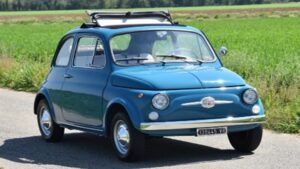
The Wool Project’s allocated space within the Mount Hagen showground facility, comprised a recently constructed seven-metre square hut made of bush materials that was open on three sides, with a wooden platform floor. The centrepiece of the display was two looms operated by the weavers, dressed in full tribal regalia and demonstrating their newly acquired weaving skills. It was a strangely incongruous sight.

To promote the handwoven product, behind the looms were hung an eye-catching display of handwoven woollen blankets stretched over lightweight wooden frames and hung from the ceiling support poles. Behind the panels, at the rear of the stand was a storeroom that was chock-a-block full of stock.

The Wool Project stand at the 1965 Hagen Show. The loom is being warped in preparation for threading and ultimately weaving
Image: Grainger family photographs

I flew into Mount Hagen from Brisbane on Friday, 19th August, the day before the Mount Hagen Show was due to commence. On my arrival, I found the Wool Project stand set up and everyone involved exuding optimism at the prospect of selling all the stock and taking orders for more, thereby assuring the weavers of plenty of work on their return to Kundiawa.

As this was to be the public launch of The Wool Project, The Department of Trade and Industry sent helpers from Port Moresby. In addition, The Australian Wool Board’s technical manager had flown in from Sydney to lend a hand.

L to R: Dan Mannix from Trade and Industry head office Port Moresby; Frank Wood Technical Manager from the Australian Wool Board and my mother, Gretchen Grainger, warping one of the looms on the Wool Project stand at the 1965 Hagen Show with the muddied Karmann Ghia in the foreground
Image: Grainger family photographs

Everyone was hyped up and ready for the experience of a lifetime, made possible through their association with The Wool Project.

I was doubly excited as my German romantic interest at the time, flew into Mount Hagen from Madang that Friday afternoon. I borrowed the Karmann Ghia to pick him up from the airstrip, after which we had a preview wander around the Show site before heading off to shower and change in preparation for a romantic dinner out.

But it began to rain heavily. Throughout Papua New Guinea stormwater is managed with a network of drains, known as ‘barats’. Measuring around 60cm wide by 80cm deep they run parallel to the road. Often covered with grass, barats were tricky to detect at night when either walking or driving, as there was no street lighting in Mount Hagen at that time.

With rain pelting down and lousy visibility, I carefully reversed the Karmann Ghia out of the driveway, but went a tad too far. Oh, dear. I inadvertently put both back wheels of my mother’s precious car in the barat with the boot resting on the other side. So we were well and truly stuck. What to do? From the car, I could see lights from the nearby hotel kitchen where I hoped I could find people to help. Luckily the cook bois responded to my request and when there was a break in the rain, they quickly lifted the back wheels of the car out of the barat and back onto the road. After thanking the kitchen crew, we drove away to celebrate my very recent admission to the Barat Club over dinner!

My boyfriend’s visit was brief because he had to return to work in Madang. As a result, I didn’t have a partner for the Mount Hagen Show Ball. But I wasn’t particularly worried as we had tickets and weren’t going to miss out on dancing to a live band that was a welcome change from dancing to long playing vinyl records. So, decked out in our finery, we set off to party.


I can’t recall seeing the Australian Governor General De L’Isle and his party at the Ball. Lord De L’Isle had come to Mount Hagen to officially open the Show. As a powerful symbol of Australian colonial authority, his presence added a degree of gravitas to the proceedings. Standing on a raised platform, he’d taken the salute with aplomb, his solar topee topped with white feathers that weren’t nearly as colourful or dramatic as the sea of Bird of Paradise plumes below him. After he’d done the job, I assume he and his party escaped the primitive Highland conditions and flew back to the comparative luxury of Government House in Port Moresby.

At the Ball I met an interesting man from Canada. He was a Cree Indian from Cutknife Saskatchewan who was working with the Canadian University Service Overseas. He was a real livewire. The evening remains memorable as he taught me the Cree Chicken Dance, much to the amusement of the cluster of onlookers propping up the bar.

The next day, slightly hungover, I headed back to the showground to lend a hand. Siwi was weaving but I could see fellow-Simbu weaver Ambane was at a loose end. I suggested we do a lap of the various displays including the grand pavilion of our hosts, the Western Highlands District. Together we entered their pavilion and as we did so, Ambane was curtly told he couldn’t come in. I immediately arced up and retorted, “He’s with me.” And we kept walking. I was irritated by the attempt to exclude my Simbu friend.

We returned to the Wool Project stand just in time to be invited to lunch at the Mount Hagen Country Club by the Australian Wool Board representative. On the spur of the moment, I asked Ambane if he’d like to join us and he agreed. Sadly, it turned out to be the most excruciatingly uncomfortable luncheon ever. The disapproval of the other diners seated nearby was palpable—deeming Ambane’s presence an unexpected and inappropriate intrusion as the Mount Hagen Country Club was a very Anglo enclave. Nothing was said but I know Ambane felt it and so did I. This experience was yet another sobering example of exclusion—my friend Ambane treated as an outsider in his own country.

Ambane and I arrived back at the Wool Project stand to find the stockpile of handwoven blankets, ponchos and raw fleece floor mats, continuing to sell like hotcakes. But there was a problem. Siwi, my favourite Simbu weaver, cornered me. He was very concerned, as he’d noticed a number of items were being sold twice. He could see the calamitous repercussions to come and so could I. There would be two buyers arriving at the end of the day to pick up one item. It appeared that the helper from Trade and Industry in Port Moresby was unaware of the system. She was taking items from the ‘to-be-picked-up’ pile and reselling them. Siwi tried to explain but the woman didn’t speak Tok Pisin. Next, I stepped in to explain in English but was waved away. So Siwi and I adjourned to the storeroom to lament. I was very upset as I felt powerless to mitigate the inevitable disaster heading our way. To comfort me, Siwi said, “Noken wari sista, mama ikam bek pastem na ba i steretim.” (“Don’t worry sister, when your mother gets back, she will sort it out.”)

My mother returned to find us huddled in the storeroom and wanted to know why. Through my tears I explained our dilemma. She listened carefully before replying gruffly in English in her attempt to jolly me out of my distressed state. Siwi, not understanding English, picked up on her tone and reacted. He arced up saying, “Noken tok olsem lo sista blo me.” (Don’t you speak to my sister like that!”). I was so shocked by Siwi’s unexpectedly defensive outburst, I immediately snapped out of my funk and left my mother to conjure a solution to the double sales dilemma.

By Sunday afternoon every last item had been sold. As first-time exhibitors at the Mount Hagen Show, everyone involved was thrilled with the positive response to the Wool Project, borne out by the long list of orders to be filled by the weavers on their return to Kundiawa. It was late afternoon by the time we’d packed up, reloaded the semi-trailer and waved the weavers farewell before following them home in the Karmann Ghia. Our return trip was very slow because the recent heavy rain had scoured out deep run-off channels and I well remember having to get out of the car a couple of times, torch in hand, to guide the front wheels of the low-slung Karmann Ghia over the worst sections.

We got back to Kundiawa late that evening, still basking in the warm glow of success. The Wool Project had taken the Mount Hagen Show by storm. The total sell-out proved there was demand from both expatriates and tourists for well designed, quality handwoven items. It was a most welcome boost for my mother as she steered the fledgling Wool Project into the future.

I spent the remainder of my holidays in Kundiawa helping with The Wool Project before returning to Toowoomba to complete my last term at The Glennie Memorial School. Then freedom! Bring it on!


ON REFLECTION:
Cross cultural concern: Simbu weaver Siwi’s unexpected verbal outburst to protect me from my mother’s chiding, is a reminder of the affection in which I was held by Wool Project people. I’m told that a number of girl children were named for me, yet another tangible indicator of my place in their lives and their hearts.

My time in New Guinea: From the beginning of our 13-year stay, I was consciously aware that ‘I was just passing through’ whereas our hosts, the people of Papua New Guinea had managed their land for thousands of years. This fact brought me to the conclusion that, as an uninvited guest in their culture, I had an obligation to be well behaved for the duration of my stay. But this was not a commonly held view at the time, as many of the other ‘guests’ were driven by opportunistic intent in one form or another. The objective being to extract as much as possible with little thought of the impact their activities may have had on our hosts. I came to understand that the Simbu people have a deep and complex relationship with their land and remain largely dependent on subsistence agriculture.

The New Guinea Highlands Highway: Driving the Karmann Ghia 1500S in the Highlands was often a challenge as the roads could be extremely dangerous due to incessant rain that caused numerous washaways and occasionally impassable landslides. However, uppermost in my mind as we negotiated the tricky bits was my father’s mantra: “You can drive a car anywhere as long as you do it slowly. And we did!

Serious landslip on The Highlands Highway in the 1960s
Image: Pacific Manuscripts Bureau

FACTS:
Mount Hagen: is the capital of the Western Highlands Province. It’s the third largest city in Papua New Guinea, located in the fertile Wahgi Valley at 1,677m above sea level. The rainfall is 2557mm a year.

The Wool Project: Was a Department of Trade and Industry initiative. The objective was to teach spinning and weaving to the local people. The Wool Project began in Kundiawa, Simbu District in 1964 and quite quickly grew to comprise 26 individual cells scattered throughout the Highlands. My mother, Gretchen Grainger, ran the project single-handed because she had the technical know-how, could design a saleable product, spoke the lingua franca, and could source suitable yarn through her network of Australian textile manufacturers.

The Highlands Highway: also known as the Okuk Highway, is the main land highway in Papua New Guinea. It connects several major cities and is vital for the movement of people and goods between the populous Highlands region and the coast.

For most of its length, the Highlands Highway is no more than a single carriageway, two lane road, which is often hindered by potholes, and land slips. The Highlands stretch of the highway in particular, is notorious for armed holdups and robberies, committed by the local bandits, called ‘raskols’.
https://en.wikipedia.org/wiki/Highlands_Highway

Back to Chapter Menu

Not a Still Life | Portrait of an Artist

Chapter 9: Getting of wisdom

After three years of secondary education in New Guinea at Rabaul High School located on the eastern tip of New Britain, it was time for me to move on to my next character-building adventure, to continue my schooling ‘down south’ in Australia. This was made possible because my mother, an employee of the New Guinea Administration, was entitled to financial assistance to help cover the costs associated with a child attending boarding school in Australia. The package also included a return airfare to Rabaul once a year. I was just fifteen.

My mother had thoroughly researched suitable boarding schools for my last two years of secondary education. The short list included: The Friends School in Tasmania; Frencham in Mittagong; St Gabriel’s in Charters Towers; St Margaret’s in Brisbane; and The Glennie Memorial School in Toowoomba. The latter was chosen because my brother and his wife had left plantation life in New Guinea to manage a family property at Drillham Siding, some 220 kilometres west of Toowoomba. The property was close enough for my brother to come to the rescue if need be. Toowoomba’s proximity to Brisbane airport was also a consideration, as I needed to get to and from New Guinea up to three times a year with a minimum of fuss.

At the end of the 1963 Rabaul high school year we came through Toowoomba on the way to Sydney for school shopping. We’d a long list of school clothing to purchase from either Baileys or Piggotts, the iconic up-market Toowoomba stores that stocked everything a Glennie girl needed from blazers and grey stockings, through to the new summer uniform fabric and a paper pattern in my size. My mother, a super seamstress, planned to make me a couple of uniforms whilst we holidayed in Sydney over Christmas.

After six weeks of catching up with friends, I was delivered back to The Glennie Memorial School to begin Year 11 with every single item of my clothing marked with a Cash’s name tag, carefully sewn on by hand. I’d arrived a few days early which proved fortuitous as it gave me the opportunity to get to know the staff and to explore the numerous single and double-storeyed wooden buildings that were scattered across the school site, in various states of repair.

The front entrance of the Glennie Memorial School at 246 Herries Street Toowoomba in 1964
Image: Glennie Archives

The Year 11 classroom was set between the main building and Sutton House, the junior boarding house which was an elegant two-storey Queenslander flanked by wide verandas. A pathway of wooden slatted duckboards ran from the end of the main building, past the Year 11 classroom and on to Sutton House. They were unsightly but invaluable after rain, making it possible to move between the buildings and avoid the red volcanic soil, that became a sticky mess permanently staining everything it came in contact with.

At any new school there’s always a lot to learn, in addition to schoolwork. The idiosyncratic societal norms of this institution were numerous. Three times a day, we made our way to the dining room. Here I discovered that it was compulsory for each of us to bring a table napkin to the dining room for use at each meal.

The Glennie Memorial School dining room in 1964, the double doors on the back wall were an entrance to the kitchen
Image: Glennie Archives

We were assigned a table, each one seating eight girls from a mix of grades, with a Senior in charge. Occasionally, when there was an overflow from the Headmistress’s table, a member of the teaching staff would join us.

The first reprimand came at breakfast on the first day of first term. The Senior in charge of our table told me to break my toast into pieces before buttering it. And the second came five days later, on Sunday morning.

As was the tradition, we Glennie Girls assembled at the front gate, and lined up to march two by two, from the school complex, to the St. James parish church, in Russell Street, for the nine-thirty Communion Service. We were required to wear our full school uniform, including hat and gloves. It was a warm summer’s morning when we set off, and I was carrying my gloves, instead of wearing them. I was spotted by a sharp-eyed Prefect, who ordered me to immediately put on my gloves, and report to the Senior’s classroom on our return to school. Somewhat perplexed by the exchange, I wondered what was in store for me. As I pondered my predicament, our procession continued, and some ten minutes later, we arrived at the rear entrance of St. James Church.

My lingering concerns were at once sidelined as we entered. The interior was breath-takingly beautiful; the roof and the honey-coloured timber ceiling, were supported by elegant arched timber trusses. Above the east-facing altar at the far end of the building, were three splendid stained-glass windows, that glowed in the morning light. We Glennie girls silently streamed in, almost completely filling the pews on the right-hand side of the nave.

The interior of St James Church Toowoomba
Image: ohta.org.au

I found the service unfamiliar and strange, having been raised by atheist parents, for whom attending any religious gathering, other than the occasional wedding or funeral, was anathema. After the service, we walked back to school. This Sunday morning ritual was to continue every week of term for the next two years.

The interior of the Glennie Memorial School chapel
Image: Churches Australia

In addition to the Sunday service at St. James church, we had up to twelve weekly gatherings for worship in various forms. These were mostly held in the charming timber-lined Glennie Chapel. By the end of my schooling, I’d been baptised and confirmed into the Anglican community, I’d memorised all the prayers for each service, as well as all the verses of the most often-sung hymns from The Australian Hymn Book.

But I digress.

Upon my return to school, I changed into ‘civvies’ and reported to the Senior’s classroom as instructed. I climbed the steps and knocked. From there, the Prefect assigned the punishment. For not wearing gloves to church, I was ordered to copy out the 119th Psalm, the longest psalm in the Anglican Book of Common Prayer and told to hand it in after dinner that evening. I was to discover that Psalm one hundred and nineteen, comprised six pages of teeny-weeny print. This seemed a strange and rather excessive penalty for a minor transgression; however, I began the task in earnest, determined to meet the deadline. At the start, I used my lined foolscap writing pad until I ran out of paper but I had no more. There were still a number of pages left to copy. What to do? Thinking laterally, I decided to use a roll of toilet paper to complete the task.

As instructed, after dinner that evening, I presented myself at the Senior’s classroom. When I handed the Prefect my writing, her reaction was immediate and apoplectic. I watched in disbelief as her face turned bright red. What happened next was totally unexpected.

Within a matter of minutes, I was whisked through a maze of hallways to the Deputy Principal’s private quarters. In the impromptu discussion that followed the Prefect put her case, declaring that my use of toilet paper was disrespectful and an affront to her authority. Then, it was my turn. I explained that my mother was making a considerable financial sacrifice to educate me at The Glennie Memorial School and that this unnecessarily severe punishment for a trivial misdemeanour, was a waste of my mother’s limited resources. And, to my surprise, that was the end of the matter. Word quickly spread and from then on, all Seniors and Staff gave me a wide berth, now well aware that I was able to stick up for myself.

I had arrived at The Glennie Memorial School with straight ‘A’ passes in eight subjects for the New South Wales Intermediate examination but sadly, from here on in, it was downhill. In the first term mathematics examination, I managed 17%, much to my parent’s horror, but there was no offer of remedial coaching. Instead, I was advised to drop the subject. Things were not much better in my other study areas either. But I adored Home Economics and Art. As the only Year 11 student doing both subjects, I benefited hugely from one-on-one teaching. Being from an artistic family with prodigious output across a myriad of disciplines, somehow the study of art history had been overlooked. Art lessons at The Glennie Memorial School made up for this oversight in spades. At the beginning of each lesson, I was asked to choose between art history or art practice. It was always a difficult decision to make because I was passionate about both.

Being so far from home, I was always longing for mail and spent hours writing letters in the hope of receiving a reply. I remember spending  lots of Prep, that is Preparation time typing letters on one of the many antiquated typewriters in the Commercial  Studies classroom. I wasn’t a Commercial student but for some reason I was never challenged. Perhaps the Prep supervisors were pleased I was actively engaged and staying out of trouble?

I was extremely unhappy at boarding school. I often fantasised about getting expelled, periodically doing something naughty in the hope I’d be asked to leave. My best effort was a spur-of-the-moment decision to break bounds on the last evening of the second term of Year 12.

I was joined on this escapade by a Year 11 friend. We decided to walk down to the Toowoomba railway station to farewell our fellow classmates from western Queensland, who were heading home on the ‘Westlander’ train. When we arrived at the station, we were warmly greeted by everyone including the Art and Drama mistresses who were assigned to supervise the girls’ departure. After the train had left the station, the mistresses kindly invited us to join them for a coffee at the Flying Dutchman, a trendy basement café nearby. What fun! But the fun didn’t last for long.

We were enjoying the incongruousness of the situation and our coffee when to our collective amazement, the English mistress appeared at the doorway of the café. To this day I can see her silhouette in the doorway. She was gobsmacked to find two naughty Glennie girls drinking coffee with two members of staff. The English mistress immediately whisked my friend and I back to school where we were questioned separately. To be honest, I was secretly thrilled, certain I could begin planning my life after expulsion. But the upshot was
way beyond extraordinary. The School’s Board of Directors decided to allow my friend and I to stay, and to sack both mistresses instead!

1965 was my final year at the Glennie Memorial School. Towards the end of that year my father, then based in New Zealand, came to visit me for the first time. He spent an hour with the Headmistress, after which she immediately called a full school assembly and resigned. Everyone was overjoyed as she was universally disliked. My father cheekily took the credit for her decision, much to my mother’s annoyance!

When my time at The Glennie Memorial School came to an end, I promised myself that I’d never return to cold conservative Toowoomba. Ever.


ON REFLECTION:
Leaving home: I didn’t realise it at the time, but leaving home at 15 to attend The Glennie Memorial School was my first step in creating a life independent of my family, particularly my mother. Thereafter, I continued to return to New Guinea whenever I had the opportunity. I was always up for an action-packed holiday, even though I was now living in Sydney and studying at The National Art School.

After graduating, things changed. I moved into full-time employment as a graphic artist with various organisations, that only offered four weeks holiday each year. A far cry from the ten weeks I enjoyed all the way through school and at the National Art School as well.

Institutions: For me, The Glennie Memorial School was a loveless place and as a consequence I developed greater personal independence as a result of the experience. I learnt to stand on my own two feet and speak up for myself; a priceless asset that I’ve utilised often as I’ve moved through life.

FACTS:
Student numbers: In 1964, the Queensland government raised the school leaving age from 14 to 15 years. As a result, most girls attending the Glennie Memorial School sat for the external Junior examination at the end of Year 10 and then left school. Because of this, enrolments for both Year 11 and 12 were greatly reduced. In 1964, I was one of only twelve girls enrolled for Year 11 at the Glennie Memorial School. The following year, almost all of my classmates returned to complete Year 12, a prerequisite for various forms of tertiary education including teachers’ college and university. The Glennie Memorial School: Was founded in 1908 and named in memory of Archdeacon Benjamin Glennie the first Anglican priest on Queensland’s Darling Downs.
https://en.wikipedia.org/wiki/Benjamin_Glennie

By 1907 Toowoomba already had a number of secondary schools for boys so the Anglican Synod decided to use an £800 bequest to establish a secondary school for girls. The original school building was designed by Toowoomba architect Harry Marks. Many more buildings have been added to the site since I left at the end of 1965.
https://en.wikipedia.org/wiki/The_Glennie_School

Back to Chapter Menu

Not a Still Life | Portrait of an Artist

Chapter 8: A new life

In early January 1961, my mother and I arrived in Rabaul, a bustling port township located at the eastern tip of the Gazelle Peninsula on the banana-shaped island of New Britain. We were still in a spin having just spent an idyllic never-to-be-forgotten tropical Christmas with my brother on Karkar Island, off Madang.

Map of Papua New Guinea showing Rabaul
Map source: moneymuseum.com

Port township of Rabaul hugging Simpson Harbour
Image: Wikipedia

But first things first. As we planned to stay, my mother rented a small sparsely furnished two bedroom flat above a retail complex on Mango Avenue, the town’s main street.

Mango Avenue—Rabaul ’s main street c 1960
Source: flikr.com

We arrived in Rabaul with our suitcases filled to overflowing with tropical holiday clothes but not a single garment suitable for the start of my first year of high school. To address the problem my mother hastily constructed a simple sleeveless blue and white check gingham frock with a full skirt and a bias-cut sash. This garment gave me something to wear for the first week at a new school and allowed time to source the various items needed to meet the Rabaul High School’s dress code. The school uniform comprised a knee-length navy-blue pleated skirt, a white short-sleeved shirt, white socks and black shoes. By the beginning of my second week, I was fully kitted out, thanks to my mother’s super sewing skills.

The next purchase was a twenty-four-inch Malvern Star girls’ bicycle. It was bright blue and came with white-wall tyres, a parcel rack at the back, a wire basket hanging off the handlebars in front and a pump, but no gears.

Malvern Star 24” ladies bicycle c 1960
Image: Bicycle Superstore

Thankfully the streets of the Rabaul township were mostly flat. With my shiny new bicycle, of which I was extremely proud, I was able to pedal to and from school and anywhere else I wanted to go as we didn’t yet have a car.

My mother had her heart set on being a ‘lady of leisure’, thanks to my father’s sizable monthly maintenance payment, that was the result of their acrimonious divorce. Very quickly she was invited to join the local ‘morning tea set’ made up of other ladies of leisure who were married to the important business men of Rabaul. But before long the novelty wore off and she decided it wasn’t her cup of tea. She managed to politely extricate herself, after receiving a job offer from the Department of Malaria Control who were in need of a typist. Thus began our nearly four-year association with Rabaul.

One of the perks that came with working for any branch of the New Guinea Administration at that time was housing. So, it wasn’t long before we moved out of the flat on Mango Avenue and into a three-bedroom house. Fortunately for us, the accommodation outlasted the typing job because she was soon headhunted by another department. This time it was the Department of Education that came knocking. Word had spread that my mother was art school trained and had years of teaching experience. She accepted their offer and became the travelling art teacher for a scattering of out-of-town government schools located on the Gazelle Peninsula.

We hardly noticed, as we gently slid into the unhurried routine of life in tropical Rabaul. A life that was in marked contrast to the one we had left behind in Australia. I made friends with my classmates and quite quickly Serena Maclean became my ‘bestie’. She was the second eldest of four, two of whom attended the high school whilst her younger sisters attended Court Street Primary School.

Serena’s parents were pre-War Territorians, who were highly regarded by newcomers like us, caught up in the mystique of New Guinea’s past. The Macleans lived in a sprawling house on a large block of land, not far from our house. But their lifestyle differed greatly from ours. In their household, pre-War domestic staffing levels prevailed. Their staff included a cook, a haus boi to keep their house clean and a laundry boi to wash and iron for all six family members as well as maintaining their shady, overgrown garden.

As my much-older brother had left home when I was five, I was effectively an only child. As a result, I had little first-hand knowledge of how siblings interacted. But my association with the Maclean family changed that because I often spent time with them after school, rather than going home to an empty house to await my mother’s return from a day’s teaching out of town.

One afternoon Serena’s older brother Maxwell, taught me to shoot his pellet gun. For target practice we took turns to hit empty tin cans lined up on the fence. Some weeks later he taught me to shoot his .22 rifle.

Some months into my first year at Rabaul High School, I took up with Jock Christian. He was a year older and a year ahead of me. His family came from Scotland and he was my very first boyfriend. We often attended innocent teenage parties organised by our parents for a gaggle of up to fifteen teenagers. Each family took turns to host these Saturday gatherings, that started in the early evening, and ran for three or so hours. Inside we danced, drank nonalcoholic punch, played pass the parcel and spin the bottle. Outside in the cool semidarkness, we played innocent ‘kissing’ games that involved a lot of running around and hiding to avoid those you didn’t want to kiss!

Another Saturday night activity was going to the movies at Rabaul’s indoor picture theatre. As Jock and I were an ‘item’, we would select a row of seats and position ourselves in the middle of the central block. The boys would then fan out to sit on Jock’s side and the girls on mine. I remember Jock and I, coyly holding hands for the duration of the movie.

Another more physical weekend activity I well remember, was an adventurous expedition a group of us planned to climb Mount Tavurvur, the active volcano that was perched on the rim of the caldera, encircling Simpson Harbour.

The volcano would often remind us of its presence when the westerly breeze carried the invisible waves of hydrogen sulphide gas across the town. The gas smelt like rotten eggs and a whiff always caught you by surprise.

The adventure began very early one Saturday morning when we were driven from town to Matupit village. Next, a villager, in his outrigger canoe, paddled us across to the base of the volcano. Once out of the canoe, we began to climb up the side of the volcano. Even though we’d started early, the temperature was rising. It was very warm and the climb was steep and difficult, particularly clambering across patches of loose basalt scree that were devoid of vegetation. We were all very hot and bothered by the time we reached the rim of the volcano but our discomfort quickly faded as we took in the breath-taking view across Simpson Harbour.

View across Rabaul and Simpson Harbour with Mount Tavurvur on the right and the light green airstrip on the left
Image: Wikipedia

We then discovered that the view down into the crater was equally breathtaking. It was like nothing I’d ever seen before or since. The internal curve of the crater was lined with greybrown rock and patches of white fumaroles that belched rotten egg gas. On the crater floor there were areas of mid-grey mud gently bubbling—bloop, bloop, bloop. Next, my attention was caught by a small cave of bright yellow sulphur crystals at the centre of the crater floor. This crystal cave, surrounded by shades of grey, is my enduring memory of the excursion.

Inside the crater of Mount Tavurvur—the crater wall covered with smoking Sulphur fumaroles
Image: Blogger.com

Thankfully, our return trip was quicker and easier. We slid down to the base of the volcano where the canoe was waiting to take us back across the bay to Matupit village, and then home. When I got home, I had lots of stories to tell and I’ve been telling them ever since!

But I digress.

Before long, my mother purchased an old and battered short wheelbase Land Rover with no synchro mesh on the gears. The vehicle was no doubt a leftover from World War 2.

Not long after the purchase, my mother suggested I learn to drive, as we were living alongside an active volcano, that could blow at any time. Her plan was that in the event of an eruption, I could drive myself, and anyone else, to safety. For driving lessons, we needed a suitable place. We were told that the Rabaul airstrip was perfect because, by late afternoon, most of the air traffic had come and gone, freeing up the airstrip for driving lessons.

My mother would drive us out to the airstrip, after which we’d ceremoniously change places. It was here I was introduced to the mysteries of double-declutching and I remember spending many happy hours practicing changing gear, making ‘u’ turns and reverse parking between two large rocks. However, mastering hill starts came a little later.

Morley at the wheel of our first vehicle in Rabaul—a pre-war short-wheel base Land Rover
Image: Grainger family photographs

There were lots of other adventures too, but one in particular, is a stand out. In 1942, Rabaul was occupied by the Japanese and, for the remainder of the World War 2, the township became their major South Pacific supply base. To protect their base of operations, Simpson Harbour was heavily fortified. Fast forward to 1960 and the area was still littered with reminders of the Japanese occupation.

Japanese Type 96 25mm AT/AA anti-aircraft gun leftover from the Japanese occupation of Rabaul
Image: PacificWrecks.com

In 1963, we moved to a house on Namanula Hill overlooking Simpson Harbour. Exploring the numerous Japanese gun emplacements, situated in the hills encircling the harbour, was for a time, an exciting after school adventure. We left our bikes where the road ran out and pushed on into the bush in search of the remains of numerous anti-aircraft guns, some of which had been partially cleared of the encroaching bush.

We were fascinated by the numerous tunnels that ran off the gun pits and chose to ignore the post-War horror stories and warnings of unstable and booby-trapped tunnels. Occasionally if we had a torch, we’d pluck up courage to explore one of them. The leader would shine the torch into the darkness and we’d follow, all the while keeping low, and resisting the urge to scream, as the bats we’d disturbed streamed out over our heads. One afternoon the novelty wore off in an instant, when part of a tunnel collapsed and we had to dig ourselves out. This experience brought our Indiana Jones-style adventures to an immediate halt. We swore each other to secrecy and to my knowledge, our parents never did find out.

Through to the end of 1963, my unremarkable education continued at Rabaul High School. Jock Christian remained my significant other until I was ‘sent south’ to boarding school in early 1964. This was a common experience for many expatriate teenagers. In the school changeover I lost contact with Jock. Years later I heard that he’d gone on to study medicine at the University of Papua New Guinea and later specialised in the treatment of tropical diseases.

At a school reunion some forty-plus years later, I met Jock and his wife of many years. We gathered together on the Brisbane River aboard the Kookaburra Queen. The drawcard was the promise of the freshest seafood plus plenty of grog and of course, the company.

Whilst we were indulging ourselves, I caught up with some of the people I’d known at Rabaul High. After lunch, most of our group left the dining table and moved outside, to take in the views of the city from the river, as the paddle steamer slowly chugged along, leaving Jock and I facing each other across the table. In the stilted chat that followed, he confessed I was the love of his life, concluding with, “Look what you missed out on?” Me? A doctor’s wife? The prospect filled me with dread. I was so shocked I was rendered speechless, in part because what I saw across the table had little appeal. Unable to speak, I missed the opportunity to point out that I didn’t feel I’d missed out on anything.

But I digress.

Our extraordinary four-year sojourn in tropical Rabaul ended whilst I was away at boarding school in Australia. My mother packed up our lives and moved to Kundiawa in the Simbu Province of the New Guinea Highlands to take up a newly-created position with the Department of Trade and Industry. Her new role was to introduce spinning and weaving skills into the Highlands, thereby providing the local people with the opportunity to enter the cash economy. The Wool Project, as it was called, had the potential to change the lives of all concerned. And it did! But I’m getting ahead of myself.

ON REFLECTION:
Rabaul: My years in Rabaul were both formative and informative. There, I had the privilege of being an uninvited guest in another’s culture. I was fascinated by our hosts, the Tolai people; in particular their customs, their language and their food. I quickly learnt to speak the lingua franca, Tok Pisin, and was often called upon to interpret for my mother when she got stuck. As a result, I began to shoulder more and more domestic responsibility as we adjusted to life in the tropics; a life that was in marked contrast to our former life that of city dwellers from Australia.

Firearms: I was grateful to learn how to fire a rifle. After Maxwell Maclean had taught me gun safety, we occasionally practiced target shooting and I recall being quite a good shot. Gun craft is a useful skill to have, but I’ve had no need to use a rifle since.

Anglo teenagers in 1960s Rabaul: As white teenagers we were quite safe as we pedalled all over town and wandered the surrounding bush. We were fearless teens prepared to push our physical boundaries in search of adventure. In retrospect, we were extremely lucky not to have come to grief.

Rabaul: history of 20th Century warfare
https://pacificwrecks.com/provinces/png_rabaul.html

Rabaul: Japanese Type 96 25 mm AT/AA anti-aircraft gun
https://en.wikipedia.org/wiki/Type_96_25_mm_AT/AA_Gun

Japanese AT/AA anti-aircraft guns: After the War, the resourceful Tolai people systematically stripped the guns that surrounded Simpson Harbour of whatever metal pieces were small enough to be carried into Rabaul to sell as scrap metal.

Jock Christian: As I’ve got older, I’ve come to realise that for both men and women the intensity of first love lingers.

FACTS:
Simpson Harbour: is considered one of the best natural harbours in the South Pacific.
https://en.wikipedia.org/wiki/Simpson_Harbour

Rabaul: eruptions timeline including Mount Tavurvur
https://en.wikipedia.org/wiki/Rabaul_caldera#Eruptions

Japanese occupation of Rabaul: the Japanese occupied Rabaul from 23 February 1942 until the 2 September 1945 when the War in the Pacific ended.

Vice Admiral Jinichi Kusaka in his underground Naval headquarters at Rabaul. In the foreground a vase filled with flowers and a table with Kusaka seated on the far side. The tunnel has electric lights and finished walls.
Image: IJN via the Siege of Rabaul date c1944
https://en.wikipedia.org/wiki/Jinichi_Kusaka

Japanese tunnels on the Kokopo Road:

Remaining Japanese entrance tunnels dug into the pumice walls beside the road between Rabaul to Kokopo, New Britian Image: https://davidwatkinstravels.blogspot.com/2012/12/rabaul-war-relics.html

The Japanese used a slave labour force in Rabaul, made up of local people, as well as Australian, British, Chinese, Indian, Indonesian and Korean prisoners, many of whom were captured at Singapore. These people were forced to dig between 300 and 500 kilometres of tunnels, into the volcanic soil around Simpson Harbour, to accommodate the military garrison. The garrison consisted of barracks, air raid shelters, storehouses, accommodation, offices, command centres and an underground hospital complex for up to one hundred thousand soldiers. As well as thousands of support personnel, including sex slaves known as ‘comfort women’.

Japanese barge tunnels dug into the side of pumice cliffs lining the shore of Blanche Bay, Rabaul New Britain
Image: Australian War Memorial copyright expired

Barge tunnels: Along the shore line of Simpson Harbour on the Kokopo Road, tunnels were dug to conceal boats and barges, thereby protecting them from frequent allied bombing raids. After the raids, the barges were returned to the harbour and garrison life continued. Many of these tunnels survive and are a lasting reminder of the Japanese presence.

Japanese tunnel near Kokopo New Britian with the remains of a WW2 Japanese barge slowly rusting away in the tropical heat
Image: Australian War Memorial

Back to Chapter Menu

Not a Still Life | Portrait of an Artist

Chapter 7: Is this paradise?

Some people dream of living an idyllic carefree life on a tropical island, somewhere in the Pacific, but not me. But due to a sequence of unsettling familial events, I did ‘live the dream’ for a short time.

In 1958 my parents divorced. In early December of 1960 my mother, the ‘innocent’ party, now in receipt of a considerable monthly maintenance payment, decided to up stakes and take me to New Guinea to visit my brother for his last ‘unmarried’ Christmas. He was managing a copra and cocoa plantation for W.R. Carpenter & Co, that was located on Karkar Island, some thirty kilometres nor-nor-east of Madang, in the Bismarck Sea.

Map of Karkar Island
Image: South China Post

Karkar Island with Marangis plantation, circled in red
Image: map-site.narod.ru

Excitement intensified as we prepared for our Christmas adventure that would be a leap into the unknown for both of us.

The adventure began by taking a Trans Australia Airlines aircraft out of Sydney to Port Moresby. It was a long flight on a clear day with breathtaking views of the Great Barrier Reef from my starboard window. I was enthralled as we flew over a never-ending random scattering of coral atolls, both large and small. Close in, the atolls were surrounded by shallower water in shades of turquoise and pale blue. As the water deepened, the colours gradually changed to shades of mid-green and grey-blue that shimmered out to the horizon.
The ever-changing vista provided me hours of diversion during the long flight that was punctuated with refreshments. Lunch was something special. Red Emperor fillets cooked to perfection. A delicious first for me and somewhat ironic as we flew over the coral reefs from where I imagined the fish had recently been caught.

Disembarking at Port Moresby, we were hit by a wall of tropical heat. Our next stop was Madang. This time, we boarded a DC3 aircraft, and when we landed at Madang airport, my brother, who had come into town especially, was there to meet us.

We planned to overnight in Madang, before travelling out to Karkar Island the next morning. As we’d been travelling all day, we were very thankful for the opportunity to enjoy our first evening in the tropics at the charming Smugglers Hotel, with its awe-inspiring panoramic view of Karkar Island’s conical volcano, that rose dramatically out of the sea.

View of picturesque Karkar Island from the verandah of the Smugglers Motel Madang New Guinea
Image: PNG Village Travel

Typical 1960s cargo boat servicing Karkar Island and other coastal communities
Image: ShipSpotting.com

Early next morning, our suitcases were loaded onto a smallish cargo boat that was tied up alongside the Madang wharf. Once on board, we discovered that there was no passenger accommodation, so I made myself as comfortable as possible on the hatch-cover for the eight-hour trip.

After leaving the protection of Madang harbour, the sea became choppy and rough. Most of the passengers were throwing up over the side, whilst I enjoyed scoffing down Devon and pickle sandwiches provided, as I was completely unaffected by the movement of the boat as it lurched up and down, and from side to side.

Despite the rough crossing we arrived safely. Many of the passengers were somewhat the worse for wear and very thankful to be on dry land once more.

My brother was employed by W.R. Carpenter and Co to manage Marangis Plantation which was located on the western side of the island. Settling into the manager’s house brought with it unexpected surprises both physical and sociological.

A typical road through a Karkar Island plantation growing coconuts for copra and cocoa for chocolate
Image: Tulsatrot.com

We found the relentless heat and humidity stiflingly oppressive and relished the occasional tropical downpour, that provided temporary relief. As city people, we were exposed to unfamiliar relics of a by-gone age, for example a kerosene refrigerator and a diesel-powered generator to provide electric lighting at night. An unexpectedly unnerving experience for me was being surrounded by people who spoke languages I didn’t understand, and they in turn, didn’t understand me.

More worrying still was the all-pervasive colonial attitude my brother demonstrated in his role as the white ‘masta’, in control of all aspects of plantation life. For example, beside the kitchen steps grew a huge avocado tree that was loaded with fruit the size of a small baby’s head. When ripe, the fruit would fall onto the grass below with a loud ‘thunk’. My mother and I were addicted to avocados and couldn’t believe our good luck—the prospect of a fresh never-ending supply filled us with glee. But our glee was short lived as my brother forbade us to eat the avocados because he said they were native food.

My brother’s transport, provided by W.R. Carpenter, was a BSA Bantam 150cc motorbike. I rode pillion with my brother whenever we visited plantations out of work hours. Plantation hopping was referred to as a ‘recreational’ activity, and I quickly came to understand the term was code for getting drunk. I also noticed that beer, rather than spirits, was the beverage of choice. Thankfully, where ever we went, there was always a bottle of lemonade for me.

Another form of recreation enjoyed by the wild white ‘mastas’ of Karkar Island was waterskiing. To be part of it, my brother ordered a flatpack boat from Australia. He chose to construct the boat on the dining room table, located on the wide veranda of his large plantation house. The house, with stunning views of the ocean, was built of native materials. When launch time came, a woven bamboo sidewall of the house was removed and the boat was ceremoniously carried down to the bay below the house by a team of plantation workers. Once launched, a 40 HP Evinrude outboard motor was attached.

Water-skiing was a favourite weekend pastime. Shortly after our arrival, it was suggested I learn to ski. At the outset I recall being more than willing. One weekend, with the boat in the bay, the plantation workers assembled along the shoreline to watch the ‘lik lik misis’ that is Tok Pisin, in the lingua franca of New Guinea, for a young white girl, have a go. With my brother giving instructions from the back of the boat, I rose from squatting to standing, but not for long. I found myself toppling forward, as if in slow motion, to fall head first into the water. As I toppled, I heard a groan of disappointment rise from the largish group of onlookers on shore. That day, I was determined to master the sport, so I kept trying. But without success. It seemed I had no natural aptitude. All in all, it was a discouraging experience and the last time I attempted water skiing.

Map of Karkar island—red line showing both Marangis and Kulili plantations

And the boat had other uses. It provided a much simpler and more comfortable way for three of us to travel to other plantations. One Sunday morning my mother, my brother and I climbed aboard and headed north to Kalili, a plantation owned by the Middleton family, located further around the island. The Middleton’s were pre-World War 2 planters. Their super-imposing plantation house was an immense Queenslander with verandas all around. I was told that during World War 2, officers of the Imperial Japanese Army and Navy used the house for Rest & Recreation, after making some minor modifications. Surveying the damage to the house after the War, the family discovered the legs of their large wooden dining table had been shortened to accommodate diners accustomed to sitting on the floor!

But I digress.

On our arrival at Kalili, we were served a beautifully prepared and presented lunch on the wide veranda with spectacular views out across the ocean. Afterwards, freshwater swimming was suggested. I was intrigued at the prospect and wasn’t disappointed. We wound our way along a narrow track through the bush to a beautiful natural spring. The spring water flowed gently down through a profusion of verdant vegetation that was filled with a myriad of colourful flowering tropical plants. We soon discovered that the water was deep enough, and the flow strong enough, to float us slowly towards the sea. I was transported to another time and place. If ever one was to encounter elves or fairies, it was there.

Plantation hospitality included an invitation to stay for dinner. It was dark by the time we climbed aboard my brother’s boat for the return trip to Marangis Plantation. It was a bright moonlit night and the sea was calm. But before long, the boat began taking on water. I was given a plastic jug and ordered to bail. It transpired that the leakage was the result of my brother’s haste in constructing the boat. Impatient, and wanting a quick result, he opted to nail rather than screw the plywood sheeting to the boat frame. I continued to bail for the duration and was very thankful that we made it back to the plantation safely.

As Christmas approached, my contribution to our planned festivities in paradise was an exotic Christmas cake, a modified Woman’s Weekly recipe, chock-full of rum-soaked dried fruit. The kitchen staff watched on attentively as I bumbled my way through the directions. I was beginning to speak a little Tok Pisin, but when lost for words I resorted to gesticulating. My performances providing light relief for all concerned.

Christmas fun for the plantation labourers took the form of a vertical ‘greasy pole’ with a tempting selection of goodies tied to a cross bar at the top. These goodies included lap-laps, native tobacco, money, soap and towels. The plantation labourers were adept palm tree climbers, but this was different. In preparation, a deep hole was dug into which a liberally greased ten-metre pole was man-handled into position. The base was then secured with rocks and firmly tamped-down soil. At the outset, the climbers made little upward progress. As the grease was gradually rubbed away, the climbers began inching upwards, higher and higher and closer and closer to the dangling booty. The winner, the first man to the top, took the lot!
The New Year of 1961 was welcomed in at a boozy gathering somewhere on the island. Not long after, our tropical island adventure came to an expected end. It was time to move on, as our objective had been achieved. We’d been introduced to plantation life, had had a most unusual holiday experience, whilst at the same time provided my brother with familial support for his last Christmas as a bachelor. His marriage proposal had been accepted, and he was poised to take the next step. But it would mean having to forego his indulgent lifestyle as a single man, managing a copra and cocoa plantation in New Guinea.


ON REFLECTION:
Life in the tropics: My brother and his Karkar Island plantation manager mates were mostly in their mid-twenties and single. They lead an unconstrained, hedonistic lifestyle, and consumed copious quantities of alcohol. Weekends were often spent moving from one plantation to the next when the booze ran out. Alcohol was the societal glue of island life, as it is in Australia, and I do wonder how many of those young men became alcohol-dependant, as a result.

Alcohol: As alcohol is mentioned a number of times in this document, I feel an explanation is needed.

My family were infrequent drinkers. My only alcohol-related childhood memory is of my parents occasionally enjoying a dry sherry before dinner. As the result of my sheltered upbringing, the alcohol consumption on Karkar Island came as a huge shock.

My mother and I lived in New Guinea between 1960 and 1973. During those thirteen years, I saw many people’s lives affected by the interface of boredom and booze, particularly beer. Because of this experience, I dislike the smell and the taste of beer. And for the record, I had my own dalliance with alcohol but quit in 1982. Yes, I remain teetotal to this day but I’m not a wowser.

Late-night boating: When I was a kid, I didn’t think to question the decisions made by adults, particularly my mother and my brother. I always assumed that our collective safety was uppermost in their thinking. When I reflect on our reckless late-night run in a leaky boat by the light of the moon, I wonder if alcohol-induced bravado played a part in the decision to return to the plantation by boat that evening.

In retrospect, I found my Karkar Island experience a separate reality. At that time, Papua and New Guinea were considered the ‘last frontier’. Many Europeans behaved like cowboys; my brother included. But during our Christmas visit my brother’s lifestyle was somewhat constrained, as he was on his best behaviour for the duration of our stay.

FACTS:
‘Masta’ and ‘Misis’: Terms used to refer to a European man or woman. These terms remain in use to this day.

Karkar Island: Is one of a string of active volcanic islands found at the southern boundary of the South Bismarck tectonic plate. As the result of intermittent volcanic activity over thousands of years, the andesitic soil is very fertile. Soil fertility and an annual rainfall of 3440mm, combine to create the perfect conditions for introduced cash crops of coconuts and cocoa. Perfect too for the island’s indigenous subsistence agriculturalists, the Takia and Waskia people, who have cultivated this island’s mineral rich soil for hundreds and possibly thousands of years.

Back to Chapter Menu

Not a Still Life | Portrait of an Artist

Chapter 6: Primary exposure

One Monday morning towards the end of January 1956, my mother presented me at the front office of Middle Harbour Public School. The school was located at the lower end of Macpherson Street, Mosman, a Sydney suburb. I was taken there to commence my compulsory Primary education. I was just seven years old.

Middle Harbour Public School main building
Image: Daily Telegraph Newspapers
Used in https://is.gd/Mr2kne

I was kitted out in a freshly home-sewn uniform and carried a smallish Globite school case. The case contained first-day basics including a number of brown paper-covered exercise books with my name, Mary Grainger, clearly written on the front of each one in my mother’s bold script as well as a selection of pencils, a ruler and tucker for the day.
Well briefed ahead of time by my parents, I wasn’t at all scared. Instead, I was fully engaged absorbing my new surroundings that comprised a cluster of buildings that were bustling with noisy children ranging in age from five to twelve. This environment was in sharp contrast to the peaceful, homely atmosphere of the Northern Nursery School that I’d left at the end of 1955.

By the mid-1950s, the Australian Post-War baby boom had stretched existing state-funded primary education facilities to the limit. To cope, Middle Harbour Public School had hastily erected numerous temporary classrooms to accommodate the surge of children from the school catchment area.

With my enrolment formalities complete, I tearlessly farewelled my mother, after which I was escorted to Mrs Crozier’s class—Class 2B—located in one of the temporary classrooms, not far from the main building.

I was warmly welcomed; directed to sit down at a wooden desk; a first for me; asked to complete a number of tasks, after which Mrs Crozier loudly announced, “You’re too clever for this class!” I was then escorted back to the main building to join Miss Buttsworth’s class—Class 2A. It was my lucky day. Miss Buttsworth was the Principal of the Infants School. She was a kind and gentle matronly woman, with upswept grey hair and a deep commitment to primary education.

Queen Elizabeth ll of Australia
Image: National Portrait Gallery Canberra
Artist: Dorothy Wilding bromide print hand-coloured by Beatrice Johnson 1952

The 2A classroom fit-out was basic, with rows of wooden desks arranged on a worn hardwood floor. On a raised dais below the blackboard stood the teacher’s desk and above the blackboard hung a beautiful framed portrait of Queen Elizabeth ll. Between the dais and the door was a largish wooden stationary cupboard that I later discovered contained an abundance of supplies for our use.

The next new experience came with the whole school assembly of students and staff conducted at the northern end of the main school building. Every term-time Monday in both summer and winter, we lined up in our class groupings to receive notices, awards or peptalks, after which we marched two by two, back to our classroom to begin the week’s scholarship.

The year of 1956 marked my first theatrical appearance. I was selected to play one of two snails in a short play titled Talking Snails. I was secretly chuffed to be chosen. There were lines to learn and snail costumes to design and construct.

A problem arose when it came to making the snails’ tentacles. I offered a solution, as I knew my mother had just the thing at The Weaving School—a box of 25cm long left-over tapered wooden spools. I realised that two spools per snail, attached to a headband, would provide the perfect solution.

My mother agreed to my request and entrusted me with: The Weaving School key; the bus numbers to get me from my school to The Weaving School and back home, plus enough money for the bus fares.

After school the following day, I took the bus to The Weaving School. I unlocked the door, climbed the stairs, selected matching spools from the box of empties, stowed them safely in my school case, walked down the stairs, locked the door and took two buses back home. This was a grand adventure for a seven-year-old.

Both the spool ‘tentacles’ headdresses and the play were a great success. And I remember a number of performances on a makeshift ‘stage’, made by pushing together two teacher’s tables at the front of Mrs Crozier’s classroom. I assume the play was Mrs Crozier’s idea as she was full of creative fun.

Each year the school would have a fund-raising fête organised by the Parents and Citizens Committee of Middle Harbour Public School. Prizes were awarded for decorated billy carts, bikes and fancy-dress costumes. The school band led the long and noisy procession of students and parents from the top of MacPherson Street and on down to the school playground where the fête was held.

Midway through my time at Middle Harbour Public School, my family established links with Papua New Guinea. The result was that for one fate my mother suggested I dress up as a young girl from Papua New Guinea. My costume comprised a prickly black curly wig, a traditional grass skirt, a bilum string bag, a cowrie shell necklace, lays of fresh frangipani and raffia-wrapped thongs. Before I could ‘dress’, my skin was coated in thick, sticky chocolate-brown theatrical make-up. However, my discomfort was definitely worth it as my mother, determined to win first prize, was duly rewarded for her effort!

From my time at Middle Harbour Public School, one particular classmate stands out. Her name was Terri Moodie and she was the headmaster’s daughter. Terri had memorised the outline of the Coca Cola soft drink logo. Whenever asked, she reproduced the logo with a dramatic flourish whilst we all stood watching, spellbound. Terri’s artistic gift was celebrated by everyone. But I was left wondering if this was really ‘art’? As my experience of ‘art’ to this point was very different.

The move into third Class at Middle Harbour Public School in 1957, brought with it the start of structured sewing lessons. I learnt: tacking, running stitch, backstitch, hemming, shell hemming, hemstitch and later, knitting. A sample of each when complete, was carefully glued into my Sewing Book, then marked out of a hundred by my teacher. The basic hand stitching skills I acquired at Middle Harbour Public School, formed the foundation for my chosen profession—that of a textile artist.

From Mary Grainger’s Sewing Book—running stitched monogram; tacking and stitching a hem
Images: The Grainger library

By the end of 1960, my primary education at Middle Harbour Public School was complete. But change was in the air. Shortly after the last day of school, my mother and I headed north to Papua New Guinea for the first time. The purpose of the journey was to spend the Christmas holidays with my brother on Karkar Island off Madang, on the north coast of New Guinea.

At the time we weren’t to know that our Christmas holiday would stretch into a life-changing thirteen-year stay, but I am getting ahead of myself…


ON REFLECTION:
Responsibility: Sourcing the wooden spools to use as tentacles in the Talking Snails school play, was an unexpected challenge as I often took the 363 Bus to and from school. But negotiating a number of unfamiliar bus routes to get to and from The Weaving School was somewhat daunting, as I usually travelled there by car with my mother.

I remember feeling pleased that my mother trusted me sufficiently to suggest I go alone —  and in hindsight the event could be viewed as an incremental rite of passage. Fortunately, nothing untoward transpired.

Since that time, child safety has become a justifiable parental preoccupation and I wonder if my mother would have so confidently sent me alone on the snail tentacle procurement mission today?

Fancy dress: Some sixty plus years on, the cultural appropriateness of dressing me up as a young girl from Papua New Guinea, would definitely be questioned. My mother’s version of ‘blackface’, harmless though it may have seemed in 1960, would now be considered inappropriate and disrespectful.

FACTS:
Bilum bag: The traditional string bags that are handmade from plant fibres by the women of Papua New Guinea. Each bilum bag is instilled with layers of rich historical and cultural significance and are widely used.

A selection of contemporary bilum baskets with string dyed with both natural and commercial dyes
Image: https://oneoftwelve.com/shop/bilums/

https://blog.qagoma.qld.gov.au/all-about-the-bilum/

The Middle Harbour Public School song:
M-I-double-D-L-E H-A-R-B-O-U-R
Thus we spell the name of the grandest school
That you’ll find both near and far
We always try to play the game
Win or lose with grace untold
And we try our best to keep right on top
Middle Harbour’s black and gold

Back to Chapter Menu

Not a Still Life | Portrait of an Artist

Chapter 5: The Paper boy

My parents weren’t religious in the accepted sense. Nonetheless, their theology was unmistakable as they religiously consumed selected sections of The Sydney Morning Herald, the preferred broadsheet of 1950s Sydney intelligencia and the group my parents considered they belonged to. Seven days a week The Herald, rolled-up and secured with a rubber band, would ‘thunk’ down somewhere in our garden, often before the household had arisen.

I was seven years old, and during the week I was always awake early. I’d lie in bed savouring the early morning stillness whilst mentally reviewing my check list in preparation for the school day ahead: homework done — tick; school books packed — tick; bus fare and lunch money safe — tick; uniform ironed and black school shoes polished — tick. All the while listening for the familiar ‘thunk’.

But on Saturday and Sunday mornings it was different. Waking early and whilst the neighbourhood slept, I would dress, tip toe down our narrow staircase to the hallway below, silently open the front door and sit myself down on the sandstone step facing the front gate, in readiness for the paper delivery.

The paperboys were a mixed bag of enterprising young fellas eager to test the waters of paid work, by delivering papers before and after school; the experience often their first taste of financial independence. One paperboy became a regular, though his name is now lost in the mists of time. We began acknowledging each other over the fence and, after a while I plucked up the courage to ask if I could accompany him on the remainder of his delivery round. To my delight, he agreed. What possessed me to ask? Boredom? Loneliness? The belief that weekends beyond my front gate had to be more exciting than my life as an only child living in the northern suburbs of Sydney? And it was!

I would bounce out of bed early on the weekends, dress and be outside the front door eagerly awaiting the paperboy’s arrival. As he tossed the paper over our front fence I opened the front gate. The gate represented the dividing line between my sheltered familial world and the wider one. I quietly closed it behind me as I stepped out into the freedom that our early-morning routine offered and together we continued his paper round. As we walked, we would chat about things of interest to pre-pubescents. Our conversation was punctuated with the intermittent ‘thunks’ as rolled-up papers hit the ground in front yards as we processed. When all the papers were delivered, we’d say goodbye. I headed home for breakfast and he proceeded back to the newsagency to confirm that all his papers had been safely delivered.

As our friendship continued, some mornings I would walk up Ben Boyd Road to meet him at the newsagency that was located near the corner of Phillips Street. I stood to one side watching; captivated by the bustle of activity created as the paperboys took charge of the papers and magazines for their individual rounds. I’ve no idea what the newsagent or the other paperboys thought of our arrangement, and nothing was ever said.

One morning, with the deliveries complete the paperboy asked if I would like to see a huge tree growing down in the bush, not far from my home. I eagerly accepted his invitation as my outdoor play to this point had been restricted to my front or back yard or the yards of our neighbours. My adventurous spirit soared. I was super-excited at the prospect of something new.

We headed along Aubin Street, turned left down into Spruson Street where we stepped off the bitumen to enter the shady coolness of the bush. The paperboy took the lead as we made our way along the winding track that led to an imposing old Sycamore tree. I spent some time wandering around the base of the tree, taking it all in. The unkempt wildness surrounding us was in sharp contrast to the manicured lawns and hedges of my domestic environment. As I stood under the Sycamore’s overarching leafy canopy, a sense of reassurance and comfort swept over me and I felt safe. Thereafter, this patch of bush became a favourite haunt. As well as providing solitude and a welcome escape from my family, it was a great source of greenery for the grandiose summer flower arrangements I occasionally created in our living room fireplace.

Early one summer morning, the customary tranquillity of the bush was shattered. The air was filled with the piercing sounds of hundreds and hundreds of shrill, recently-hatched cicada nymphs, slowly making their way upwards to the safety of the Sycamore’s expansive canopy. The waves of sound were hypnotic. To my surprise, the paperboy knew the names of each cicada variety, and when I asked, he shared them with me. On that day, they were mostly Green Grocers and a few highly-prized Black Princes climbing the tree, and I couldn’t resist taking one of each home for closer inspection.

Green Grocer cicada Cyclochila australasiae
Image: Permaculture Visions.com

Black Prince cicada Psaltoda plaga
Image: Permaculture Visions.com

Sadly, some months later the halcyon days of accompanying the paperboy on his morning deliveries came to an end but I don’t remember why. Maybe the paperboy quit? Maybe my parents intervened or cancelled their delivery?

Looking back down the tunnel of time, I am grateful my parents had The Sydney Morning Herald delivered, thereby creating the circumstances for my companionable adventures with the paperboy.


ON REFLECTION:
I’ve no idea why the nameless paperboy was prepared to have me tag along on his rounds, nor did it occur to me to ask. Maybe he too sought companionship?

In hindsight I am very grateful. This young fella unwittingly gave me an hour or so of untroubled freedom and the opportunity to briefly escape the escalating tensions at home.

As I write this I wonder if the paperboy was a substitute for my brother who was twelve years older than me. He left home to join the Australian Army when I was five years old and didn’t return. With the gift of hindsight, it’s possible that my friendship with the paperboy was an unconscious attempt to replace my older sibling.

And for the record, at no time did the paperboy behave inappropriately. Our outings were completely innocent and I wonder if parents with young children today would approve? We seemed to be freer then, and safer, or was I just lucky?

Cicadas: remain a constant reminder of my childhood.

Swarm of Green Grocer cicadas Cyclochila australasiae climbing a tree trunk
Image: The Daily Telegraph newspaper

FACTS
In 1955 The Sydney Morning Herald was printed circulated Monday through Saturday. On Sunday it was replaced with the Sun-Herald. Both papers were Fairfax publications.
https://en.wikipedia.org/wiki/The_Sydney_Morning_Herald

Back to Chapter Menu

Not a Still Life | Portrait of an Artist

Chapter 4: An uplifting wedding

My Sydney childhood straddled the late 1940s and all of the 1950s.

We lived at number 5 Aubin Street Neutral Bay as a conventional nuclear family. A mother and a father—married—a son and a much younger daughter, me. My parents, both transplanted Poms rented a flat that was part of an imposing two-storey house fronting onto Ben Boyd Road at the ‘Bay’ end, with glimpses of Sydney Harbour. The landlord had two daughters who were a good bit older than the other kids in the area. Even so, they would occasionally invite us to play in their enormous front garden where we’d spend an hour or so running around making a lot of noise playing ‘Whippie taken 1-2-3.’

But mostly I played with the younger neighbourhood kids as we were closer in age.

Our ‘L’-shaped front garden was considerably smaller than the landlord’s and our front fence was draped with neatly trimmed mauve lantana. We had a crazy-paving path to our front door and in one corner of the garden, there grew a decoratively shaped Indian Hawthorn tree that flowered profusely in spring.

My mother’s textile treasures were stored upstairs in a large brown trunk that my parents had brought with them from England in 1937, when they embarked on their grand adventure—upping stakes and travelling to the other side of the world to make a new life. When the lid of the trunk was raised, the upper tray revealed the most delicate items with my mother’s wedding veil on top.

I had already made the connection between my parents wedding photographs featuring ‘the veil’, and this diaphanous mass of yellowing white tulle that swelled into life when the trunk was opened. Each time the lid was lifted, I was filled with anticipation and wonder— excited to glimpse the contents anew. The veil, as well as the other textile treasures that linked my parents to their country of origin were neatly folded below.

My parents John Edward Webb Ginger and Ethel Vera Wyon’s wedding on 25th January 1936 in Watford Hertfordshire United Kingdom
Image: Grainger family photographs

One year when the Indian Hawthorn tree was in full bloom and with the wedding veil in mind, I asked my mother if I could invite the neighbourhood kids to come and ‘play brides’ in our front garden. To do this we would need to borrow the wedding veil. To my surprise, my mother agreed. With hindsight I assume I was the only kid in the neighbourhood who hadn’t yet attended a family wedding as we were a transplanted, non-church-going nuclear family. Irrespective, somehow, I had become obsessed with brides and weddings,
possibly the result of an incident that instantly became part of Grainger family folklore.

The incident occurred one sunny Saturday afternoon in suburban Sydney, when my mother and I drove past a church where there was a wedding in progress. I pleaded with her to stop so I could ‘see the bride’. Reluctantly she pulled over. I hastily scampered across the road and up to the top of the wide, imposing flight of sandstone steps that led to the church’s open entrance doors. Filled with excitement and expectation I waited, occasionally peeking inside hoping to catch a glimpse of the bride. Before long, the bridal party emerged and in the tradition of the time, lined up in order along the top step for photographs. I stood beside the bride rooted to the spot, overawed by her beauty and taking in every detail of her elegant wedding dress, when I noticed a tiny black beetle on her skirt.

From across the road my mother watched as the bride bent down to speak to me, after which, I scurried down the steps and back to the car. I was bursting with excitement.

“Mummy, Mummy, the bride spoke to me.”
The reply, “Oh, yes? And what did she say?”
“She said, ‘Would you mind getting out of the way little girl?’”
“I wanted to tell her she had a beetle on her skirt!”

My mother found it difficult to keep a straight face!

But I digress.

Homemade bridal bouquet of homegrown Indian Hawthorn flowers tied with white grosgrain ribbon
Image: Ann Alcock

We kids assembled and began preparations for our mock wedding. Of course, as the event was my idea, my garden and my veil, I would be the bride.

With the other wedding party rôles allocated, before we could commence the formalities, we focussed on making the white Indian Hawthorn blossom bouquets that we tied with white ribbon—one for the bride and one each for the bridesmaids.

Next, we brought chairs from the house for the bridal party; arranged them to one side of the garden path and finally, the veil.

Just like the real thing, our wedding was photographed. Somewhere the small black and white photographs record the event. And as my memory mists they provide reassurance that our garden wedding wasn’t a figment of my imagination.

Unfortunately, on that day our ‘playing brides’ formalities came to an unexpectedly abrupt end. We all watched spellbound, as a sudden super-strong westerly wind lifted the billowing lightweight veil from the top of my head, taking it up…up…up… to finally lodge in the landlord’s towering Camphor Laurel tree, where it remained entangled for months never to be retrieved. This chance occurrence was possibly an omen—as my parents divorced some years later.

ON REFLECTION:
As a woman who has chosen not to marry, I’m well aware of the irony of my childhood wedding story. My childhood obsession with weddings clearly demonstrates the power of subtle but sustained societal pressure on all female children of my generation to marry. However, I voluntarily took the path of ‘spinsterhood’ and as a result, didn’t get to ‘play brides’ for real. Possibly the ‘garden wedding’ of my childhood, with its dramatic denouement, was enough?

FACTS:
Whippie taken 1-2-3: This game was a ‘hide and seek’ variation.
Indian Hawthorn tree: botanical name Rhaphiolepis ferruginea

Back to Chapter Menu

Not a Still Life | Portrait of an Artist

Chapter 3: Playmates

I grew up in Sydney. Between 1950 and 1960, my family rented a flat at 5 Aubin Street, Neutral Bay. It was a very Anglo-centric experience.

Recently renovated 5 Aubin Street Neutral Bay Sydney
Image: Google Street view

Our landlord Mr McCarthy, lived in the same building with his wife and two daughters, Ann and Lyn. Their more imposing section of the building, faced Ben Boyd Road, with our front gardens divided by a high and unclimbable wooden fence. The McCarthy sisters were some years older than me, at an age when a few years can often create an unbridgeable gulf. As a result, play dates were rare.

14 Ben Boyd Road Neutral Bay Sydney: the grand house owned by the McCarthy family. Looks much the same today as it did in the mid-1950s
Image: Google Street view

Next came the McBurney siblings, Robert and Alexandra. Robert was my age, and Alexandra was a little younger. They lived with their parents in a rented two-bedroom first floor flat that faced Ben Boyd Road, and our backyards were separated by a low timberframed wire fence.

12 Ben Boyd Road Neutral Bay Sydney: showing the first floor flat rented by the McBurney family on the down side of the McCarthy’s grand house
Image: Google Street view

I mostly went to play at other people’s homes, because my middle-aged parents actively discouraged filling our small flat with noisy children. For them, one child was enough. They were quietly relieved that my troubled brother, twelve years older, had already left home and were relishing the peace and quiet his absence created.

I frequently visited the McBurney’s flat. Getting there was quick. I scampered across our concreted backyard, scaled the low back fence, crossed the spongy green grass beside the spreading mulberry tree, skirted the Hill’s hoist, sometimes festooned with washing, and clambered up the flight of red brick steps to their back door. Often it was open; I would knock politely and enter. Mrs McBurney was a self-employed dressmaker who worked from home. Her Singer treadle sewing machine had pride of place against a wall in the main bedroom where, from the three windows that faced Ben Boyd Road, glimpses of Sydney Harbour could be seen. Then as now, harbour views however tiny, were a status symbol.

Mrs McBurney specialised in wedding dresses. Sometimes, when I arrived unannounced, she would be fitting a ‘bride-to-be’ in an  exquisite white creation of plain or embroidered satin, often embellished with a combination of lace, organza, beads and small covered buttons. The dresses mostly comprised a fitted bodice, sheer sleeves and always a voluminous skirt that was held out with masses of tulle petticoats. Variations of this design epitomised the style of many 1950s wedding dresses.

Mrs McBurney used their small entrance vestibule for fittings, where she had a full-length mirror screwed to the wall. From their adjoining living room, I had an unobstructed view of the steady stream of young women preparing for ‘the most important day of their lives’. Some were shy; others more worldly, all trusting Mrs McCarthy to work her fabric magic to make princesses of them all on their ‘big’ day. Without doubt, my exposure to the behind-the-scenes preparations for the ‘big’ day, fuelled my already well ingrained infatuation with brides and weddings.

In addition, the McBurney’s grassed backyard had great appeal for games of all kinds; particularly for picking mulberries, the best game of all. Their mulberry tree held a special place in our hearts. It grew close to the southern boundary fence. When the tree was fruiting, I would pick my way between the windfalls to climb the fence,  balancing carefully before stepping across into the fork of the tree. This fork was the perfect spot from which to reach the numerous surrounding branches, all loaded with plump juicy black mulberries.  Occasionally I collected some for my mother using a small tin can with a home-made wire handle. How many mulberries made it back to our kitchen I can’t recall, but I always returned home with a full tummy as well as mulberry-stained face, fingers and clothes.

And lastly, Peter George Forester, my most constant playmate. In the mid-1950s, he and his family came to live in the block of flats next door. The Foresters were refugees from Hungary and had a lucrative electrical store at Summer Hill, a Sydney suburb some distance from Neutral Bay. When television came to Sydney in 1956, their business boomed. Naturally, the Foresters had the biggest and best black-and-white television in Christendom. Whenever possible, I would visit Peter George at 5:30pm on weeknights to watch the Mickey Mouse Club on Channel 9. He and I, usually in our pyjamas, would lie on our tummies close to the screen and watch enthralled. We sang along with the program host, Jimmy: “Who’s the leader of the Club, that’s made for you and me? M-I-C – K-E-Y – M-O-U-S-E…”

Of all the Mouseketeers, Annette Funicello, with her dark hair and winning smile was my favourite by a country mile.

A collection of Mouseketeers as I remember them; Annette Funicello second row, third from the right
Image: Gettys Images

I found visiting the Foresters quite exotic, as the mouth-watering smells that emanated from their tiny kitchen, often filled the flat. There was goulash, stuffed cabbage leaves and capsicums, made using precious family recipes that were potent reminders of their home country, with paprika the hero ingredient. I don’t remember being invited to eat with them. Watching their magnificent television was treat enough.

Peter George and I often played together even though I was a couple of years older. He always had the fanciest toys—including a huge teddy bear and a shiny red pedal car that he would occasionally let me drive. And sometimes we made things together.

Mary (aka Morley) with Peter George Forester’sTeddy bear in the front garden at 5 Aubin Street Neutral Bay Sydney
Image: Grainger family photographs

Mary (aka Morley) driving Peter George Forester’s shiny pedal car on the footpath outside 5 Aubin Street Neutral Bay Sydney
Image: Grainger family photographs

On one memorable occasion we constructed a string telephone. First, we made a small hole in the bottom of two tin cans. Next, we connected the cans with a long length of string, firmly knotting the ends inside each can. By stretching the string, whilst at the same time speaking into the open end of one can, sound would travel along the string and be amplified into the second. We were dead keen to try out our new gadget but, unwisely we chose a Sunday morning for the trial. As Peter George and I were both early risers, we managed to suspend the gadget across the space between our first-floor bedroom windows before our families awoke.

With the string stretched taught, we began to chat as quietly as possible, well aware our parents were enjoying their precious Sunday morning sleep in. But unfortunately, we were not quite quiet enough. To say our unintentionally noisy ‘communication’ experiment was frowned upon by both sets of parents was an understatement. I recall we were both chastised and our gadget confiscated. A sad day, though we weren’t sad for long because we were always on the lookout for our next project.


ON REFLECTION:
My family: I am the last born, and the second living child in my family. My brother, twelve years older left home when I was five to join the Australian Army. As a result, I was in effect raised as an only child.

Therefore, the valuable hours spent with the neighbourhood kids was my introduction to building and sustaining friendships. These friendships were complemented by the interactions I had during the week, whilst at The Northern Nursery School and beyond. Learning to interact with the ‘locals’, provided a formative experience for which in hindsight, I’m very grateful.

Mrs McBurney: Mrs McBurney’s bridal dressmaking business added another dimension to the textile exposure I already received at home. My mother was an innovative stitcher. Her most prized possession was a green 1954 Elna Supermatic sewing machine with its knee control lever. When I was six, my mother taught me to sew on this machine and since then, an Elna is my sewing machine of choice.

A 1954 Elna Supermatic sewing machine with knee control lever
Image: Antiquario Caminhoto

Bride obsession: I occasionally wonder about my childhood obsession with weddings and brides. Probably in part due to the influence of my parents large wedding photographs, that were taken outside the door of the church where they were married. In the photographs my mother looks radiant: the bodice of her white silk satin floor-length ‘A’-line dress, is beautifully fitted. The finishing touches were a delicate crowned veil and a bouquet of white Arum lilies, brought in from France.

My father, John Edward Webb Ginger and my mother Ethel Vera Wyon on their wedding day in Watford Hertfordshire United Kingdom
Image: Grainger family photographs

A surviving wedding drawing made by Mary Grainger at 5½ years old—evidence that I was in the grip of a full-blown wedding obsession from an early age
Image: Grainger family documents

The Mickey Mouse Club: was my first experience of post-World War 2 American culture. In the late nineteen fifties, American culture gained even greater influence in my life, after my mother hired a black-and-white television from Radio Rentals. At that time, we were forcefed a diet of American ‘sit-com’ re-runs, and old Hollywood movies, interspersed with the occasional series from the BBC. These programs were punctuated with the occasional home-grown TV production,  broadcast live. However, this formulaic approach to programming remained in place until our local TV production organisations began to produce interesting programs about Australia and Australians.

Back to Chapter Menu

Not a Still Life | Portrait of an Artist

Chapter 2: My very first commission

The Northern Nursery School located at 114 Belmont Road in the Sydney suburb of Mosman, opened its doors in 1936.

It was the inspiration of Miss Hutchinson who, on return from an extensive study tour of progressive nursery schools in England, set up her own innovative educational venture with the help of her equally progressive colleague, Miss Carver. Hutchie’s or Miss Hutchie’s, as the facility was affectionately known, was situated in an imposing  freestanding two-storey red brick Federation house, in a well-to-do part of Sydney.

The building was set back from the road and was surrounded by well-kept gardens. The front boundary was marked by two sets of imposing wrought-iron entrance gates that opened to a wide semi-circular drive way. The Nursery School occupied all of the groundfloor rooms, including the garage. We assumed Miss Hutch and Miss Carver lived upstairs, ‘above the shop’ so to speak.

The Northern Nursery School at 114 Belmont Road Mosman
Image source: The Real Estate Agency Balmain

In 1940, my progressive parents wanting the best education for my brother, then four years old, enrolled him in the Northern Nursery School. At this point he was an only child in need of social contact with other children, as well as a carefully structured early education program that was designed around his needs.

After the Japanese midget submarines attacked Sydney Harbour in May and June of 1942, the Northern Nursery School parents, very concerned for their children’s safety, requested the staff take the children to the Blue Mountains, west of Sydney. When the coast was declared clear of invaders in late August that year, the children and staff returned to Belmont Road to pick up where they’d left off.

Early in 1944 my brother, then seven years old, left the security of Miss Hutch’s Nursery School for Primary School. He’d successfully mastered intra-generational social skills as well as the rudiments of reading, writing, numbers and telling the time.

Early in 1951 it was my turn. I was two years old. On weekday mornings, my mother would drop me off at the Nursery School on the way to her workplace, The Weaving School that was located down the road and around the corner in Military Road Mosman. This was a most convenient arrangement for all concerned.

To this day, I have clear memories of the activities that filled my time at the Northern Nursery School.

I remember: playing outside in the fresh air. We loved the full-size swings and an imposing shiny silver slippery slide, set up in the  garden beside the building. At that time, play equipment of this kind was only found in municipal parks and was a magnet for children of all ages.

I remember: drawing and colouring in. My very favourite art activity at that time was to begin with a large sheet of pristine white paper and, in the jargon, ‘take a line for a walk’. This meant drawing a continuous line that crossed and recrossed itself, thereby creating interesting irregular curved shapes of all sizes. Next came the serious task of selecting the right colour for each shape. I took great care to apply the colour evenly and not to go outside the lines—a most meditative exercise.

I remember: lunchtime. Lunch was held in the large dining hall at the back of the building where a gaggle of chattering children gathered. We sat on long wooden benches, placed each side of sturdy wooden tables. We always ate a hot lunch and sometimes drank fresh tomato juice, the smell of which always takes me back to that time.

I remember: playing a memory training game. A tray, scattered with a random selection of objects was covered with a cloth. The cloth was lifted for thirty seconds and then replaced. The test was to remember and name each of the objects.

I remember: moulding plasticine. Plasticine was the forerunner of play dough.

I remember: Painting, whilst wearing an oversized painting smock. With my clothes protected, I thoroughly enjoyed applying strong primary and secondary colours to a large sheet of paper, that was clipped to a child-sized easel.

I remember: building complex constructions from what seemed to be an endless supply of smooth wooden blocks of all sizes. These were the days before plastic Lego.

I remember: Climbing onto a slatted wooden bench on the front verandah of the red brick building, to practice reading with a grown up. Little Golden Books and the series Fun with Dick and Jane, were standard children’s books of that time.

I remember: a compulsory afternoon nap on a low hessian-covered stretcher. Afterwards, I was collected by my mother and taken home.

The highlight of my time at the Northern Nursery School was receiving my very first art commission. I was five years old. My teacher Heidi Bauer, was an Austrian Post-War refugee who was a Rudolph Steiner-trained teacher. She believed that a zero to seven-year-old child’s imagination and sense of wonder was fostered through stories, songs, art, creative play and interaction with nature. Heidi often watched me as I drew. She particularly liked my large pre-historic flowers.

One day, out of the blue she asked me to decorate a long, tan-coloured Holland roller-blind to hang over the window above her kitchen sink. To do this I was given a magnificent boxed set of sixty pristine Royal Talens wax crayons. I was repeatedly reminded that these crayons were very special, with emphasis on the fact that they had been especially imported from the Netherlands for this project. Before beginning, I remember opening and re-opening the box to gaze at the flawless crayons. I was held spellbound by the glorious rainbow of  colours.

When the Holland blind arrived, I began work. I didn’t have a plan. I just filled one side of the blind with a generous scattering of weirdly-shaped and extraordinarily colourful flowers. The crayons were fabulous and provided me with an early and most important object lesson. Ever since, I have endeavoured to source the very best art materials I can afford to use in my artworks.

Thankfully the decorated Holland blind was a huge success. With great fanfare, I was invited to Heidi’s kitchen to see the fruit of my creativity hanging in place. Heidi was exceedingly happy with the result. This was a very confirming experience for a five-year-old, and I was secretly thrilled that she liked what I’d done.

Just like my brother, my nursery school education came to an unwelcome end when I was just seven years old. In early 1956, I left the sanctuary of The Northern Nursery School to attend Middle Harbour Public School, a well-regarded state-funded institution located on nearby MacPherson Street in Cremorne. I was well prepared to commence my primary education because, like my brother at the same age, I’d already mastered the basics of reading, writing, numbers and telling the time.


ON REFLECTION:
Miss Hutchinson and Miss Carver represented a slim stratum of Anglo Australian society. Both were well educated professional women, offering a specialised service for a niche group of parents, wanting progressive early education for their pre-school children.

Thanks to The Northern Nursery School’s progressive approach to early childhood education, my creativity was nurtured. My experience was enhanced by Heidi Bauer’s Rudolph Steiner training and the value she placed on creative expression. Thanks to her guidance and encouragement, I was able to withstand the rigors of both a Primary and a Secondary public-school education, where creativity often took a back seat. The emphasis instead being firmly placed on developing the three ‘Rs’.

But at home it was a different story. From the beginning, creativity in many forms was encouraged. My parents were both ‘makers’. My mother was a weaver and a stitcher and my father was an electrical engineer. At home I was surrounded by ‘making’, and as a result, I
received tacit approval for whatever I created.

Heidi Bauer, my teacher at The Northern Nursery School, recognised and acknowledged my creative ability by commissioning me to decorate her kitchen blind. Confirmation of my artistic gifts had even greater impact when it came from outside my family.

FACTS:
The Northern Nursery School fees: Fees were five pounds (£5) a term and included a hot midday meal and drinks.

Rudolph Steiner: Rudolph Steiner’s philosophy of education is encapsulated in his Waldorf Education methodology. In it, Steiner stipulates that the learning process is essentially threefold, engaging head, heart, and hands—or thinking, feeling, and doing.

The priority of the Steiner ethos, is to provide an unhurried and creative learning environment, where children can find joy in learning and experience the richness of childhood, rather than early specialisation or academic hot-housing.
https://en.wikipedia.org/wiki/Waldorf_education

Royal Talens crayons: were ordered from the Netherlands for Heidi’s project. Royal Talens continues to produce high quality art materials.
https://en.wikipedia.org/wiki/Royal_Talens

Winifred West was another educational trail-blazer in Australia. In 1913, she and a group of radical educators, set up the Frencham School for girls at Mittagong, south west of Sydney and later the Sturt Craft Workshops.
https://adb.anu.edu.au/biography/west-winifred-mary-9052
https://en.wikipedia.org/wiki/Frensham_School

Back to Chapter Menu

Not a Still Life | Portrait of an Artist

Chapter 1: Creativity unleashed

My family, that is my parents and my brother, left England in 1936 bound for Australia.

Then there was the Second World War.

My mother’s War was surprisingly liberating. In 1941 my father, the family breadwinner was unexpectedly interned, leaving my mother alone in Sydney to fend for herself and my six-year-old brother, a very long way from familial support.

My mother, a resourceful woman with sewing skills, quickly found full-time work in a Sydney clothing factory and later with a real estate agent in Mosman, collecting rents. She enjoyed the freedom that came with walking the steep hilly streets of the surrounding suburbs during the week, as well as caring for my brother and visiting my father at the internment camp when she could.

By War’s end, my family was profoundly changed. My mother was quietly determined not to resume the servile drudgery of laying out my father’s clothes daily, as his mother had done, followed by a full day of housework—shopping, washing, ironing, cooking—interspersed with childcare. She’d experienced the freedom financial autonomy brings and, she liked it. The genie was well and truly out of the bottle.

My mother was a vivacious intelligent art-school-educated woman. My father was a gifted electrical engineer and inventor. When life settled down after the War, they hatched a plan to open a weaving school. Family folklore doesn’t reveal where my mother and father learnt to weave. Possibly from a German relative or a book?

Publicity shot of my mother at her loom with my father’s humorous comments added
Image: Grainger family photographs

The Weaving School had its genesis on the first floor of a rickety weatherboard building at 717 Military Road Mosman, next door to the movie theatre. My father used his engineering skills to design and build both the table and floor looms, the weaving stools and warping mills as well as all the associated equipment required for their fledgling enterprise. My mother taught basic weaving skills. As her reputation grew, students came from far and wide wanting to learn to weave.

In early 1948 my parents heeded the post-war call to ‘populate or perish’ and I was conceived. My mother continued to weave away as her pregnancy progressed. To accommodate her swelling tummy, my father placed wooden blocks under the two front legs of the loom, thereby raising the breast beam. In November 1948, I was born. I’m convinced I learned to weave in utero, probably explaining why I find all aspects of the process effortless.

My earliest childhood memories are of time spent at The Weaving School. I clearly remember my mother cooking my lunch on a single burner Primus stove, perched on the stained ceramic sink in the tea-making corner of the room. She would steam a small fish fillet and a selection of fresh vegetables; beans, carrots, peas, spinach; all lightly mashed for my consumption. Unsurprisingly, steaming remains my preferred cooking method to this day.

After lunch my mother, a great believer in the benefits of fresh air, would put me down to sleep in a strange folding bed contraption draped in canvas and mosquito netting that she set up in the neighbour’s backyard. The downstairs entrance door of The Weaving School was left open so when I awoke an hour or so later, my mother could hear me stir and retrieve me.

After my nap and full of beans, often literally, the creative fun started. To explain, my mother came from a seriously artistic family. For her, encouraging my creative expression was paramount. She provided a continuous supply of coloured pencils, wax crayons, paper, cardboard, paints and brushes.

Against the southern wall of The Weaving School was a dilapidated cedar chaise lounge, with lumpy stuffing and tatty brown-grey upholstery, that played a pivotal role in facilitating my early creative exploration. Now, fully awake and armed with a fistful of pencils, I would clamber up onto the chaise lounge and facing the wall, take up mark-making where I had left off, adding to the extant groupings of figures and flowers. I quickly grasped that drawing on the walls was permitted at The Weaving School but forbidden at home. But I remain convinced my mother’s unconstrained encouragement of my creativity, plus my genetic inheritance from her family, motivated me to later explore a career in the arts.

But I digress.

Apart from the stand out memories of lunch and drawing on the wall, I have one other. I clearly remember effortlessly floating from the bottom to the top of The Weaving School’s long flight of well-worn wooden stairs. When I put myself back to that time, I once again feel the weightlessness of the experience. I remember reporting the incident to my mother in detail but I can’t recall her response of either belief or disbelief.

I like to believe my parents’ solid demonstration of how imagination, creative thinking and skills, can combine to realise dreams. And it’s a distinct possibility that their successful Weaving School venture, provided me the foundation skills as well as a tangible example of dreams fulfilled. Their venture also gave me the courage to have a go at being a self-employed textile artist. The opportunity to ‘win my own bread’.

ON REFLECTION:
My childhood: To be honest, I’m unsure how many of my childhood memories of events are the result of hearing family stories told and retold around me, as I was growing up. But being encouraged to create was a joy-filled experience for me. Joy intensified by the broad artistic exposure my parents provided. With them I attended classical music recitals, both public and private; visited art galleries and artist’s studios and ate delicious food at a variety of ethnic restaurants. All these experiences were part of post-War Sydney’s rich cultural life, as a direct result of the influx of European immigrants, who’d escaped the horrors of World War 2.

My parents: My pre-War, immigrant parents, weathered World War 2, and went on to forge a niche enterprise in their adopted land where, emboldened by Australian Post-War optimism, they believed anything was possible and were prepared to have a crack.

On reflection, I see my early enculturation as an example of trade skills that were traditionally passed from father to son, but in my case, passed from father and mother to daughter.

I believe the development of my mid-life career, that of producing artwork to tour, drew on the talents of both my parents, as it combined my mother’s artistic influence and my father’s problem-solving skills. Their skill sets, applied both individually and in combination, enabled me to tell our diverse stories by melding visual arts textiles, and Australian social history.

Back to Chapter Menu